



Apple welcomed 2022 with a bang, having released its third-generation iPhone SE last week. There are good reasons it was given prime-time treatment during the event.
The model is the Cupertino-based company's hook for enticing users of older-generation iPhones — who are not ready to jump into the $1,000 territory — to keep their loyalty tied to the brand, and another attempt to win over Android users.
Being the cheapest iPhone with the lowest specifications, it has been building a growing base of users.

“The iPhone SE has been a solid mid-segment performer for Apple,” said Jeff Fieldhack, a research director at Counterpoint Research, noting that the 2020 iPhone SE model accounted for 13 per cent of global iPhone sales in that year.
He said the SE “continued to have fantastic longevity”, appealing to both new iOS users looking to upgrade from budget Android phones or iPhone users replacing iPhone 8 devices or older models.
That said, let us find out what makes the new iPhone SE tick.
Form: a dead ringer for the 2020 iPhone SE
The third-generation SE retains the design of the 2020 version, which was based on 2017’s iPhone 8 (the original SE from 2016 was a 5S clone), with a 11.9-centimetre (4.7-inch) LCD screen and curved edges.
The button and port placements are similar to those of the standard iPhone: volume on the left, power and SIM slot on the right and USB-C below. As with its predecessor, it does not come with a 3.5 millimetre audio port.
It also shares a couple of key “tough” attributes with the iPhone 11, 12, 13 and SE 2 models — an aluminium chassis and a glass front and back. It is also water resistant, although only up to a depth of one metre, compared to two metres for the 11 and six metres for the 12 and 13.
Its biggest disadvantage on this front is the fact that its screen brightness maxes out at only 625 nits, considering the entry-level iPhone 13 has 800 nits. This is definitely an issue if you are using the SE under bright sunlight.
Physically, there is nothing really fancy or surprising about the SE. However, looks can be deceiving.
Performance
Under the hood is the key component the SE has to make a case for itself — the A15 Bionic chip, the same processor found inside the iPhone 13 series. This continues the tradition of SEs having the same chip as the concurrent mainline iPhones of its era (the A9 in the 2016 SE and iPhone 6S, and the A13 Bionic in the 2020 SE and iPhone 11).
Apple says that the SE is significantly better in terms of performance, compared with the second-generation version, with improvements across all aspects.
We don't want to be too technical with the cores and everything else (it has a lot, particularly the 16-core Neural Engine), but we can say that it definitely lives up to its billing, with no lags as far as we have seen.
research director at Counterpoint Research
You will also need to be used to classic iPhone controls, which is a reminder for any mainstream iPhone user somehow thinking of “downgrading”. The default swipe from the top brings down notifications while swiping from below reveals the control panel. Pressing the home button brings you back to the home screen and double-pressing it shows your recent apps.
One thing that remains popular with a certain set of iPhone users is the Touch ID, thanks to its convenience and because Covid-19 messed up Face ID's own advantages.
However, that is soon going to change because iOS 15.4, expected to be released this week and built into new iPhone SE and Alpine Green iPhone 13 devices, will have a feature that lets Face ID unlock the device even with a mask on.
Remember, only mainstream iPhones — from the X to 13 — support Face ID, which requires the TrueDepth camera found in these devices. Count the most recent four iPad Pros as well.
Camera: when one is enough
Here is something interesting: the new SE's lone camera is, pound-for-pound, a clone of its predecessor's — retaining a 12-megapixel sensor, the same aperture value and 5X digital zoom.
But the main difference is that it now has Deep Fusion, which is, in its simplest terms, Apple's method of processing images (one shot takes several images, then the iPhone selects the best layers and combinations to come up with the final image).
Enhancing this process further is the A15 Bionic chip. While the SE does not have the privilege of having several cameras, it still holds up pretty well. At night or in low-light conditions, there will be some grain, but it does a decent job of lighting up dark situations. (Sample shots in a gallery below)
-

An image taken with the new iPhone SE at Expo 2020 Dubai. All Photos: Alvin Cabral / The National -

The new iPhone SE has an A15 Bionic chip, the same processor found inside the iPhone 13 series. -
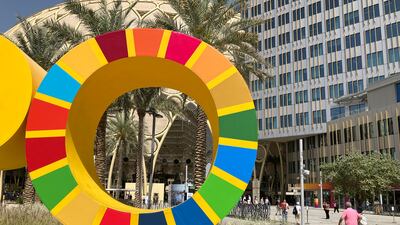
The device's camera has a 12-megapixel sensor, the same aperture value and 5X digital zoom. -
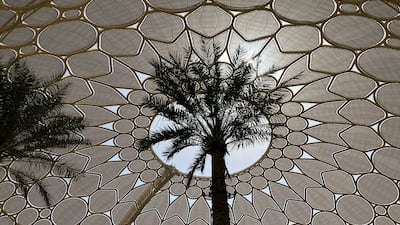
The 7MP front camera takes great portrait shots but lacks a wider angle similar to those found in higher-end iPhones. -

The device's biggest disadvantage is the fact that its screen brightness maxes out at only 625 nits, considering the entry-level iPhone 13 has 800 nits. -

The SE holds up pretty well at night or in low-light conditions. -

Apple says that the SE is significantly better in terms of performance, compared with the second-generation version. -

The SE's battery can last for 15 hours when watching video content and for 10 hours when streaming. -
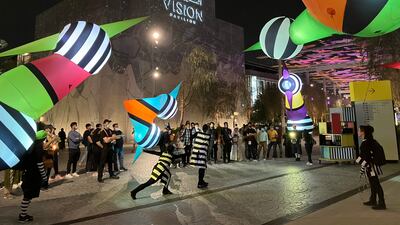
The third-generation SE retains the design of the 2020 version, which was based on 2017’s iPhone 8. -

The SE comes with classic iPhone controls, which is a reminder for any mainstream iPhone user somehow thinking of 'downgrading'. -

The model is Apple's attempt to entice users of older-generation iPhones to stay loyal to the brand and another attempt to win over Android users.


The same thing applies when it comes to video. Anything with good enough lighting will result in good media, and those dimly-lit will not be so great, so it is important to pick your spots when shooting.
The 7MP front camera is not bad either, but again, pick your spots at night. Portrait shots are still great but you do not have a wider angle similar to those found in higher-end iPhones.
Battery: lasts a little longer
Apple promises that the new SE has “better” battery life. On paper, it can go up to 15 hours and 10 hours of video and streamed video, respectively, compared to the second generation’s 13 hours and eight hours. Audio playback is where it receives a big bump-up — from 40 hours to 50 hours.
In our one-hour YouTube-at-full-brightness test, the SE 3 lost 10 per cent of battery life, which compares to the 12 per cent lost by the SE 2. The math may not add up but we always have to consider other factors here in play, including some background activity going on while you watch videos.
Apple says the improvement in battery life is because of the A15 Bionic chip, which further optimises the phone’s processes.
Particularly impressive, however, is how the battery held up while using the camera app to take pictures and mostly record videos. The device lost a very respectable 7 per cent when the camera was used for a 30-minute span — almost non-stop.
The SE's battery also kept its cool during the use of process-intensive apps, including the camera and gaming. However, using it under the noontime sun will make it simmer a little more than usual. In any case, its temperature did not really go up at alarming levels.
The competition: Samsung Galaxy
Samsung Galaxy A52/A72 5G: For the uninitiated, Samsung's Galaxy A series is now the company's entry-level category, behind the flagship S and Z foldable devices. The A52 5G and A72 5G, which were launched last August, are arguably the most serious contenders to give the iPhone SE a run for its money. The quad cameras of the devices — which are cheaper than the SE — are an enticing prospect.
Realme 9 Pro: We are strictly going by the stats here, since it will be unfair to judge something we have not tested. Released only last month, the Realme 9 Pro has three cameras and also supports 5G. It is also priced below the SE and even the Galaxy devices, so that is another bonus.
Honor 50: Another device with four cameras priced below Dh2,000, the Honor 50 promises a camera experience at par with the best mid-rangers, and arguably its biggest selling point is its 108MP lead sensor.
When is it available, and for how much?
The iPhone SE will be available from this Friday, March 18, but orders are still being taken. You will have three storage options — 64 gigabytes, 128GB and 256GB — for Dh1,849, Dh2,059 and Dh2,479, respectively.
-

The iPhone through the ages: Former Apple CEO Steve Jobs introduces the iPhone to the world in San Francisco, California, on January 9, 2007. It had a 3.5-inch screen and 2MP camera. Reuters -

The iPhone 3G was launched in 2008 with a faster 3G connection. It also added location services. Reuters -
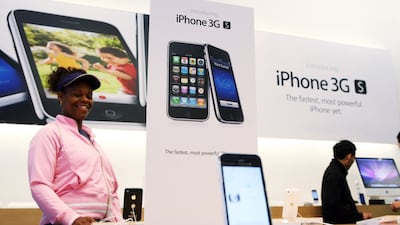
The iPhone 3GS was released on June 19, 2009. It was twice as fast as its previous version. AFP -

The iPhone 4 was released on June 24, 2010. It featured FaceTime for the first occasion as well as a retina screen. Reuters -

A later release, this time on October 14, 2011, the iPhone 4S had a new dual-core processor. Reuters -

Apple CEO Tim Cook takes to the stage following the reveal of the iPhone 5 in San Francisco, California, on September 12, 2012. This was the first 4-inch screen and the phone was faster and slimmer. Reuters -
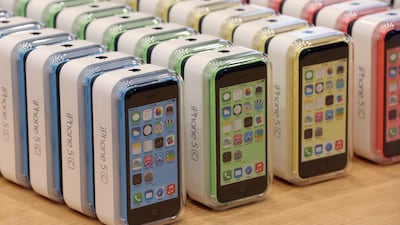
The iPhone 5C arrived on September 20, 2013 and was less expensive and very similar to the iPhone 5 except it came with colourful casing. Getty Images -
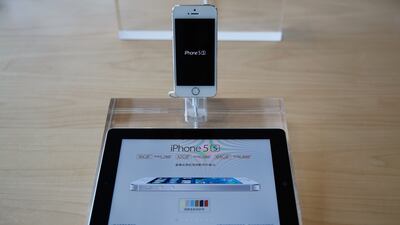
The iPhone 5s came at the same time as the 5C and introduced touch ID and a motion data processor as health and fitness apps started to come to the fore. Getty Images -
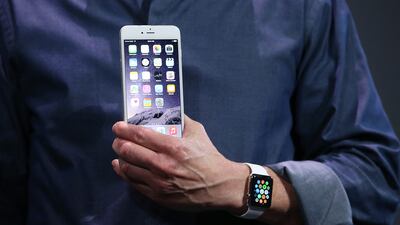
The iPhone 6 marked another double launch when unveiled on September 9, 2014. The 6 had a 4.7-inch screen, faster processor and improved camera. AFP -

The iPhone 6 Plus had a 5.5-inch screen and was $100 more expensive. Reuters -
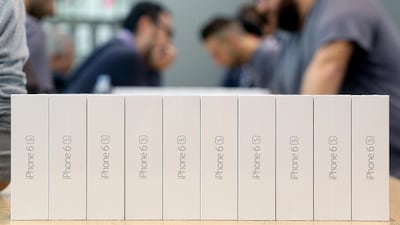
The iPhone 6s came on September 25, 2015 with 3D touch and a camera that could shoot 4K video. EPA -

The iPhone 6s Plus is displayed at Tokyo's flagship store on September 25, 2015. Both new phones came in a new colour - rose gold. AFP -
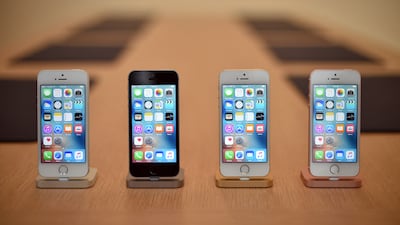
Unveiled on March 21, 2016, the iPhone SE had the same design as the iPhone 5 and saw a return to the 4-inch screen which was preferred by some users. It was more affordable and hence lacked features such as Touch ID. AFP -

The iPhone 7 announced on September 7, 2016, said somewhat controversially goodbye to the audio jack. Reuters -
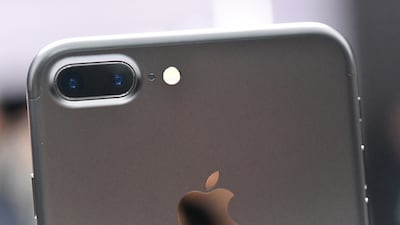
The iPhone 7 Plus had a dual camera added. AFP -

The iPhone 8 was released on September 22, 2017 and had a new glass and aluminium design, retina HD screen. Reuters -
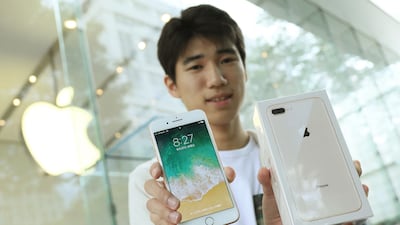
A customer gets his hands on an iPhone 8 Plus on launch day in Tokyo on September 22, 2017. The launches also saw speakers that were 25% louder and the most powerful and smartest chip in a smartphone (according to Apple). AFP -

The iPhone X marked a decade of iPhones on September 12, 2017. It's main changes were an edge-to-edge super retina screen. Touch ID was removed with Face ID introduced. Reuters -

The iPhone XS was released on September 21, 2018 and had a Super Retina OLED screen with improved scratch and water resistance. Face ID was faster. Reuters -

The iPhone XS Max had the largest iPhone screen to date at 6.5 inches. It could handle 3 million pixels. Reuters -
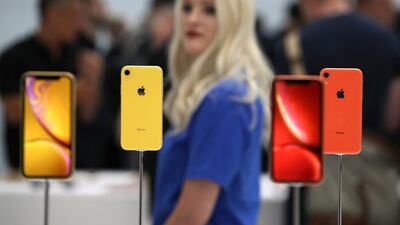
The iPhone XR was slightly cheaper than the XS and came with a 6.1-inch screen. AFP -
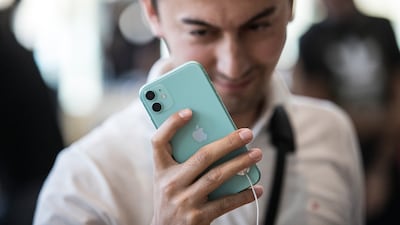
A customer looks at the iPhone 11 at an Apple store in Dubai Mall on September 20, 2019. EPA -
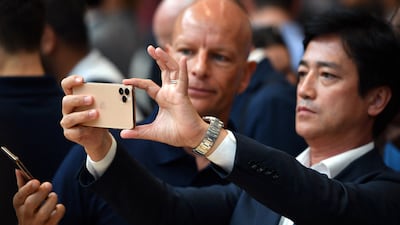
A man tries out the iPhone 11 Pro in Cupertino, California, on September 10, 2019. AFP -

Midnight Green was introduced for the iPhone 11 Pro Max, while there was also a new three-camera system. Reuters -
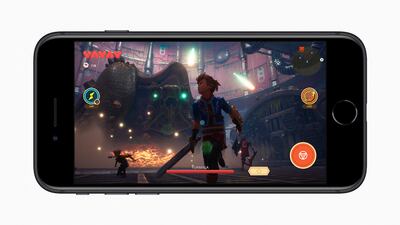
Arriving on April 15, 2020, the iPhone SE was for budget-minded customers and was pretty much a replica of the iPhone 8. Its 4.7-inch screen felt rather on the small side compared to the big screens of its big brothers. Apple Inc. / AFP -
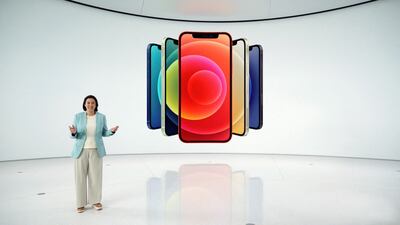
The iPhone 12 on October 13, 2020 introduced a new processor and a screen that offered four times better protection if dropped. Apple / AFP -

The iPhone 12 mini offered a 5.4-inch screen. Getty Images -
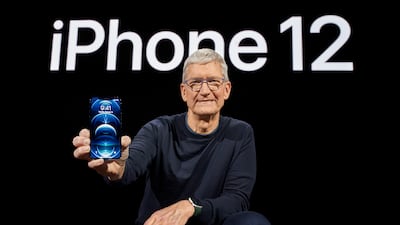
Mr Cook showcases the iPhone 12 Pro during an event at Apple Park in Cupertino, California, on October 13, 2020. This upgrade saw a faster chip, 5G speed, a "camera system that’s killer in low light. A LiDAR Scanner for more realistic AR. And two great sizes to choose from — including our largest display ever". Apple / EPA -

The iPhone 12 Pro Max was categorised as a 'legacy phone'. Reuters -
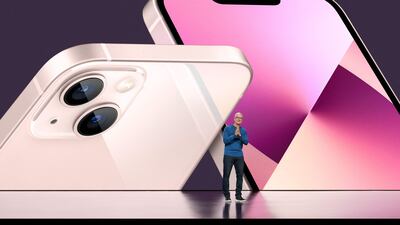
The new iPhone 13 was unveiled on September 14, 2021. It has a smart data mode which helps battery life, more 5G bands and antenna lines that use material made from recycled plastic water bottles. AFP -
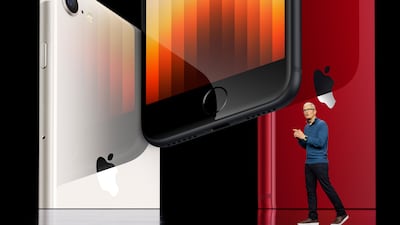
Apple chief executive Tim Cook showcases the new iPhone SE that offers 5G connectivity and has an A15 Bionic chip. EPA -
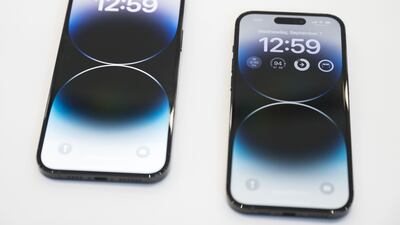
The Apple iPhone 14, 14 Plus, Pro Max and the Apple iPhone 14 Pro were unveiled during an event on September 7, 2022. It didn’t raise its US prices during one of the worst years for inflation in decades. The biggest addition was emergency calling after a car crash. Bloomberg


Verdict
Did Apple make a mistake by sticking with a retro design on the new iPhone SE? Not really. Are we disappointed? A bit, but only because non-full-screen designs with really thick bezels are becoming old.
We also continue to push for a 128GB base model for a future SE; we think Apple missed a great opportunity to significantly boost its value proposition by keeping a 64GB one.
Hardware aside, the iPhone SE is a solid phone, one that will surely merit serious consideration from the crowd we mentioned at the beginning of this review.
It won't be outlandish to assume that the third-generation iPhone SE could be the last iPhone to don the classic design with a home button, given that all expectations point to an in-screen fingerprint scanner on a future iPhone, which we expect sooner than later.

