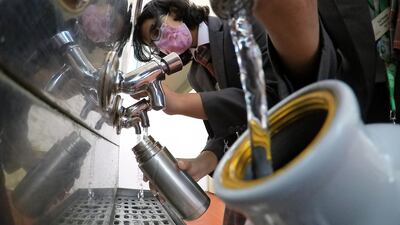
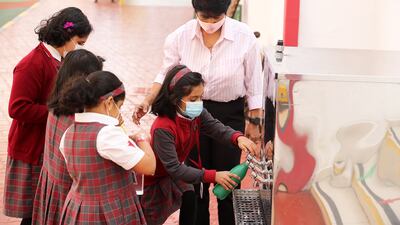
Gems Education, the largest education operator in the UAE, faced a cyber attack that had a minimal impact on the group’s operations, the company said on Thursday.
The company said an investigation was under way. It has not yet confirmed whether any personal or financial data has been breached.
“We became aware of a recent cyber security incident, at which time we immediately enacted our cyber security response plan. Thanks to our robust business continuity plans, impact to our operations has been minimal,” Dino Varkey, group chief executive of Gems Education, said in an email sent to parents.
“It may be some time before we can determine the full extent of the incident,” Mr Varkey said.
Started in 1959, Gems Education has more than 40 schools in the UAE, as well as schools in Saudi Arabia, Qatar, Europe, Africa, India, South-East Asia and North America.
Gems said it does not store the bank account details or credit card information of the families or guardians of its pupils. But it said some personal data could have been compromised.
That includes identification documents, financial information, such as payment history, and data related to creditworthiness, health or medical records, and log-in details, such as usernames and passwords.
The group has engaged third-party expertise and legal counsel to assist in its investigation.
“We have also notified the relevant authorities, including our education and data protection regulators and law enforcement. We are closely working with them and they continue to support us,” Mr Varkey said.
Cyber attacks have risen sharply in recent months, with a recent World Economic Forum report calling 2021 an “unprecedented year for cyber crime in terms of volume and severity”.
The cost of breaches amounted to an average of $3.6 million per incident for businesses alone, as companies rapidly digitised to ensure business continuity during the pandemic.
Overall, cyber criminal activities were projected to inflict damage worth about $6 trillion globally in 2021, a study by research company Cybersecurity Ventures found.
Message to parents
Gems has suggested a few guidelines and precautionary steps for parents to follow:
- Be suspicious if anyone contacts you by email, phone call or text message asking you to confirm your personal data or financial details;
- Change all your and your child’s passwords, including those for Gems accounts. Always use strong passwords and enable two-step authentication on all your online services;
- Check bank accounts regularly and contact the bank if you see any transactions that you do not recognise.

'The Batman'
Stars:Robert Pattinson
Director:Matt Reeves
Rating: 5/5
Tips%20for%20travelling%20while%20needing%20dialysis
%3Cul%3E%0A%3Cli%3EInform%20your%20doctor%20about%20your%20plans.%C2%A0%3C%2Fli%3E%0A%3Cli%3EAsk%20about%20your%20treatment%20so%20you%20know%20how%20it%20works.%C2%A0%3C%2Fli%3E%0A%3Cli%3EPay%20attention%20to%20your%20health%20if%20you%20travel%20to%20a%20hot%20destination.%C2%A0%3C%2Fli%3E%0A%3Cli%3EPlan%20your%20trip%20well.%C2%A0%3C%2Fli%3E%0A%3C%2Ful%3E%0A
What is the Supreme Petroleum Council?
The Abu Dhabi Supreme Petroleum Council was established in 1988 and is the highest governing body in Abu Dhabi’s oil and gas industry. The council formulates, oversees and executes the emirate’s petroleum-related policies. It also approves the allocation of capital spending across state-owned Adnoc’s upstream, downstream and midstream operations and functions as the company’s board of directors. The SPC’s mandate is also required for auctioning oil and gas concessions in Abu Dhabi and for awarding blocks to international oil companies. The council is chaired by Sheikh Khalifa, the President and Ruler of Abu Dhabi while Sheikh Mohamed bin Zayed, Abu Dhabi’s Crown Prince and Deputy Supreme Commander of the Armed Forces, is the vice chairman.
Mercer, the investment consulting arm of US services company Marsh & McLennan, expects its wealth division to at least double its assets under management (AUM) in the Middle East as wealth in the region continues to grow despite economic headwinds, a company official said.
Mercer Wealth, which globally has $160 billion in AUM, plans to boost its AUM in the region to $2-$3bn in the next 2-3 years from the present $1bn, said Yasir AbuShaban, a Dubai-based principal with Mercer Wealth.
“Within the next two to three years, we are looking at reaching $2 to $3 billion as a conservative estimate and we do see an opportunity to do so,” said Mr AbuShaban.
Mercer does not directly make investments, but allocates clients’ money they have discretion to, to professional asset managers. They also provide advice to clients.
“We have buying power. We can negotiate on their (client’s) behalf with asset managers to provide them lower fees than they otherwise would have to get on their own,” he added.
Mercer Wealth’s clients include sovereign wealth funds, family offices, and insurance companies among others.
From its office in Dubai, Mercer also looks after Africa, India and Turkey, where they also see opportunity for growth.
Wealth creation in Middle East and Africa (MEA) grew 8.5 per cent to $8.1 trillion last year from $7.5tn in 2015, higher than last year’s global average of 6 per cent and the second-highest growth in a region after Asia-Pacific which grew 9.9 per cent, according to consultancy Boston Consulting Group (BCG). In the region, where wealth grew just 1.9 per cent in 2015 compared with 2014, a pickup in oil prices has helped in wealth generation.
BCG is forecasting MEA wealth will rise to $12tn by 2021, growing at an annual average of 8 per cent.
Drivers of wealth generation in the region will be split evenly between new wealth creation and growth of performance of existing assets, according to BCG.
Another general trend in the region is clients’ looking for a comprehensive approach to investing, according to Mr AbuShaban.
“Institutional investors or some of the families are seeing a slowdown in the available capital they have to invest and in that sense they are looking at optimizing the way they manage their portfolios and making sure they are not investing haphazardly and different parts of their investment are working together,” said Mr AbuShaban.
Some clients also have a higher appetite for risk, given the low interest-rate environment that does not provide enough yield for some institutional investors. These clients are keen to invest in illiquid assets, such as private equity and infrastructure.
“What we have seen is a desire for higher returns in what has been a low-return environment specifically in various fixed income or bonds,” he said.
“In this environment, we have seen a de facto increase in the risk that clients are taking in things like illiquid investments, private equity investments, infrastructure and private debt, those kind of investments were higher illiquidity results in incrementally higher returns.”
The Abu Dhabi Investment Authority, one of the largest sovereign wealth funds, said in its 2016 report that has gradually increased its exposure in direct private equity and private credit transactions, mainly in Asian markets and especially in China and India. The authority’s private equity department focused on structured equities owing to “their defensive characteristics.”
If you go
Where to stay: Courtyard by Marriott Titusville Kennedy Space Centre has unparalleled views of the Indian River. Alligators can be spotted from hotel room balconies, as can several rocket launch sites. The hotel also boasts cool space-themed decor.
When to go: Florida is best experienced during the winter months, from November to May, before the humidity kicks in.
How to get there: Emirates currently flies from Dubai to Orlando five times a week.
The biog:
Languages: Arabic, Farsi, Hindi, basic Russian
Favourite food: Pizza
Best food on the road: rice
Favourite colour: silver
Favourite bike: Gold Wing, Honda
Favourite biking destination: Canada