

Over the last two years, a series of unexpected events has scrambled global supply chains.
The coronavirus, the war in Ukraine, Brexit, and a container ship wedged in the Suez Canal have combined to delay deliveries of everything from bicycles to pet food.
In response, a growing group of start-ups and established logistics firms has created a multi-billion-dollar industry, applying the latest technology to help businesses minimise the disruption.
Interos, Fero Labs, KlearNow and others are using artificial intelligence and other cutting-edge tools so manufacturers and their customers can react more swiftly to supplier snarl-ups, monitor raw material availability, and negotiate the bureaucratic thicket of cross-border trade.
The market for new technology services focused on supply chains could be worth more than $20 billion a year in the next five years, according to analysts.
By 2025, more than 80 per cent of new supply chain applications will use AI and data science in some way, according to tech research firm Gartner.
"The world's [become] too complex to try to manage some of these things on spreadsheets," said Dwight Klappich, a Gartner analyst.
Interos, valued at more than $1bn in its latest funding round, is one of the most successful in the nascent market. The Arlington, Virginia-based company says it has mapped out 400 million businesses globally and uses machine learning to monitor them on behalf of corporate customers, alerting them immediately when fires, floods, hacking or any other events cause a potential disruption.
Before Russian tanks rolled into Ukraine in February, the company had assessed the impact of an invasion. Interos said it identified about 500 US companies with direct supplier relations with companies in Ukraine. Further down the chain, Interos found 20,000 US companies had links to second-tier suppliers in Ukraine, and 100,000 US firms had links to third-tier suppliers.
-
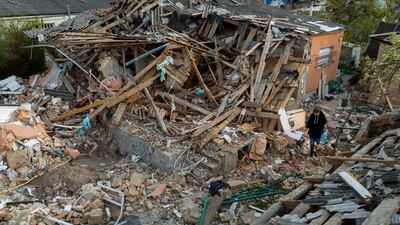
A woman rescues some of her belongings from her house in Irpin, near Kyiv, which was nearly completely destroyed by Russian bombing in late March. AP -

A driver helps a woman board a bus at a reception centre for displaced people in Zaporizhzhia, Ukraine. AP -

People fleeing Mariupol's Azovstal plant arrive on buses at a registration and processing area for internally displaced people in Zaporizhzhia. AFP -
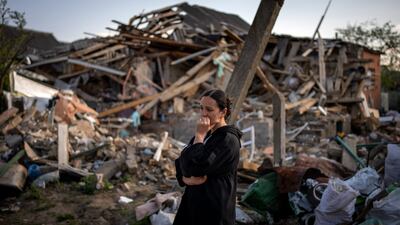
A woman stands next to her home in Irpin, near Kyiv, after it was nearly completely destroyed by Russian bombing. AP -

People hold banners and shout slogans during a demonstration in support of Mariupol defenders in Kyiv, Ukraine. Getty Images -
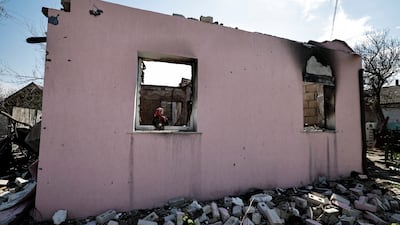
A woman stands near her house that was destroyed by shelling in Sloboda, Chernihiv region, Ukraine. Reuters -
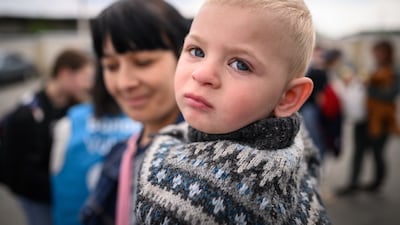
A mother and child in Lviv, Ukraine, wait to board transport destined for Przemysl, Poland. Getty Images -

President Volodymyr Zelenskiy claps as British Prime Minister Boris Johnson addresses the Ukrainian Parliament in Kyiv via videolink. Reuters -

Firefighters work to extinguish flames after a Russian bombardment at a park in Kharkiv, Ukraine. AP Photo -

The television tower is illuminated in the national colors of the Ukrainian flag to show solidarity with the country at the Olympic Park in Munich, southern Germany. AFP -
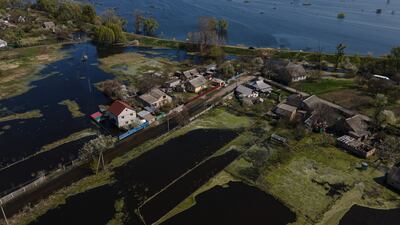
Flooded gardens and fields are shown in Demydiv, Ukraine. To keep Russian armoured columns at bay, Ukrainian forces released water from a nearby hydroelectric dam to intentionally flood Demydiv, a village north of Kyiv. The decision was effective, but efforts to drain the area are complicated. Getty Images -

A damaged Orthodox icon is seen in the corner of local resident Yurii's heavily damaged house in Fenevychi, Ukraine. Getty Images -
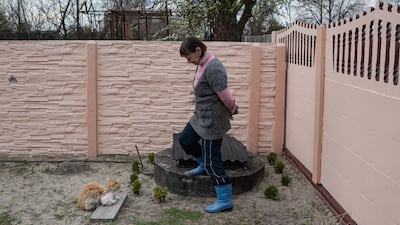
Valentyna, 71, stands by her cat, who was injured in the fighting, in Fenevychi. Getty Images -
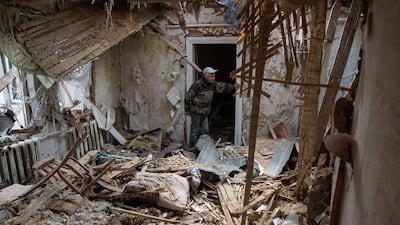
Yurii, 53, stands in his heavily damaged house in Fenevychi. Getty Images -
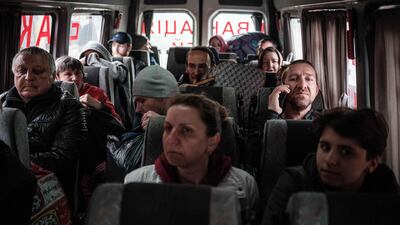
Evacuees from the eastern Ukraine city of Lyman, which has suffered heavy shelling, ride on a bus in Raihorodok. AFP -

A man delivers loaves of bread to a woman in the eastern Ukraine city of Lyman. AFP -
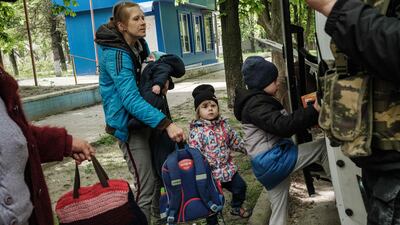
Nazar, right, boards a bulletproof bus to evacuate with his family from the eastern Ukraine city of Lyman. AFP -
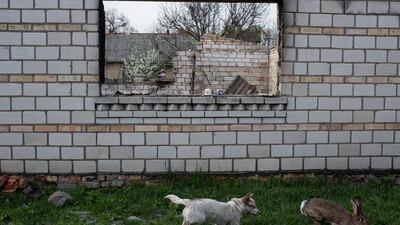
A dog chases a hare by the wall of a burnt house in Fenevychi. Getty Images -

Nine-year-old Galina, right, and Nazar, 8, arrive with their families in Raihorodok. AFP -

Natalia Pototska, 43, cries as her grandson Matviy looks on in Zaporizhzhia. AP -
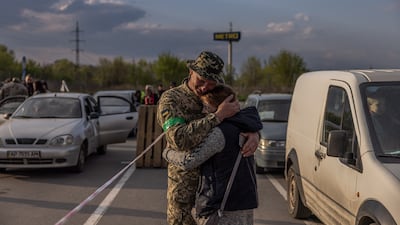
Hryhorii, a member of the Ukrainian military meets his wife Oksana, who fled from the Russian-occupied Novomykhailivka village, at the evacuation point in Zaporizhzhia. EPA -

Ukraine's President Volodymyr Zelenskiy welcomes Denmark's Minister of Foreign Affairs Jeppe Kofod to Kyiv. Reuters -
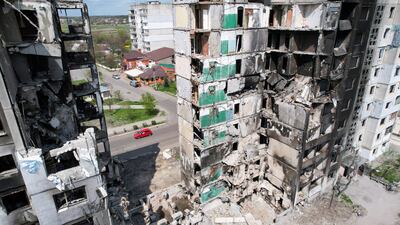
Buildings destroyed by Russian shelling in Borodianka, in Ukraine's Kyiv region. Reuters -
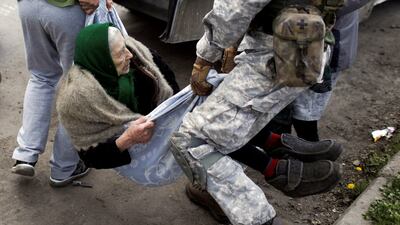
Volunteers carry an elderly woman in a blanket during the evacuation of a frontline village retaken by Ukrainian forces in Kharkiv. Reuters -
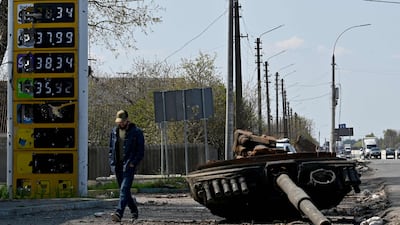
A Ukrainian man walks past the turret of a Russian tank next to a destroyed petrol station in the village of Skybyn, north-east of Kyiv. AFP -
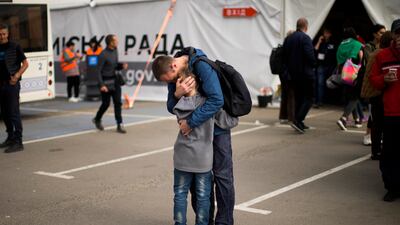
Andrii Fedorov hugs his son Makar as they are reunited in Zaporizhzhia, Ukraine, after the boy and his mother fled besieged Mariupol. AP -
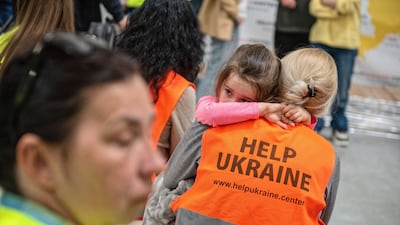
Volunteers at the Help Ukraine Center in Lublin, south-eastern Poland. More than 3 million Ukrainian refugees are now in Poland. EPA -

Police officers deliver loaves of bread to residents in the eastern Ukrainian city of Lyman, which is being heavily shelled. AFP -
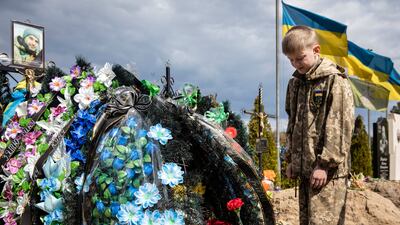
Savelii, 10, mourns at the grave of his father, who died protecting his city as a member of the Territorial Defence, in Irpin, Ukraine. EPA -
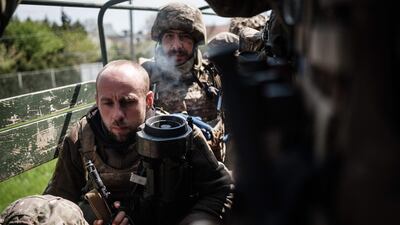
Ukrainian soliders ride on a truck to a resting place after fighting in the front line for two months near Kramatorsk. AFP -
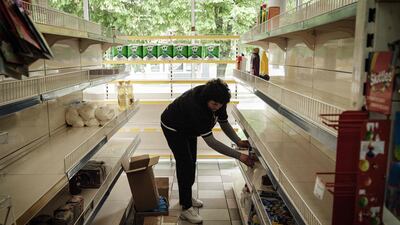
A shopkeeper clears shelves before closing up in Sviatohirsk, eastern Ukraine, amid the Russian invasion. AFP -
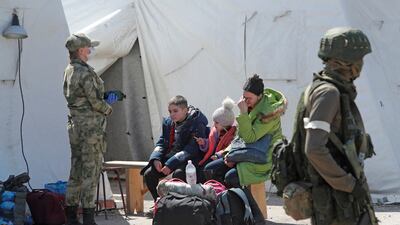
Civilians who left the area near Azovstal steel plant as part of an evacuation of Mariupol arrive at temporary accommodation in Bezimenne, Donetsk region. Reuters -

Azovstal steel plant employee Valeria, who was part of an evacuation of Mariupol, hugs her son Matvey, who had earlier left the city with his relatives, as they meet again in Bezimenne, Donetsk. Reuters -
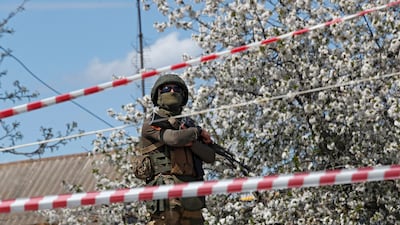
A pro-Russian troop stands guard in Bezimenne, Donetsk. Reuters -
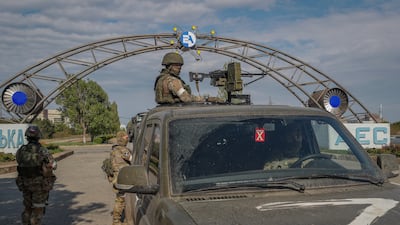
A picture taken during a visit to Mariupol organised by the Russian military shows Russian serviceman on patrol outside the Zaporizhzhia Nuclear Power Station in Enerhodar, south-eastern Ukraine. EPA -

A woman is assisted during the UN-led evacuation of the Azovstal steel plant, after nearly two months of siege warfare on Mariupol by Russia. Reuters -
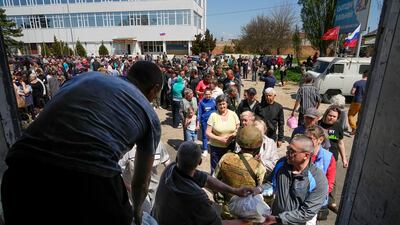
Civilians gather for humanitarian aid, distributed by the Donetsk People Republic Emergency Situations Ministry in Berdyansk, in territory under the government of the Donetsk People's Republic, eastern Ukraine. AP -
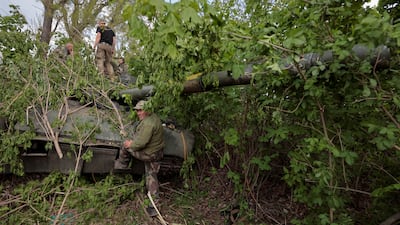
Ukrainian servicemen are seen near a T-80 tank captured from Russian troops in Kharkiv region. Reuters -
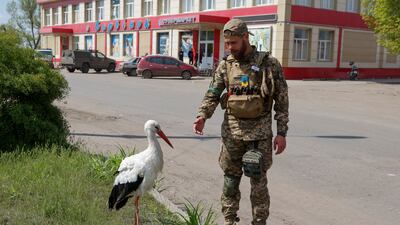
A Ukrainian soldier takes a break from the conflict and tries to pet a stork in Barvinkove, Kharkiv region. Reuters -

A satellite image shows damage at the Azovstal steelworks in Mariupol, Ukraine. AP


After the war started, 700 companies approached Interos for help in assessing their exposure to suppliers in Ukraine and Russia, according to chief executive Jennifer Bisceglie.
The company is developing a new product to enact other hypothetical supply chain disruption scenarios, such as China invading Taiwan, for customers to understand their exposure to risk and where to find alternative suppliers, she said.
Supply chain shocks are inevitable, Ms Bisceglie told Reuters. "But I think we're going to get better at minimising these disruptions."
US airline Delta Air Lines, which spends more than $7bn a year on catering, uniforms and other goods on top of its plane and fuel budget, is one company using Interos to keep track of its 600 primary suppliers and 8,000 total suppliers.
"We're not expecting to avoid the next crisis," said Heather Ostis, Delta’s supply chain chief.
"But we're expecting to be a lot more efficient and effective than our competitors in how we assess risk when that happens."
California-based KlearNow sells a platform that automates cumbersome paper-dominated customs clearance processes.
That has been a lifesaver for EED Foods, based in Doncaster, England, which imports Czech and Slovak sweets and smoked meats for expat customers in Britain.
"Before Brexit, we were very scared we would have to shut down," said Elena Ostrerova, EED's purchasing manager. "But instead, we are busy as never before."
Ms Ostrerova says her company is still growing at an annual rate of 40 per cent after Brexit took effect in early 2020, partly because some competitors gave up rather than tackle the onerous new paperwork for importing from the EU.
KlearNow’s customs clearance platform keeps track of its hundreds of shipments from Central Europe. It tallies totals on thousands of items, correcting mistakes on everything from country of origin to gross net weight, and providing an entry number — under which all the information about a shipment is contained — for the company hauling it to Britain, she said.
"We have minimum human involvement," Ms Ostrerova said, which saves the company time and the cost of manual data input.
The pandemic highlighted the need for manufacturers to adapt to changing suppliers so that they can continue to make identical products, no matter the origin of the raw materials, said Berk Birand, chief executive of New York's Fero Labs.
The start-up's platform uses machine learning to monitor and adapt to how raw materials from different suppliers affect product quality; from varying impurities in steel, to the level of viscosity in a surfactant, a vital ingredient in shampoo. The system then communicates with plant engineers to tweak manufacturing processes so that product consistency is maintained.
Dave DeWalt, founder of venture capital firm NightDragon, which led Interos' $100 million Series C funding round last year, says regulators are going to take much greater interest in supply chain risk.
"If you have a supply chain issue that could cost you major shareholder value, you'll have a major responsibility, too," Mr DeWalt said. "I believe that's coming in the near future."
Major logistics firms are also using machine learning to boost their competitiveness.
US truck fleet operator Ryder System uses the real-time data from its fleet, and those of its customers and partners, to create algorithms for predicting traffic patterns, truck availability and pricing.
Silicon Valley venture capital firm Autotech Ventures has invested in both KlearNow and newtrul, which aggregates data from transport management systems in America's highly fragmented trucking sector to predict pricing changes.
"Mapping your supply chain and interconnectivity at the individual part level is the holy grail," said Autotech partner, Burak Cendek.

