


Eurovia, a French multinational sepciality infrastructure company, is developing “smart roads” that can light nad defrost themselves as well as generate enegy. The firm has an R&D budget of up to €10 million (Dh41.4m) per project.
-
-

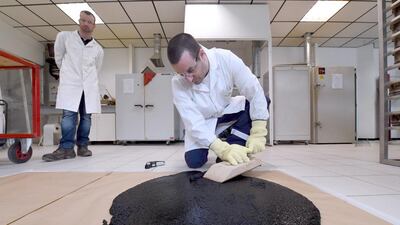
The Eurovia project manager, Bertrand Pouteau, displays the space for a smart road sensor into a piece of tar surface. Such sensors, it is hoped, will be used to improve the operation of autonomous vehicles. Medhi Fedouach/AFP -

Mr Pouteau at the Eurovia research centre in Merignac, near Bordeaux. The company has operations across Europe, and the United Kingdom, as well as North and South America. Medhi Fedouach/AFP -

A Eurovia lorry tests a road surface equipped with sensors. The firm is developing “smart roads”, stronger, able to light and defrost themselves and generate energy. Medhi Fedouach/AFP -

A researcher at Eurovia tests a car wheel on a tar surface. Medhi Fedouach/AFP -

A researcher works on tar at the Eurovia research centre in Merignac. Medhi Fedouach/AFP -

The director of the Eurovia research centre, Ivan Drouadaine, displays the various kinds of tar developed for smart roads at the centre. Medhi Fedouach/AFP -
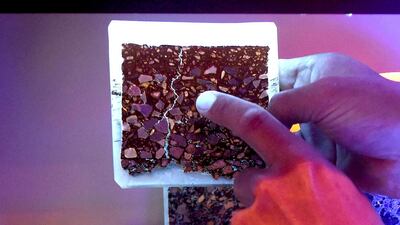
Mr Drouadaine displays, under infrared light, cracks formated in tar due to cold weather, at the Eurovia research centre in Merignac, near Bordeaux. The smart roads the firm is developing are able to defrost themselves, thereby extending the life of the road surface. Medhi Fedouach/AFP -
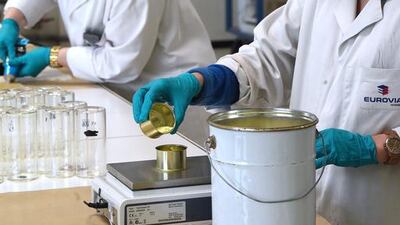
Researchers works on the manufacturing of new kinds of tar for smart roads at the Eurovia research centre in Merignac. Medhi Fedouach/AFP -
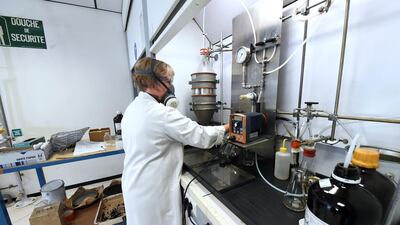
A researcher works on newly developed tar for smart roads at the Eurovia research centre. Medhi Fedouach/AFP
Smart roads just around the bend – in pictures
Most popular today

