


At a climate dinner with business leaders at Cop26, US climate envoy John Kerry was upbeat.
Cop26, in his opinion, delivered in a way that no Cop had done so in the past: the money was finally in place.
“For 2022, we now have the full $100 billion that we wanted to have and $100bn going forward, so if we take that issue off the table that changes the dynamics,” Mr Kerry told the UK’s business community at a Confederation of British Industry dinner at the Hilton Hotel in Glasgow.
Mr Kerry was referring to the long-awaited $100bn a year promised by rich nations to developing countries, which he says is now set to delivered in 2022, a year earlier than previously thought.
He made reference to commitments by Japan to put $10bn into the mitigation efforts over the next five years, allowing a further $8bn in private finance to be leveraged.
Securing and then delivering the cash needed to fund crucial emission cuts in developing countries has been considered a critical test of the UN summit, which needs to build trust between the wealthy and poor, who urgently need finance to ensure the transition from fossil fuels to renewable energy goes ahead.
“You’re now leading the largest economic transformation in the world,” Mr Kerry told business leaders at the CBI event.
“Every Cop I’ve been to in history has never had the feel of what I feel here in Glasgow today. New energy, new urgency, a new sense of possibility and we’ve never had as much corporate presence and commitment as we have today. Thanks to you, we’re going to, I believe, be able to raise ambition beyond anything that we imagined.”
Lord Karan Bilimoria, president of the CBI, which speaks on behalf of about 190,000 businesses across the UK, told delegates at the dinner that the large presence of business at the climate conference in Glasgow set it apart from previous Cop meetings.
"It's not just countries setting targets, it's businesses setting targets and it's businesses walking the talk as well. It's a watershed Cop, there's no question about it," he said.
"The other big thing in Cop this time ... is finance. We're seeing the huge amounts of commitments when it comes to finance that have been committed to enable this green transition."
A day later, former US vice president Al Gore was equally upbeat about the pledges made by countries and companies at the climate talks.
“Here we are, nearing the halfway point of this historic conference, and much remains to be done. But I would also like to note that much has been achieved already,” he told delegates on Friday.
“Some of it is in the form of pledges that must be kept and part of our task, all of us, is to ensure that these pledges are, in fact, kept.”
The Cop26 event, which has another week to run, has been considered "the world's best last chance" by leaders to cap global temperature increases at the 1.5°C to 2°C limit set out in the 2015 Paris Agreement.
The stakes for the planet are huge – among them the effect on economic livelihoods around the world and the future stability of the global financial system.
However, the effect is expected to hit the developing world much harder because much of the world's poor, who live in the tropical or low-lying regions, are already suffering from the effects of climate change, such as droughts and rising sea levels.
Poorer countries rarely have the resources to mitigate against the damage from global warming with a report from the Network of Central Banks and Supervisors for Greening the Financial System projecting overall output losses of above 15 per cent for much of Asia and Africa, rising to 20 per cent in the Sahel countries.
former US vice president
Unchecked warming would shave 7 per cent off world output by 2100, the International Monetary Fund said, while NFGS puts it even higher at 13 per cent.
Meanwhile, a 2020 World Bank report said climate change would drive up to 132 million more people into extreme poverty by 2030, because of lost farming income; rising food prices; increased disease; and economic losses from extreme weather.
With the world’s wealthy countries responsible – because they have generated the bulk of the emissions since their industrial revolutions – the $100bn pledge to help developing countries transition is vital to reverse the damage already wrought.
The issue is that it has taken a long time to come, with the pledge dating back to 2009 when the intention was to fulfil it by 2020.
With the money due to come from a mixture of public and private sources, governments had blamed stagnant private investment for the failure to meet the target by 2020.
While the OECD recently said the target would not be reached until 2023, Mr Kerry made it clear on Thursday that richer nations will deliver the $100bn of climate finance from 2022 – a year earlier than expected.
Earlier in the week, at the summit’s designated Finance Day, the UK's Chancellor of the Exchequer, Rishi Sunak, said a coalition of banks, insurers and asset managers would provide the delayed $100bn to meet the Paris Agreement goals.
Mr Sunak assured developing countries that the money would be in their treasuries more than a decade after it was promised.
"While we know we are not yet meeting it soon enough, we will work closely with developing countries to do more and to reach the target sooner," Mr Sunak said.
While $100bn was the annual amount targeted for developing nations, the actual figure secured at Cop26 by the private sector commitment was $130bn.
Sourced by an initiative called the Glasgow Financial Alliance for Net Zero, led by Mark Carney, former governor of the Bank of England and now a UN envoy for climate, the coalition brought together 450 companies who make up 40 per cent of the world's banking assets.
While there was a warm feeling inside the Cop26 venue that justice had been done with the “wall of capital” in place, outside on the streets of Glasgow in the wind and rain, climate change protesters had a different feeling.
On Friday, more than 8,000 joined street protests and teenage Swedish activist Greta Thunberg addressed a rally in the city centre.
This was followed by a colourful demonstration of more than 100,000 climate protesters on Saturday, with many sceptical about the big-money pledges.
Some carried placards calling for "Climate Justice" and a "Fair Cop" as they made their way to a park on the edge of the city in the afternoon.
"We need the biggest emitters to be held responsible," Kathy Jetnil-Kijiner, from the Marshall Islands, told the crowd.
"We did nothing to contribute to this crisis, and we should not have to pay the consequences."
-

Protesters march in Bristol, south-west England, on November 6, 2021. Protest groups in the UK are marching in solidarity with protesters in Glasgow who are demonstrating alongside the UN Climate Change Summit, Cop26, being held in the Scottish city. They are demanding that governments and businesses commit to climate solutions. Photo: Getty -

Protesters march in Bristol, south-west England, on November 6, 2021. They are marching in solidarity with protesters in Glasgow, who are demonstrating in the Scottish city. Photo: Getty -

Protesters are demanding that governments and businesses commit to climate solutions and limit the rise in global temperatures. Photo: Getty -

Bristol is one of several British cites in which the protests are being held. Photo: Getty -

Protesters are marching in Bristol and other UK cities in solidarity with demonstrators in Glasgow. Photo: Getty -

A demonstration in Bristol on November 6, 2021. Photo: Getty -

The march in Bristol. Photo: Getty -

The climate march in Bristol, England, on November 6, 2021. Photo: Getty -

The climate march in Bristol, England, on November 6, 2021. Photo: Getty -
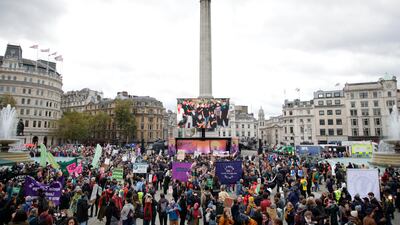
Climate activists gather in Trafalgar Square, London, on November 6. Protests are being held in many cities around the world as the first week of Cop26 comes to an end. Photo: AP -
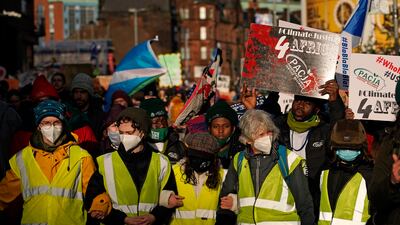
Climate activists attend a protest on November 6 in Glasgow, which is hosting the summit. Photo: AP -

People protest in Glasgow. Photo: Reuters -
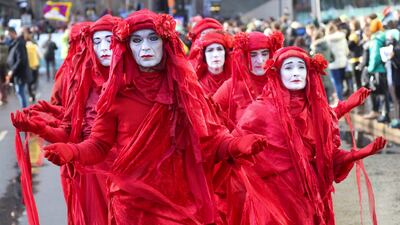
Activists take part in a protest in Glasgow on November 6, 2021. Cop26 is being held until November 12. Photo: Reuters -

Environmental activists attend a protest organised by the Cop26 Coalition in London, on Saturday, November 6, 2021. The protest was held as leaders and activists from around the world met for the UN climate summit. Photo: PA -
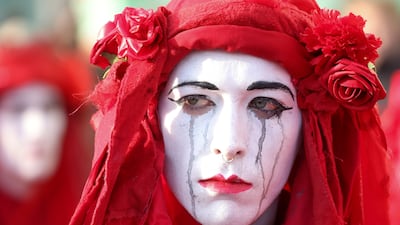
An activist takes part in a protest during Cop26 in Glasgow, Scotland, on November 6, 2021. Photo: Reuters -
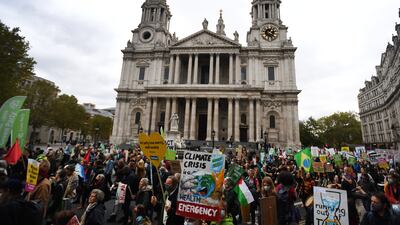
Thousands of protesters demonstrate in central London, on November 6, 2021. Photo: EPA


Jill Bird, 66, who travelled to the march from Bristol, was among a group wearing white jumpsuits with "greenwash busters" backpacks.
She wants rich nations to live up to their pledge of providing $100bn annually to vulnerable nations that "keeps being promised and promised and promised and doesn't actually materialise".
Mr Kerry made it clear that he understood the sceptism.
“Twenty countries, folks, produce 80 per cent of all the emissions,” he told the CBI conference.
“So it’s no wonder that vulnerable nations and less developed nations are angry and frustrated and looking for help and it is appropriate that we, the developed world, step up and make the difference. And we can, no question about it.”
He also made it clear that business has a key part to play in the transition.
“Everybody is going to have to be part of this transition, but business, more than anybody, is the one entity that we really need at the table this time that can make the difference,” he said.
“Why? Because you are those trillions of dollars. You are in the marketplace. You are the job creators. You’re the folks who can bring to the table the focused effort to create the jobs of the future and transition those markets."
While Cop26 negotiations paused on Sunday before a frantic week of shuttle diplomacy, as ministers arrive to push through hard-fought compromises, countries still need to flesh out how pledges made in the Paris deal work in practice.
This will include nailing down rules governing carbon markets, common reporting timetables and transparency.
Mr Carney said reforms of the financial system were needed, including mandatory climate disclosure rules, so that the $100tn pot did not go to waste.
Mr Sunak echoed a similar sentiment, saying financial rules needed to ensure that “what sits there on a piece of paper is actually going to turn into tangible actual projects on the ground”.
Mr Gore also called for “radical transparency” that includes the monitoring of emissions from the ground, sea, air and by satellite, but also identifying those responsible for releasing greenhouse gases into the atmosphere.
“We are compiling a comprehensive list of those who are responsible for each of the entities that are emitting greenhouse gases, not to be the climate police, but to be the neighbourhood watch. Except the neighbourhood is the globe and we are all in this together,” he said.
Mr Kerry said the real cost of the transition would be much, much higher.
“No government in the world has enough money” to cope with the climate crisis and “trillions” of dollars in private finance will be needed, he said.
“Billions don’t cut it, we need the trillions," he said.
However, Mr Kerry was insistent that the wealthy nations will “overcome the gap”.
“No one ever said or that we could come here to Glasgow and just make an announcement, and this problem’s going away and it’s cured. This is always going to be tough, but it’s doable,” he said.
“It’s always dangerous to get a little too far over your skis, but I believe that we’re on the brink of just the inflection moment, a huge moment in history.”

