


A potential ceasefire deal between Ukraine and Russia could have several positive effects on Europe’s economy and its stock markets, although any impact will depend on the terms of the deal, analysts say.
US President Donald Trump has said he wants to bring about a ceasefire in Ukraine, and senior US and Russian officials met in Saudi Arabia this week to discuss the possibility of a meeting aimed at efforts to end the war.
Mr Trump said Ukrainian President Volodymyr Zelenskyy would visit the White House on Friday to sign “a very big agreement” under which Kyiv will hand revenue from its mineral resources to the US as payment for military aid.
“There is enough common ground to make a ceasefire deal possible between Ukraine and Russia. However, conflicting objectives challenge the long-term viability of such a deal,” said Christian Gattiker, head of research at Julius Baer.
Whether the discussions will lead to lasting peace is still uncertain, agreed Vijay Valecha, chief investment officer of Century Financial. “If a ceasefire in Ukraine happens, it could have several positive effects on Europe’s economy and stock market,” he said. “Lower geopolitical risks might boost consumer confidence, encouraging people to spend more instead of saving.
“Gas prices in Europe could drop, easing energy costs for businesses and households. Transport costs could also come down due to lower gas prices and the opening of international trade and airspace routes. Defence spending is expected to rise regardless of whether the ceasefire is temporary or long-term.”
It is expected that defence spending could exceed 3 per cent of gross domestic product, in line with recent comments from Nato general secretary Mark Rutte. “This would support the defence sector, creating long-term demand for military capabilities across Europe,” Mr Valecha said.
The implications of the Trump administration’s stance on Europe will “continue to mean that the latter must scramble to fund a more credible military presence and/or pay the US for it to continue to provide a security umbrella”, said John Hardy, chief macro strategist at Saxo Bank.
“Defence-related stocks across Europe have taken off to the upside for good reason as we are set for years of significant investment in the industry, though there is some risk that the US will want some of that spending to go its way.”
While a potential ceasefire deal would be supportive of “global risk-on sentiment in financial markets, but on its own, it would likely not be a game-changer for the European economic outlook”, said Mr Gattiker.
“The outlook for reconstruction spending in Ukraine depends on the quality of the deal,” he added. "Weak or missing security guarantees, constraints to Ukraine’s armament and a large cession of territory would seriously impede reconstruction spending and migration back to Ukraine, while making little difference for the increase in defence spending."
Equities
Easing geopolitical risks and lower energy prices should support consumer confidence, which could help the consumer discretionary sector, Mr Valecha said.
The substantial reconstruction efforts needed in Ukraine, estimated by the World Bank to cost about $500 billion, would also stimulate demand in the construction and industrial sectors. Industries such as building materials and steel will also be supported by rising demand, beyond Ukraine, and lower input costs from falling gas prices, he said.
Mr Gattiker expects stocks in cyclical sectors, such as chemicals, construction materials and industrials, to benefit from a potential ceasefire deal.
head of research, Julius Baer
“In emerging economies, Poland is set to benefit strongly from both reconstruction efforts and lower gas prices. Moreover, we remain wary of potential negative impacts, such as a possible repatriation of Ukrainian migrants weighing on domestic consumption and exacerbating wage inflation, given already tight labour market conditions,” he said.
“The sentiment among investors towards European equities has shifted from overly bearish at the beginning of the year to cautiously optimistic ... thus, we see the increased risk of a ‘sell the news’ situation, where investors take profits once a ceasefire deal has been announced.”
Currencies
The immediate reaction on currency markets is expected to be some softening of the US dollar and other safe-haven currencies, such as the Swiss franc, said Mr Gattiker.
“In the longer term, a peace deal and the subsequent lifting of sanctions against Russia could remove the stigma of the US dollar’s weaponisation and restore confidence in the dollar’s characteristics as a global reserve currency," he said.
Meanwhile, declining geopolitical tension, cheaper gas, reducing inflation and potential economic growth are expected to bode well for the euro, Mr Valecha said.
-
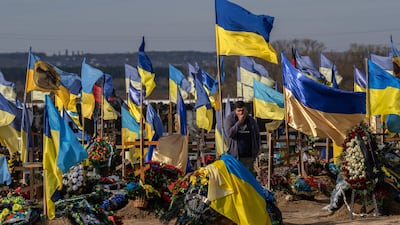
To mark the third year of the Ukraine-Russia war, The National looks back at some of the striking images captured during the conflict. Getty Images -
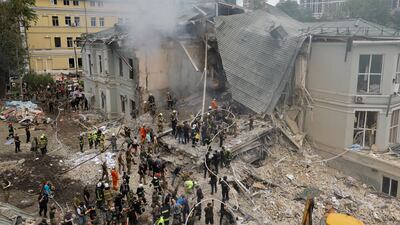
Ukrainians working at the site of a rocket strike on the 'Okhmadyt' children's hospital in Kyiv in 2024. EPA -
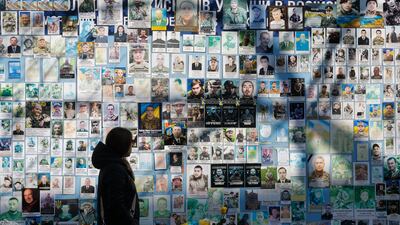
A woman walks past a memorial wall dedicated to fallen defenders of Ukraine in downtown Kyiv in 2024. EPA -
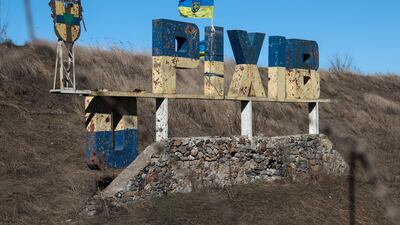
A damaged town sign in Orikhiv, near the frontline in the Zaporizhzhia region, in 2024. EPA -

Gravediggers prepare the burial site for victims of a Russian missile strike in Hroza in 2023. Getty Images -
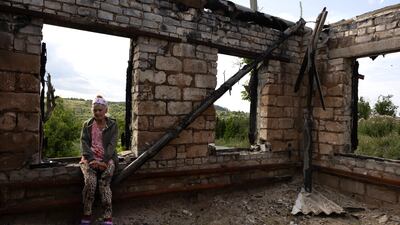
Widow Lubov Doroshenko, 67, returns to her destroyed home in 2023 in Bohorodychne. Getty Images -

A Ukrainian serviceman of the 24 Separate Mechanized Brigade fires a mortar towards Russian positions, at an undisclosed location in the Donetsk region in 2023. EPA -
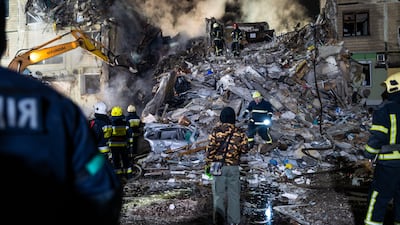
Emergency workers search the remains of a residential building that was struck by a Russian missile in Dnipro in 2023. Getty Images -
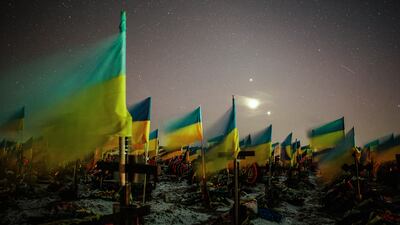
Ukrainian national flags waving over the graves of fallen Ukrainian soldiers in a military cemetery in Kharkiv in 2023. EPA -
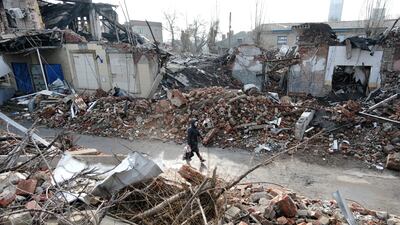
A woman walks by destroyed buildings 20 miles west from the front lines of fighting in the Donetsk Region in 2023. Getty Images -
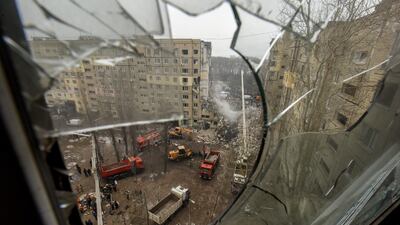
A view taken through the broken glass of a window overlooking the site of a damaged residential building in Dnipro in 2023. EPA -
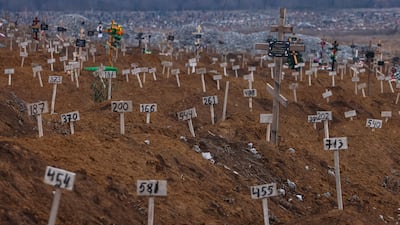
Numbers mark the graves of unidentified people killed during fighting at the cemetery in Mariupol in 2022. EPA -
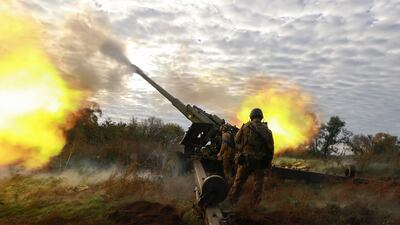
Ukrainian servicemen shoot from a captured Russian 152, 4mm howitzer Msta-B on a front line near Kupyansk city in 2022. EPA -
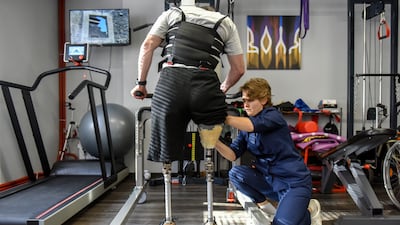
A prothesis is adjusted on an Azov Regiment serviceman at a rehabilitation centre in Kyiv in 2022. EPA -
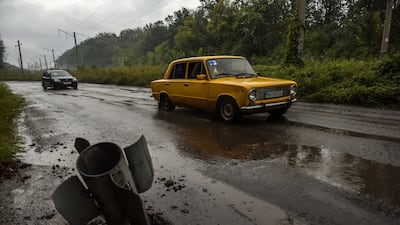
Cars drive past the shell of a rocket in Shevchenkove, Kharkiv region, in 2022. EPA -

A Ukrainian serviceman rests while travelling with a team of humanitarian volunteers in the Kherson area in 2022. EPA -
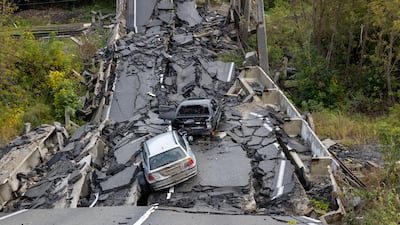
A destroyed bridge in Kupiansk in 2022. Getty Images -

A girl arrives at an evacuation point for people fleeing Mariupol, Melitopol and the surrounding towns under Russian control in 2022. Getty Images -
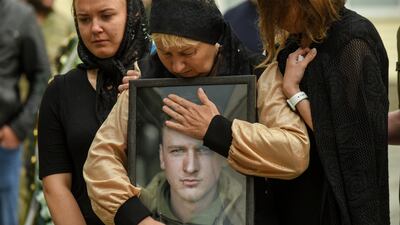
The mother of Ukrainian serviceman Andrii Verkhoglyad holds her son's portrait during his funeral ceremony at St. Michael's Golden-Domed Monastery in Kyiv in 2022. EPA -
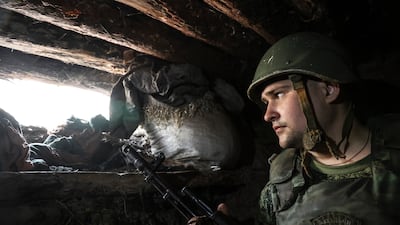
Self-proclaimed Donetsk People's Republic militia monitors a section of the road near Avdiivka, Donetsk region, in 2022. EPA -

Firefighters work to extinguish a fire at a warehouse after it was hit by Russian shelling in Kharkiv in 2022. Getty Images -
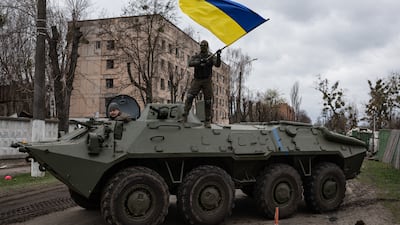
A Ukrainian soldier waves the Ukrainian national flag while standing on top of an armoured personnel carrier in Hostomel in 2022. Getty Images -
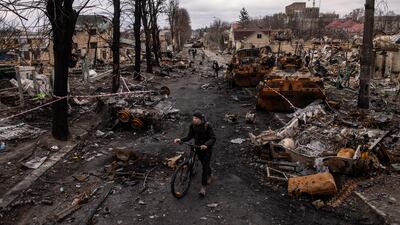
A man pushes his bike through debris and destroyed Russian military vehicles in Bucha in 2022. Getty Images -
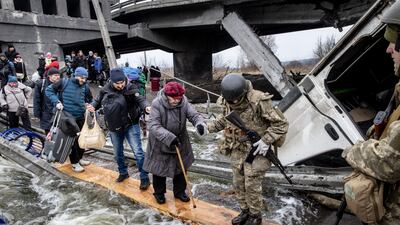
Residents of Irpin flee heavy fighting in 2022. Getty Images -
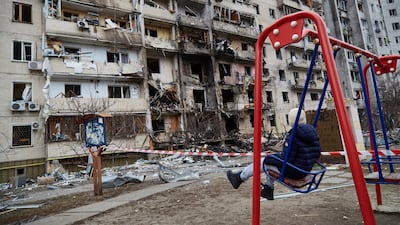
A child on a swing outside a residential building damaged by a missile in Kyiv in 2022. Getty Images


Commodities
"In the context of commodities, we could equally see the wheat and grain prices ease and ease the inflation expectations globally. The latter could give support to dovish central bank expectations and boost appetite for risky assets," said Ipek Ozkardeskaya, senior analyst at Swissquote Bank.
Europe, especially Germany, has had strong ties with Russia through energy trade, and if the conflict is resolved, it could lead to a rollback of sanctions and significantly lower European energy prices, said Mr Valecha.
A potential reopening of Ukraine’s gas pipeline could also reduce prices by a further 20 per cent to 25 per cent, which would benefit all European gas importers and, in turn, boost economic growth and reduce inflation.
Looking at gold, a ceasefire could reduce its appeal as a safe investment, although long-term demand remains strong, he added.
Mr Gattiker also agreed that appetite for gold as a central bank reserve asset remains high. “Beyond any short-term dent to market sentiment – which could happen once progress in the ceasefire talks is made – we do not believe that the long-term fundamental backdrop for gold is set to change significantly,” he said.

