


More than a third of people globally could not survive financially if they suddenly lost their income due to climate change-related disasters, according to a new report by Lloyd’s Register Foundation.
About 34 per cent of respondents to the World Risk Poll 2021 survey said they could cover their basic needs for less than a month if they were no longer receiving an income, while 12 per cent said their finances would last less than a week, the London-based charity said on Wednesday.
Lloyd’s Register Foundation polled 125,000 people in 121 countries for its biannual study.

“Financial security is a crucial aspect of resilience,” said Sarah Cumbers, director of evidence and insight at Lloyd’s Register Foundation. "When people are exposed to a shock or stressor — such as a global recession or a disaster caused by a natural hazard — it can deprive them of their livelihoods.
“We saw this with the Covid-19 pandemic, when many were forced into unemployment. The results of the poll show just how vulnerable people across the world are, making financial support key to improving resilience as climate-related crises become more frequent and more severe.”
In 2020, the Covid-19 pandemic tipped the world economy into its worst recession since the Great Depression, forcing countries into lockdowns that led to higher unemployment and reduced salaries, the International Monetary Fund said.
While governments around the world have eased restrictions and reopened economies, the pandemic and a number of recent weather events have highlighted the importance of saving to create an emergency fund.
The current global economic uncertainty — compounded by the Russia-Ukraine war, rising inflation and higher interest rates — have also put the spotlight on the financial well-being of millions of people around the world.
People are more likely to struggle financially in South Asia — where 57 per cent said they could pay their living expenses for less than a month if they lost their income — and in North Africa, with only 49 per cent of respondents able to cover their basic needs for the same period, Lloyd’s Register Foundation said in the report.
Meanwhile, 27 per cent of the world’s population have experienced some type of disaster in the past five years, with the most common form — those caused by flooding or heavy rain — experienced by 10 per cent of people.
“With climate change-related disasters increasing across the world, illustrated most recently by the widespread floods in Pakistan, the poll’s findings highlight a need for policymakers to work together to ensure people are supported in the event of a crisis,” the report said.
Watch: dust storm uproots tents of Pakistan's flood survivors
So far, the flooding in Pakistan has killed more than 1,400 people and caused severe damage.
“I think it is going to be huge. So far, [a] very early, preliminary estimate is that it is big, it is higher than $10 billion,” Ahsan Iqbal, Pakistan's planning minister, told Reuters in August.
However, regions considered to have better infrastructure and economic security, such as Australia, New Zealand, and North America, scored higher on the resilience index.
director of evidence and insight at Lloyd’s Register Foundation
In 2019, the east coast of Australia was devastated by raging wildfires that burnt 7 million hectares of land stretching from south-east Queensland to eastern Victoria and cost the economy an estimated $70bn.
The world's least resilient region, the charity found, was Central and West Africa, where 17 per cent of people said they had experienced a disaster caused by flooding.
“We know from previous analysis that low-income countries have been hardest-hit by disasters in recent years, with one in four people in these countries directly affected by the Covid-19 pandemic and other hazards,” said Jenty Kirsch-Wood, head of global risk management and reporting at the UN's Office for Disaster Risk Reduction.
“What’s more, low-income and lower middle-income countries lose a greater share of their national gross domestic product as a result of these disasters than their higher-income peers — 0.8 per cent to 1 per cent, compared with 0.1 per cent and 0.3 per cent in high-income and upper middle-income countries, respectively.”
Climate change around the world — in pictures
-

Engineers carry solar panels on to the roof of a property in Barcelona in September 2022. Spain and other Mediterranean countries have generated record amounts of power from wind and solar farms. Bloomberg -
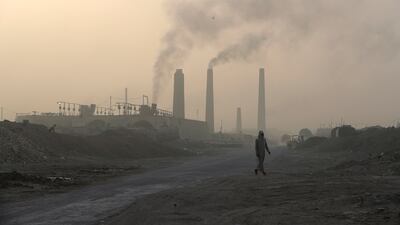
Smoke rises from brick factory stacks in Nahrawan, Baghdad. Tackling emissions from heavy industry is crucial to tackling global warming. Reuters -
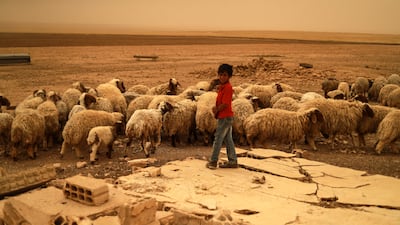
A boy stands near a flock of sheep as a sandstorm approaches in the Syrian countryside of Tabqa. Syria is among the countries most vulnerable and poorly prepared for climate change, which is expected to worsen. AFP -
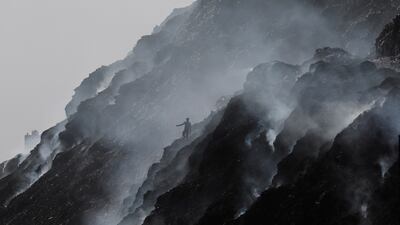
Mountains of smouldering rubbish at the Bhalswa landfill in New Delhi, India. Reuters -

Greenpeace activists take part in a climate change protest in front of the Brandenburg Gate in Berlin in May. AP -
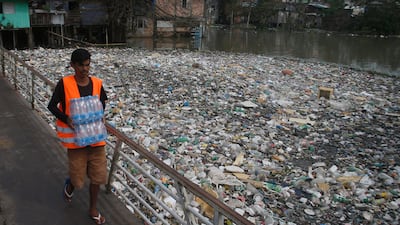
A man carries water bottles across the heavily polluted Negro River in Manaus, Brazil. About 35 tonnes of rubbish are removed daily from the river. AP -
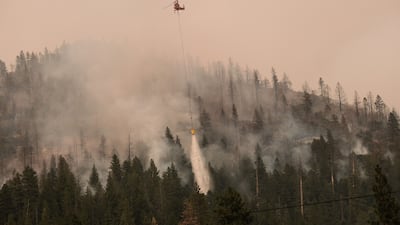
A helicopter drops water on a brush fire in California. Bloomberg -
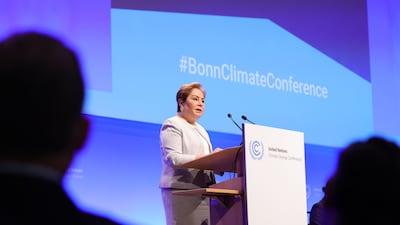
UN climate chief Patricia Espinosa speaks on the opening day of the Bonn climate change conference in Germany. Getty -
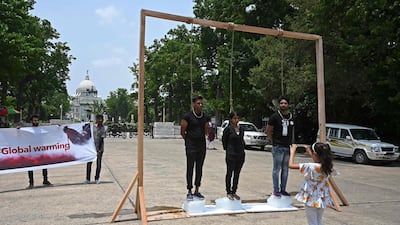
Activists take part in a demonstration to raise awareness of global warming, during an event to mark World Environment Day in Kolkata. AFP -
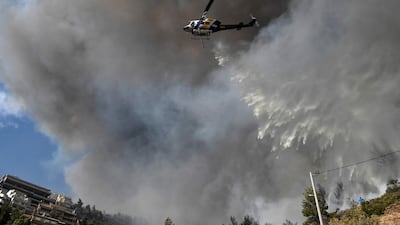
A helicopter drops water on a bushfire near a residential district in Athens. The fire forced residents to flee. AFP -
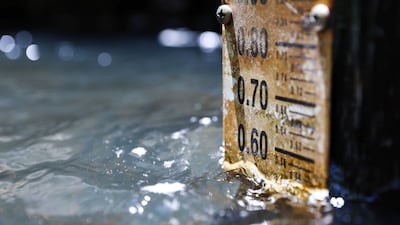
A gauge measures water levels in the Rio Nambe river, in New Mexico. Ninety per cent of the state is experiencing extreme drought. Getty -

Afghan refugees search for recyclable material from heaps of rubbish in Karachi, Pakistan. AP -

A climate activist ties herself to the net during the semi-final tennis match between Croatia's Marin Cilic and Norway's Casper Ruud at the French Open in Roland Garros in Paris. AP -
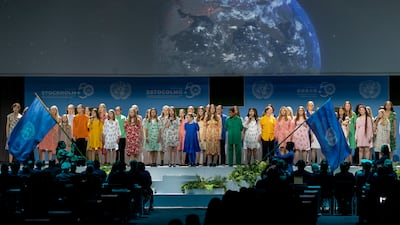
A dance group performs at a climate summit in Stockholm, Sweden. Getty -

US climate envoy John Kerry talks to a delegate at the Stockholm 50 climate summit. Getty -
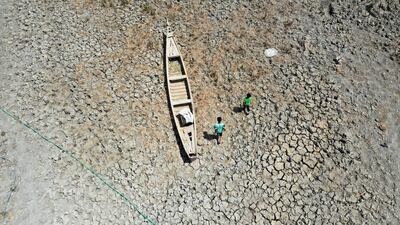
A boat is stranded during low tide at the Chebayesh marsh in Dhi Qar province, Iraq. Reuters -
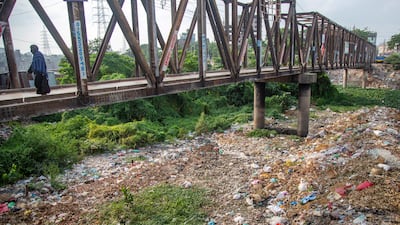
A woman crosses a polluted river in Dhaka, Bangladesh. EPA -
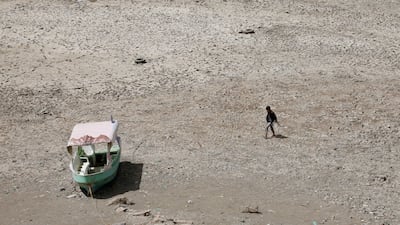
A man walks past an abandoned boat in the bed of a drought-affected reservoir on the outskirts of Sana'a, Yemen. EPA



