

Evan Spiegel and Bobby Murphy
Like the disappearing “snaps” that users post on its social media app, Snap’s Evan Spiegel and Bobby Murphy just saw a big chunk of their fortunes vanish.
Shares of Snap tumbled 41 per cent in New York trading last Tuesday — its biggest intraday decline — after the company cut revenue and profit forecasts, slashing the wealth of its two co-founders, as well as other billionaire social media owners.
Mr Spiegel, 31, who is chief executive, saw $1.4 billion, or 30 per cent, of his fortune disappear, while Mr Murphy, Snap's chief technology officer, dropped $1.8bn, or 36 per cent. They are among the largest wealth declines of any US billionaires by percentage this year, the Bloomberg Billionaires Index shows.
Mr Spiegel and Mr Murphy are now worth $3.4bn and $3.1bn, respectively, the wealth index shows.
It wasn’t just Snap’s billionaires who took a hit. Shares of Facebook owner Meta Platforms fell by as much as 10 per cent, shaving 8 per cent or $5.7bn off the fortune of chief executive Mark Zuckerberg.
The losses add to a string of precipitous declines for some of America’s wealthiest entrepreneurs amid a rout in tech stocks. Netflix chief executive Reed Hastings’s wealth has fallen by 53 per cent since the start of the year, one of the largest drops among US tech billionaires.
As recently as September, Mr Spiegel was worth $15.3bn and ranked among the 140 richest people in the world, according to the Bloomberg index. He and his wife, Australian supermodel Miranda Kerr, recently used part of their fortune to forgive the college debt of graduates of the Otis College of Art and Design in Los Angeles.
Mr Spiegel owns slightly more than 10 per cent of the California-based social media company, which he created with Mr Murphy in 2011 while he was a student at Stanford University.
Their Snapchat app took off for what was then a relatively novel feature: the ability to post “snaps” containing photos or videos that would quickly disappear.
Mr Spiegel has sold more than $1.6bn worth of Snap shares since the company went public in 2017, while Mr Murphy has unloaded about $640 million worth, according to data compiled by Bloomberg.

Stephane Bancel
Moderna chief executive Stephane Bancel plans to donate the bulk of his family wealth, focusing his philanthropy on issues such as health care and global food security.
“We’ve told the kids that they get a good education, we take care of that,” Mr Bancel said in an interview on the sidelines of the World Economic Forum in Davos, Switzerland. “They’ll get the family house, you know. But the rest we’re going to give away.”
Last week, Mr Bancel, 49, said he plans to exercise some of his Moderna stock options over the course of the next 12 months and sell the shares, donating the proceeds. That could generate about $355m for charity, he said. He has an estimated net worth of $4.1bn, according to the Bloomberg Billionaire’s Index.
Mr Bancel holds a 5.4 per cent stake in Moderna through his own shares and two separate entities, according to data compiled by Bloomberg.
The Covid-19 vaccine maker’s stock soared to a high of nearly $500 a share in August before losing value amid concern about whether vaccine orders would keep pace. The entire biotech sector has declined over that time period as well.
Mr Bancel also said he’s interested in doing more philanthropically on climate change. He has invested in climate companies, citing a stake in nuclear fusion energy start-up Commonwealth Fusion Systems.
The Moderna chief executive said his teenage daughter persuaded him to become a vegetarian by pointing out the climate ramifications of eating meat.

Robert Brockman
The judge overseeing billionaire Robert Brockman’s tax evasion case, the largest against an individual in US history, rejected his claims that dementia leaves him incompetent to stand trial.
US District Judge George Hanks Jr’s decision means Mr Brockman, 80, must defend a 39-count indictment accusing him of evading taxes on $2bn of income and other crimes. Mr Brockman’s lawyers argued his progressive dementia, caused by Alzheimer’s and Parkinson’s disease, has accelerated recently. If his condition worsens, they could file a new incompetency claim.
“The court finds that despite Brockman’s recent health problems, the government has met its burden of establishing that Brockman is competent to stand trial,” Judge Hanks ruled in federal court in Houston.
Testing shows Mr Brockman is “exaggerating his symptoms of severe dementia and his cognitive abilities are not as poor as reflected by his cognitive test results", the judge wrote. “In other words, Brockman is malingering to avoid prosecution.”
The judge agreed with prosecutors who said that while Mr Brockman has some cognitive impairment, he has exaggerated his decline since 2018 as US investigators focused on whether he controlled billions of dollars in a Bermuda charitable trust.
They said Mr Brockman functioned at a high level even after his October 2020 indictment. Mr Brockman later stepped down as chief executive of Reynolds & Reynolds, a software company.
The ruling follows an eight-day competency hearing in November, when doctors, medical experts and colleagues testified about Mr Brockman’s cognitive state. Defence witnesses said that neuroimaging studies showed Mr Brockman suffered from progressive dementia.
Prosecution witnesses said that while Mr Brockman may have early Alzheimer’s disease, he faked the severity of his dementia for years. In a court filing, prosecutors said he led a double life, “presenting to select doctors as severely cognitively impaired, while simultaneously leading a normal, unimpaired life”.
The Justice Department has investigated Mr Brockman for five years. Prosecutors said most of the income he failed to pay taxes on came from investments in Vista Equity Partners, founded by billionaire Robert F Smith.
Mr Brockman must also contend with the Internal Revenue Service, which imposed a $1.4bn tax assessment against him in October. In January, he sued the US to halt the agency’s immediate assessment of that levy. Days later, he filed a separate lawsuit in Tax Court.

Michael Dell
Technology entrepreneur Michael Dell once again finds himself at the centre of one of his industry’s biggest deals.
Mr Dell holds a roughly $16.2bn stake in VMware, meaning he’s likely to have an important say in a potential takeover of the cloud-computing provider by chipmaker Broadcom. The two companies are in talks about a transaction.
While it’s not known what price Broadcom is willing to pay for VMware, which has a market value of $40bn, it may have to offer a sizeable premium to get the company’s shareholders on board.
VMware’s market capitalisation touched $70bn as recently as October, when Mr Dell’s interest would have been worth some $28bn.
“Valuation and Michael Dell’s 40 per cent stake could be hurdles to Broadcom’s reported M&A interest in VMware,” said Woo Jin Ho, analyst at Bloomberg Intelligence. “Deal synergies exist, but we believe VMware may seek a valuation before the recent market drop.”
-
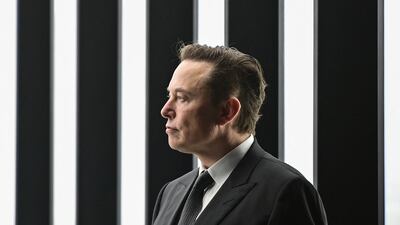
Top 10 richest people in the world: 1. Tesla chief executive Elon Musk - $246bn. AFP -
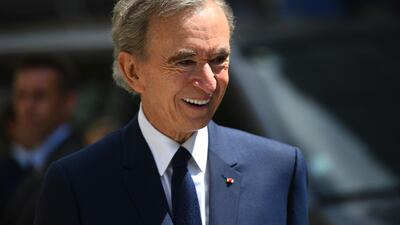
2. Head of French luxury goods maker LVMH Bernard Arnault - $157.7bn. AFP -
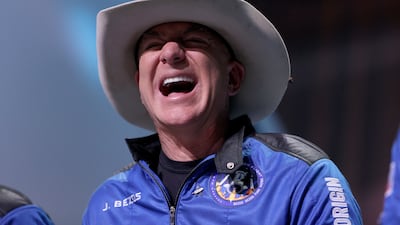
3. Jeff Bezos of Amazon - $150.1bn. Getty -
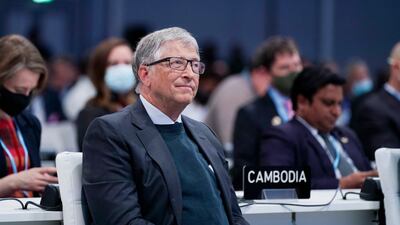
4. Microsoft founder Bill Gates - $129.4bn. AFP -

5. Adani Group chairman Gautam Adani - $125.9bn. Reuters -
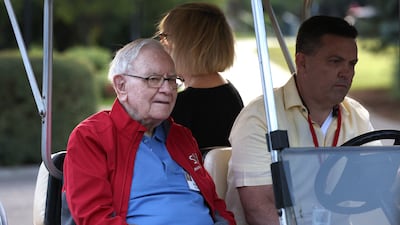
6. Chairman and chief executive of Berkshire Hathaway Warren Buffett - $116.6bn. AFP -

7. Reliance Industries chairman Mukesh Ambani - $105.4bn. Reuters -

8. Businessman Larry Ellison - $102.5bn. Reuters -

9. Larry Page, co-founder of Google/Alphabet - $98.5bn. Reuters -

10. Co-founder of Google/Alphabet Sergey Brin - $94.7bn. Reuters


Buyers offered an average 34.1 per cent premium in takeovers of software companies announced over the past five years, data compiled by Bloomberg show. Assuming Broadcom offered a similar add-on, that would still only value VMware at around $54bn and it’s unclear whether that would be enough for Dell.
The 57-year old founder of Dell Technologies has a net worth of $44.2bn, according to the Bloomberg Billionaires Index, and isn’t shy about getting into a corporate fight.
He took his eponymous PC maker private in 2013 in a $24.9bn deal in the face of fierce opposition from renowned activist investor Carl Icahn. Around three years later, he led a $67bn acquisition of EMC Corporation in what remains one of the biggest tech deals in history.
Then, in 2018, he won a battle to buy out shareholders of stock that tracked Dell’s stake in VMware — created after the EMC takeover — once again defeating opposition from Mr Icahn.
There may also be the chance of rival offers for VMware tempting Mr Dell to hold out. “We believe VMware could attract interest from other suitors pursuing software such as Cisco,” Mr Ho said.

