
When Elon Musk, the billionaire founder and chief executive of Tesla and SpaceX, announced his surprise $43 billion takeover bid to buy 100 per cent of Twitter and take it private, it is safe to say he ruffled a few feathers on the board of directors, judging by their “poison pill” response.
Chances are that you have seen this type of scenario play out before — but in spy thrillers. The protagonist’s cover is blown and he is on the run. But when he is surrounded by adversaries and there is no escaping an imminent capture, he decides to pop the poison pill to avoid being tortured and forced to reveal key secrets.
Apparently, there is an equivalent of that in the corporate world, where companies adopt the “poison pill” to escape or delay a hostile takeover bid.
However, it seems that Twitter may have abandoned its poison pill strategy after media reports on Monday said it had entered into negotiations with Mr Musk.
Here, we explain the poison pill strategy and why it doesn’t always work for companies seeking to protect themselves from a hostile takeover.
But more importantly, what comes next in the battle between Twitter and Mr Musk?
Why did Mr Musk make a bid for Twitter?
Mr Musk, a vociferous proponent of free speech, often criticised the way the microblogging platform was run and how it often muffled freedom of expression.
On March 25, he ran a poll on the microblogging platform asking his more than 82 million followers if they thought Twitter adhered to the principle of free speech.
Mr Musk followed it up with another tweet saying: “The consequences of this poll will be important. Please vote carefully.”
Up to this point, no one had a clue what Mr Musk’s game plan was.
Then, on April 4, came the announcement that he had acquired a 9.2 per cent stake in Twitter, worth about $2.89bn on the day, making him the largest shareholder. The stock price surged by about 30 per cent on the news.
The following day, Twitter chief executive Parag Agrawal announced on Twitter that Mr Musk had been appointed to the company’s board of directors. It was a conditional offer that would limit his ownership to a stake in Twitter of no more than 14.9 per cent.
However, when everyone zigs, Mr Musk must zag. In an abrupt reversal on April 9, Mr Musk informed Twitter of his decision to decline the board seat, ensuring he would not be limited to a 14.9 per cent stake in the company.
What was the game plan?
While industry watchers were scratching their heads trying to make sense of it all, Mr Musk, the world’s richest man with a net worth of $294bn, made his move, launching his takeover bid on April 14 to buy 100 per cent of Twitter and take it private.
As part of the new deal, Mr Musk wanted to buy Twitter outright. A letter he sent to Twitter chairman Bret Taylor, which was disclosed in a securities filing, revealed that he offered to buy 100 per cent of Twitter for $54.20 per share in cash. In the same letter, Mr Musk said it was his “best and final” offer to all Twitter shareholders.
Why not $55, you might ask? Well, it is Mr Musk and the number 420 is US slang for cannabis. Anyway, Mr Musk's $43bn hostile takeover bid created sensational headlines — from Anchorage to Abu Dhabi.
-
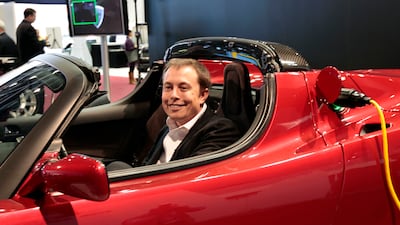
Mr Musk unveils a new all-wheel-drive version of the Model S car in Hawthorne, California, in 2014. Reuters -

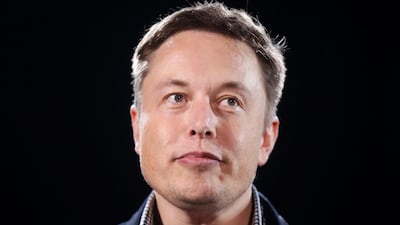
Tesla and SpaceX founder Elon Musk. Getty Images -
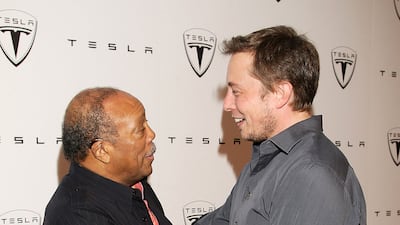
Mr Musk with music producer Quincy Jones. AFP -

The wealthiest person in the world with a worth of $274.3 billion, Mr Musk was named 'Person of the Year' by 'Time' magazine in 2021. Getty Images -
Focus on Mr Musk's taxes grew last year as Tesla achieved a rarefied $1 trillion in market value. Reuters -

The billionaire has hit back, saying he does not draw a salary from either SpaceX or Tesla, and pays an effective tax rate of 53 per cent on stock options he exercises. AFP -
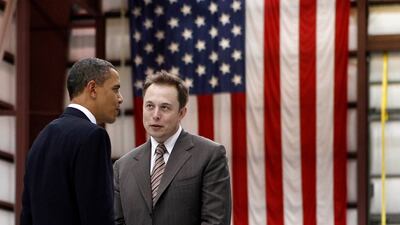
Then US president Barack Obama speaks to Mr Musk on a tour of Cape Canaveral Air Force Station in Cape Canaveral, Florida, in 2010. Reuters -
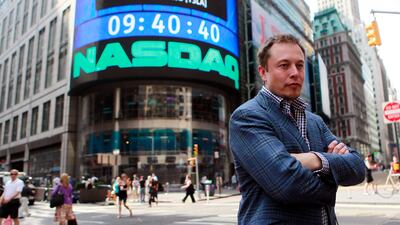
Mr Musk during a television interview after Tesla's initial public offering at the Nasdaq market in New York, in 2010. Reuters -
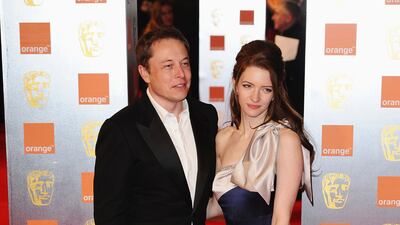
With former wife Talulah Riley at the 2011 Orange British Academy Film Awards in London. Getty Images -
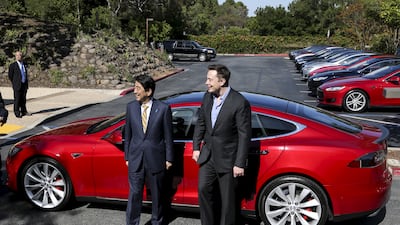
With Japan's former prime minister Shinzo Abe after a test drive of the Tesla Model S P85D in Palo Alto, California, in 2015. Reuters -

Mr Musk during the 67th International Astronautics Congress in Guadalajara, Mexico, in 2016. EPA -
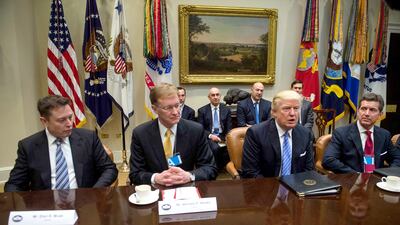
From left: SpaceX chief executive Elon Musk, Corning chief executive Wendell Weeks, then US president Donald Trump and Johnson & Johnson chief executive Alex Gorsky during a meeting at the White House. AFP -
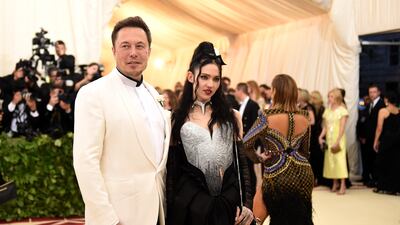
Mr Musk and former wife Grimes at The Metropolitan Museum of Art in New York City, in 2018. AFP -
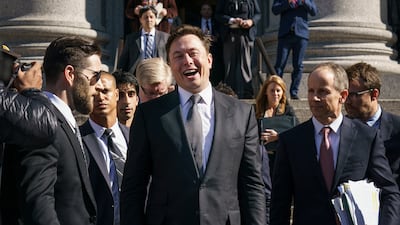
Mr Musk leaves a court in New York City, in 2019, after a hearing in a lawsuit brought against him by the US Securities and Exchange Commission. Getty Images -

A prototype of SpaceX's Starship spacecraft is seen before Mr Musk gives an update on the company's Mars rocket Starship in Boca Chica, Texas, in 2019. Reuters -

Mr Musk at the construction site of the Tesla Gigafactory in Gruenheide, near Berlin, Germany, last year. EPA -

Dancing onstage during a delivery event for Tesla's China-made Model 3 cars in Shanghai. Reuters -
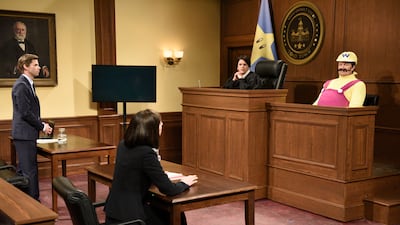
Mikey Day as a lawyer, Cecily Strong as a judge, and host Elon Musk as Wario during the "Wario" sketch on NBC's 'Saturday Night Live', in May. Getty Images -

Mr Musk with Armin Laschet, CDU party federal chairman and prime minister of Germany's North Rhine-Westphalia, talk during a tour of the plant of the future foundry of the Tesla Gigafactory in Grünheide, near Berlin, Germany. Getty Images


Enter the poison pill
Twitter management quickly responded by putting in place a shareholder rights plan, known in corporate parlance as a poison pill.
The measure would make it more expensive for Mr Musk to increase his stake in the company to 15 per cent or more. A poison pill plan is enacted by a company’s board in an attempt to create a roadblock to a coercive takeover of the company or at least delay it, thus buying time to find a better alternative.
What is the history of the poison pill strategy?
The use of the poison pill strategy in the face of hostile takeovers was devised in 1982 by Martin Lipton, a mergers and acquisition lawyer in New York.
At the time, large conglomerates were trying to gobble up smaller counterparts by using brute force. Often, they would acquire these companies against the wishes of management. Mr Lipton wanted to find a way for these companies to push back.
Thus, the poison pill was created to stave off an unsolicited, non-binding proposal to acquire a company.
It is designed to make it less attractive — or more expensive — for the acquirer to successfully complete the takeover.
Which type of poison pill strategy is Twitter using?
Formally known as the shareholder rights plan, this strategy could indeed lead to a better deal for Twitter shareholders. There are a few versions of poison pills and Twitter is using the most common form of the strategy.
For starters, the Twitter poison pill has a limited duration. Twitter’s rights plan will expire on April 14, 2023.
The stated goal of the plan is to increase shareholder value, making sure they receive as high a price as possible, as well as to give the company enough time to process and consider Mr Musk’s proposal and any others it may receive.
But the part of Twitter’s announcement that is at the heart of the rights plan is as follows:
“Under the Rights Plan, the rights will become exercisable if an entity, person or group acquires beneficial ownership of 15 per cent or more of Twitter's outstanding common stock in a transaction not approved by the board. In the event that the rights become exercisable due to the triggering ownership threshold being crossed, each right will entitle its holder (other than the person, entity or group triggering the rights plan, whose rights will become void and will not be exercisable) to purchase, at the then-current exercise price, additional shares of common stock having a then-current market value of twice the exercise price of the right.”
Let us unpack that. Simply put, this means if Mr Musk’s stake in Twitter exceeds the 15 per cent threshold, the shareholder rights will be triggered.
Note that these rights are for all existing shareholders (except the acquirer; in this case, Mr Musk), who can buy newly created shares of Twitter at a 50 per cent discount to market value, giving them one right per share.
In other words, if you currently own 10 shares in Twitter, you would be able to buy 10 more shares at the 50 per cent discount. Everyone except Mr Musk would be able to double the number of shares they own — and it would be very profitable for shareholders to do this.
What does this mean for Mr Musk's bid?
It dilutes Mr Musk's stake and dramatically shrinks his Twitter ownership. Let us look at some hypothetical numbers to understand how all this works.
Imagine Mr Musk continues to buy Twitter shares until he owns 15 per cent of a total of 100,000 outstanding shares available. So, he now owns 15,000 shares and everyone else owns 85,000 shares.
At this point, the poison pill is activated and Twitter issues 85,000 new shares at a 50 per cent discount, open to everyone except Mr Musk. If everyone in this group exercises their rights, the number of shares for this cohort jumps to 170,000 shares.
At this point, Mr Musk is down to owning 15,000 shares out of the 185,000 shares, or about 8.11 per cent, that are currently outstanding.
Mr Musk’s ownership stake is almost cut in half and the agreement stipulates that he can’t buy the new discounted shares. He will have to pay the higher price if he wants to buy more shares, which could render his bid prohibitively expensive to keep the acquisition effort alive.
Is the poison pill strategy effective?
Enacting a poison pill provision through a shareholder rights plan does not mean a takeover attempt has been squashed.
Poison pills are typically enacted by companies struggling with poor performance and are vulnerable to hostile takeovers, according to a CFO Magazine article published in 2001.
Interestingly, from 1997 to the article's publication, for every company that successfully used the poison pill defence to rebuff an unwanted advance, 20 companies with poison pills were eventually taken over.
It is an age-old tactic adopted by companies to allow the board to disseminate information about the value of the company to shareholders, seek other strategic alternatives and negotiate with the hostile bidder to raise the price.
Which other companies have dropped a poison pill?
Twitter is not the only famous company to take up the anti-takeover tool.
In 2012, Netflix used a poison pill strategy to prevent billionaire activist investor Carl Icahn from acquiring the company.
American retailer JC Penney used the plan in 2010 after hedge-fund manager William Ackman attempted a hostile takeover by raising his stake.
In 2008, Yahoo successfully invoked the poison pill provision to fend off Microsoft’s hostile takeover bid.
What does it mean for shareholders?
In the absence of a white knight galloping in to make a better offer for Twitter, the company began negotiations with Mr Musk on Sunday, The New York Times reported yesterday.
Mr Musk said it was his best and final offer but the wording in his letter to the chair of the board is sufficiently ambiguous, saying: “If it is not accepted, I would need to reconsider my position as a shareholder.”
Moreover, while the board might institute a defensive strategy, ultimately, it is the shareholders who control the company.
It is not farfetched, therefore, to conceive Twitter shareholders may agree with Mr Musk about the need to replace board members.
After all, the board has failed to increase shareholder value as evidenced by the stock’s price history. On the day of its initial public offering in 2013, Twitter stock was trading at $44.90. At the time of writing, its price had surged 4.19 per cent to reach $50.98 in after-hours trading in New York on the news that negotiations had begun between the two parties an announcement was imminent.
Despite this, the price has been flat for about 10 years and shareholders could make a very strong argument that Twitter management has had more than enough time to increase shareholder value — and they didn’t, or couldn’t.
Last Thursday, Mr Musk revealed the ace up his sleeve after securing a funding commitment of $46.5bn to finance his bid and was also considering initiating a tender offer for Twitter's shares, a filing to the US Securities and Exchange Commission showed.
Meanwhile, The Times, citing people with knowledge of the situation who it did not identify, said the two sides were discussing details including a timeline and fees if an agreement was signed and then fell apart, AP said. The people said the situation was fluid and fast-moving, it added.
While the deal has yet to be confirmed, it seems that Mr Musk has succeeded in wooing many of the company’s shareholders after securing financing of $46.5bn.
In the meantime, it is going to be an interesting ride to see what the next chapter brings.

