Apple's stock market value is greater than the combined capitalization of Exxon Mobil, Procter & Gamble and AT&T. AFP Photo

Apple becomes the world's first trillion dollar company


  • English
  • Arabic

Apple became the first $1 trillion publicly listed US company on Thursday, crowning a decade-long rise fuelled by its ubiquitous iPhone that transformed it from a niche player in personal computers into a global powerhouse spanning entertainment and communications.

The tech company's stock jumped 2.8 per cent to as high as $207.05, bringing its gain to about 9 per cent since Tuesday when it reported June-quarter results above expectations and said it bought back $20 billion of its own shares.

Founded in 1976 in the garage of co-founder Steve Jobs, Apple has pushed its revenue beyond the economic outputs of Portugal, New Zealand and other countries. Along the way, it has changed how consumers connect with one another and how businesses conduct daily commerce.

_______________

Read more

Who can recall life without iPhone?

Apple earnings beat expectations as it sells pricier iPhones

Apple results and iPhone performance in spotlight

Apple launches $300m renewable energy fund for China

_______________

Apple's stock market value is greater than the combined capitalization of Exxon Mobil, Procter & Gamble and AT&T. It now accounts for 4 per cent of the S&P 500.

One of three founders, Jobs was driven out of Apple in the mid-80s, only to return a decade later and rescue the computer company from near bankruptcy.

He launched the iPhone in 2007, dropping "Computer" from Apple's name and super-charging the cellphone industry, catching Microsoft, Intel , Samsung Electronics and Nokia off guard. That put Apple on a path to overtake Exxon Mobil in 2011 as the largest US company by market value.

Stock has surged more than 50,000 per cent since its 1980 initial public offering, dwarfing the S&P 500's approximately 2,000-per cent increase during the same almost four decades.

Ramon Penas / The National

During that time, Apple evolved from selling Mac personal computers to becoming an architect of the mobile revolution with a cult-like following.

Jobs, who died in 2011, was succeeded as chief executive by Tim Cook, who has doubled the company's profits but struggled to develop a new product to replicate the society-altering success of the iPhone, which has seen sales taper off in recent years.

_______________

Read more

Apple plans to start news subscription service

Apple said to work on touchless iPhones

iPhone X release in UAE: All you need to know

_______________

In 2006, the year before the iPhone launch, Apple generated less than $20 billion in sales and net profit just shy of $2 billion. By last year, its sales had grown more than 11-fold to $229 billion - the fourth highest in the S&P 500 - and net income had mushroomed at twice that rate to $48.4 billion, making it the most profitable publicly-listed U.S. company.

One of five US companies since the 80s to take a turn as Wall Street's largest company by market capitalization, Apple could lose its lead to the likes of Alphabet  or Amazon if it does not find a major new product or service as demand for smartphones loses steam.

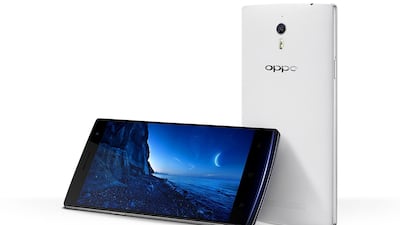
The world's most popular smartphones, Q1, 2018

Mercer, the investment consulting arm of US services company Marsh & McLennan, expects its wealth division to at least double its assets under management (AUM) in the Middle East as wealth in the region continues to grow despite economic headwinds, a company official said.

Mercer Wealth, which globally has $160 billion in AUM, plans to boost its AUM in the region to $2-$3bn in the next 2-3 years from the present $1bn, said Yasir AbuShaban, a Dubai-based principal with Mercer Wealth.

Within the next two to three years, we are looking at reaching $2 to $3 billion as a conservative estimate and we do see an opportunity to do so,” said Mr AbuShaban.

Mercer does not directly make investments, but allocates clients’ money they have discretion to, to professional asset managers. They also provide advice to clients.

“We have buying power. We can negotiate on their (client’s) behalf with asset managers to provide them lower fees than they otherwise would have to get on their own,” he added.

Mercer Wealth’s clients include sovereign wealth funds, family offices, and insurance companies among others.

From its office in Dubai, Mercer also looks after Africa, India and Turkey, where they also see opportunity for growth.

Wealth creation in Middle East and Africa (MEA) grew 8.5 per cent to $8.1 trillion last year from $7.5tn in 2015, higher than last year’s global average of 6 per cent and the second-highest growth in a region after Asia-Pacific which grew 9.9 per cent, according to consultancy Boston Consulting Group (BCG). In the region, where wealth grew just 1.9 per cent in 2015 compared with 2014, a pickup in oil prices has helped in wealth generation.

BCG is forecasting MEA wealth will rise to $12tn by 2021, growing at an annual average of 8 per cent.

Drivers of wealth generation in the region will be split evenly between new wealth creation and growth of performance of existing assets, according to BCG.

Another general trend in the region is clients’ looking for a comprehensive approach to investing, according to Mr AbuShaban.

“Institutional investors or some of the families are seeing a slowdown in the available capital they have to invest and in that sense they are looking at optimizing the way they manage their portfolios and making sure they are not investing haphazardly and different parts of their investment are working together,” said Mr AbuShaban.

Some clients also have a higher appetite for risk, given the low interest-rate environment that does not provide enough yield for some institutional investors. These clients are keen to invest in illiquid assets, such as private equity and infrastructure.

“What we have seen is a desire for higher returns in what has been a low-return environment specifically in various fixed income or bonds,” he said.

“In this environment, we have seen a de facto increase in the risk that clients are taking in things like illiquid investments, private equity investments, infrastructure and private debt, those kind of investments were higher illiquidity results in incrementally higher returns.”

The Abu Dhabi Investment Authority, one of the largest sovereign wealth funds, said in its 2016 report that has gradually increased its exposure in direct private equity and private credit transactions, mainly in Asian markets and especially in China and India. The authority’s private equity department focused on structured equities owing to “their defensive characteristics.”

Nepotism is the name of the game

Salman Khan’s father, Salim Khan, is one of Bollywood’s most legendary screenwriters. Through his partnership with co-writer Javed Akhtar, Salim is credited with having paved the path for the Indian film industry’s blockbuster format in the 1970s. Something his son now rules the roost of. More importantly, the Salim-Javed duo also created the persona of the “angry young man” for Bollywood megastar Amitabh Bachchan in the 1970s, reflecting the angst of the average Indian. In choosing to be the ordinary man’s “hero” as opposed to a thespian in new Bollywood, Salman Khan remains tightly linked to his father’s oeuvre. Thanks dad. 

PROVISIONAL FIXTURE LIST

Premier League

Wednesday, June 17 (Kick-offs uae times) Aston Villa v Sheffield United 9pm; Manchester City v Arsenal 11pm 

Friday, June 19 Norwich v Southampton 9pm; Tottenham v Manchester United 11pm  

Saturday, June 20 Watford v Leicester 3.30pm; Brighton v Arsenal 6pm; West Ham v Wolves 8.30pm; Bournemouth v Crystal Palace 10.45pm 

Sunday, June 21 Newcastle v Sheffield United 2pm; Aston Villa v Chelsea 7.30pm; Everton v Liverpool 10pm 

Monday, June 22 Manchester City v Burnley 11pm (Sky)

Tuesday, June 23 Southampton v Arsenal 9pm; Tottenham v West Ham 11.15pm 

Wednesday, June 24 Manchester United v Sheffield United 9pm; Newcastle v Aston Villa 9pm; Norwich v Everton 9pm; Liverpool v Crystal Palace 11.15pm

Thursday, June 25 Burnley v Watford 9pm; Leicester v Brighton 9pm; Chelsea v Manchester City 11.15pm; Wolves v Bournemouth 11.15pm

Sunday June 28 Aston Villa vs Wolves 3pm; Watford vs Southampton 7.30pm 

Monday June 29 Crystal Palace vs Burnley 11pm

Tuesday June 30 Brighton vs Manchester United 9pm; Sheffield United vs Tottenham 11.15pm 

Wednesday July 1 Bournemouth vs Newcastle 9pm; Everton vs Leicester 9pm; West Ham vs Chelsea 11.15pm

Thursday July 2 Arsenal vs Norwich 9pm; Manchester City vs Liverpool 11.15pm


WHAT IS A BLACK HOLE?

1. Black holes are objects whose gravity is so strong not even light can escape their pull

2. They can be created when massive stars collapse under their own weight

3. Large black holes can also be formed when smaller ones collide and merge

4. The biggest black holes lurk at the centre of many galaxies, including our own

5. Astronomers believe that when the universe was very young, black holes affected how galaxies formed

UAE currency: the story behind the money in your pockets