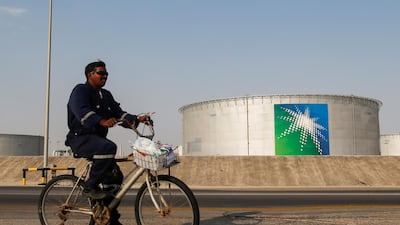
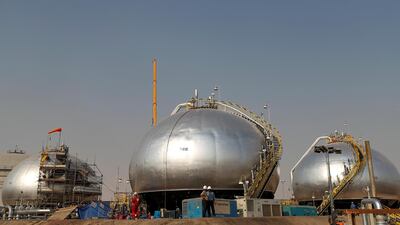
Saudi Arabia has transferred a 4 per cent stake in energy major Saudi Aramco to the Saudi Arabian Investment Company, a wholly-owned subsidiary of the sovereign wealth fund, the Public Investment Fund, Crown Prince Mohammed bin Salman said on Sunday.
Following the transfer to Sanabil Investments, as the PIF unit is known, the state remains Aramco’s largest shareholder, retaining a 90.186 per cent stake in the company, Aramco said in a statement to the Saudi stock exchange Tadawul, where its shares are traded.
The state had transferred 4 per cent of Aramco's shares to the PIF in February as part of the kingdom’s “long-term strategy to support the restructuring of its economy, in line with Vision 2030".
The latest transfer will not affect Aramco's total number of issued shares, and the shares transferred will rank equally alongside other existing ordinary shares, the company said in the bourse statement.
The 4 per cent stake would be worth roughly $77 billion, based on Saudi Aramco's current market price.
“This is a private transfer between the state and Sanabil, and the company [Aramco] is not a party to the transfer and did not enter into any agreements or pay or receive any proceeds from the transfer,” it said.
The company also confirmed that the transfer “does not have an impact” on its operations, strategy, dividends distribution policy or its governance framework.
It will announce any material development as required by the applicable rules and regulations.
Saudi Aramco, the world’s top oil supplier, completed the world's largest initial public offering in 2019, raising $25.6 billion, and later sold more shares boosting the total to $29.4 billion.
Its annual net profit surged 46 per cent in 2022, driven by higher oil prices, to a record $161.1 billion, the company said in a regulatory filing last month.
Earlier this month, Fitch Ratings raised Aramco’s long-term foreign and local currency issuer default ratings to A+ from A with a stable outlook because of the company’s strong business profile and its ambitions to deliver a “sustainable and progressive dividend”.
Yasir al-Rumayyan, governor of PIF and chairman of Aramco, said last year that the company may consider selling more shares if the market conditions are right.
The transfer of a part of the state’s shares in Aramco is a continuation of Saudi Arabia’s long-term initiatives to diversify the national economy and expand investment opportunities in line with Vision 2030, the Saudi Press Agency quoted Prince Mohammed, who is also the chairman of PIF, as saying.
The transfer will also solidify PIF’s strong financial position and credit rating, he said.
The move comes as the fund continues with its mandate to launch new sectors, build new strategic partnerships, localise technologies and knowledge, and create more direct and indirect job opportunities in the local market, he added.
One of the world’s largest sovereign wealth funds, with about $620 billion in assets, the PIF is at the centre of the Saudi Vision 2030 initiative to diversify the country’s economy away from hydrocarbons.
Under a five-year strategy announced in 2021, the PIF aims to more than double the value of its assets under management to $1.07 trillion and commit $40 billion annually to develop Saudi Arabia's economy until 2025. It will contribute $320 billion to the kingdom's non-oil economy.
The fund created 10 new sectors, launched more than 30 new companies, created 331,000 jobs in Saudi Arabia, and tripled assets under management over the past four years.
These include health care, renewables, telecoms, media and technology, food and agriculture, automotive, transportation and logistics, real estate, aerospace and defence, construction and building components and services. The kingdom will also continue to develop entertainment, leisure and sports, financial services, metals and mining, and the retail sector.
Some of the companies established by the fund include the futuristic city known as Neom, the Red Sea Development Company, Qiddiya, the KAFD Development and Management company, SAMI, the Saudi Jordanian Investment Fund, Jeddah New Downtown Company, Saudi Entertainment Venture, Saudi Information Technology Company and National Energy Services.

Brief scores:
QPR 0
Watford 1
Capoue 45' 1
21 Lessons for the 21st Century
Yuval Noah Harari, Jonathan Cape
History's medical milestones
1799 - First small pox vaccine administered
1846 - First public demonstration of anaesthesia in surgery
1861 - Louis Pasteur published his germ theory which proved that bacteria caused diseases
1895 - Discovery of x-rays
1923 - Heart valve surgery performed successfully for first time
1928 - Alexander Fleming discovers penicillin
1953 - Structure of DNA discovered
1952 - First organ transplant - a kidney - takes place
1954 - Clinical trials of birth control pill
1979 - MRI, or magnetic resonance imaging, scanned used to diagnose illness and injury.
1998 - The first adult live-donor liver transplant is carried out
Mercer, the investment consulting arm of US services company Marsh & McLennan, expects its wealth division to at least double its assets under management (AUM) in the Middle East as wealth in the region continues to grow despite economic headwinds, a company official said.
Mercer Wealth, which globally has $160 billion in AUM, plans to boost its AUM in the region to $2-$3bn in the next 2-3 years from the present $1bn, said Yasir AbuShaban, a Dubai-based principal with Mercer Wealth.
“Within the next two to three years, we are looking at reaching $2 to $3 billion as a conservative estimate and we do see an opportunity to do so,” said Mr AbuShaban.
Mercer does not directly make investments, but allocates clients’ money they have discretion to, to professional asset managers. They also provide advice to clients.
“We have buying power. We can negotiate on their (client’s) behalf with asset managers to provide them lower fees than they otherwise would have to get on their own,” he added.
Mercer Wealth’s clients include sovereign wealth funds, family offices, and insurance companies among others.
From its office in Dubai, Mercer also looks after Africa, India and Turkey, where they also see opportunity for growth.
Wealth creation in Middle East and Africa (MEA) grew 8.5 per cent to $8.1 trillion last year from $7.5tn in 2015, higher than last year’s global average of 6 per cent and the second-highest growth in a region after Asia-Pacific which grew 9.9 per cent, according to consultancy Boston Consulting Group (BCG). In the region, where wealth grew just 1.9 per cent in 2015 compared with 2014, a pickup in oil prices has helped in wealth generation.
BCG is forecasting MEA wealth will rise to $12tn by 2021, growing at an annual average of 8 per cent.
Drivers of wealth generation in the region will be split evenly between new wealth creation and growth of performance of existing assets, according to BCG.
Another general trend in the region is clients’ looking for a comprehensive approach to investing, according to Mr AbuShaban.
“Institutional investors or some of the families are seeing a slowdown in the available capital they have to invest and in that sense they are looking at optimizing the way they manage their portfolios and making sure they are not investing haphazardly and different parts of their investment are working together,” said Mr AbuShaban.
Some clients also have a higher appetite for risk, given the low interest-rate environment that does not provide enough yield for some institutional investors. These clients are keen to invest in illiquid assets, such as private equity and infrastructure.
“What we have seen is a desire for higher returns in what has been a low-return environment specifically in various fixed income or bonds,” he said.
“In this environment, we have seen a de facto increase in the risk that clients are taking in things like illiquid investments, private equity investments, infrastructure and private debt, those kind of investments were higher illiquidity results in incrementally higher returns.”
The Abu Dhabi Investment Authority, one of the largest sovereign wealth funds, said in its 2016 report that has gradually increased its exposure in direct private equity and private credit transactions, mainly in Asian markets and especially in China and India. The authority’s private equity department focused on structured equities owing to “their defensive characteristics.”
The specs
Engine: four-litre V6 and 3.5-litre V6 twin-turbo
Transmission: six-speed and 10-speed
Power: 271 and 409 horsepower
Torque: 385 and 650Nm
Price: from Dh229,900 to Dh355,000
Turkish Ladies
Various artists, Sony Music Turkey
Guns N’ Roses’s last gig before Abu Dhabi was in Hong Kong on November 21. We were there – and here’s what they played, and in what order. You were warned.
- It’s So Easy
- Mr Brownstone
- Chinese Democracy
- Welcome to the Jungle
- Double Talkin’ Jive
- Better
- Estranged
- Live and Let Die (Wings cover)
- Slither (Velvet Revolver cover)
- Rocket Queen
- You Could Be Mine
- Shadow of Your Love
- Attitude (Misfits cover)
- Civil War
- Coma
- Love Theme from The Godfather (movie cover)
- Sweet Child O’ Mine
- Wichita Lineman (Jimmy Webb cover)
- Wish You Were Here (instrumental Pink Floyd cover)
- November Rain
- Black Hole Sun (Soundgarden cover)
- Knockin’ on Heaven’s Door (Bob Dylan cover)
- Nightrain
Encore:
- Patience
- Don’t Cry
- The Seeker (The Who cover)
- Paradise City
Ten tax points to be aware of in 2026
1. Domestic VAT refund amendments: request your refund within five years
If a business does not apply for the refund on time, they lose their credit.
2. E-invoicing in the UAE
Businesses should continue preparing for the implementation of e-invoicing in the UAE, with 2026 a preparation and transition period ahead of phased mandatory adoption.
3. More tax audits
Tax authorities are increasingly using data already available across multiple filings to identify audit risks.
4. More beneficial VAT and excise tax penalty regime
Tax disputes are expected to become more frequent and more structured, with clearer administrative objection and appeal processes. The UAE has adopted a new penalty regime for VAT and excise disputes, which now mirrors the penalty regime for corporate tax.
5. Greater emphasis on statutory audit
There is a greater need for the accuracy of financial statements. The International Financial Reporting Standards standards need to be strictly adhered to and, as a result, the quality of the audits will need to increase.
6. Further transfer pricing enforcement
Transfer pricing enforcement, which refers to the practice of establishing prices for internal transactions between related entities, is expected to broaden in scope. The UAE will shortly open the possibility to negotiate advance pricing agreements, or essentially rulings for transfer pricing purposes.
7. Limited time periods for audits
Recent amendments also introduce a default five-year limitation period for tax audits and assessments, subject to specific statutory exceptions. While the standard audit and assessment period is five years, this may be extended to up to 15 years in cases involving fraud or tax evasion.
8. Pillar 2 implementation
Many multinational groups will begin to feel the practical effect of the Domestic Minimum Top-Up Tax (DMTT), the UAE's implementation of the OECD’s global minimum tax under Pillar 2. While the rules apply for financial years starting on or after January 1, 2025, it is 2026 that marks the transition to an operational phase.
9. Reduced compliance obligations for imported goods and services
Businesses that apply the reverse-charge mechanism for VAT purposes in the UAE may benefit from reduced compliance obligations.
10. Substance and CbC reporting focus
Tax authorities are expected to continue strengthening the enforcement of economic substance and Country-by-Country (CbC) reporting frameworks. In the UAE, these regimes are increasingly being used as risk-assessment tools, providing tax authorities with a comprehensive view of multinational groups’ global footprints and enabling them to assess whether profits are aligned with real economic activity.
Contributed by Thomas Vanhee and Hend Rashwan, Aurifer