

Federal Reserve officials may debate a historic one percentage-point rate hike later this month after another searing inflation report piled pressure on the central bank to act.
“Everything is in play,” Atlanta Fed president Raphael Bostic told reporters in St Petersburg, Florida, on Wednesday after US consumer prices rose a faster-than-forecast 9.1 per cent in the year through June.
Asked if that included raising rates by a full percentage point, he replied: “It would mean everything."
Investors bet that the Fed is more likely than not to raise interest rates by 100 basis points when it meets on July 26 and 27, which would be the largest increase since it started directly using overnight interest rates to conduct monetary policy in the early 1990s.
Americans are furious over high prices, and critics blame the Fed for its initial slow response.
Cleveland Fed President Loretta Mester, in an interview on Bloomberg Television on Wednesday, declined to say if she favoured going bigger at the July meeting, noting there were important data releases between now and then.
However she said there was “no reason” for raising rates by less than the 75 basis points that policymakers delivered last month.
“What I take from the report, and it was uniformly bad — there was no good news in that report at all — is that inflation remains at an unacceptably high level,” she said.
“We at the Fed have to be very deliberate and intentional about continuing on this path of raising our interest rate until we get and see convincing evidence that inflation has turned a corner.”
San Francisco Fed chief Mary Daly, speaking in a separate interview with The New York Times late on Wednesday, said: “My most likely posture is 0.75 [per cent], because of the data I’ve seen.”
She said that she had expected the CPI number to be high: “I saw that data and thought: this isn’t good news. Wasn’t expecting good news.”
The Fed has turned aggressively against inflation, after being blamed for its slow response initially that rocked financial markets and increased the risk that its actions could tip the US economy into recession.
Both Mr Bostic and Ms Mester pushed back against the idea of a trade-off between inflation and employment, arguing that they had to deliver price stability, even if that hurts the labour market.
“The Fed is right to worry about the unmooring of inflation expectations — and this report raises the chance of an even larger rate hike than 75 basis points down the line,” said Bloomberg economists Anna Wong and Andrew Husby.
Given the acceleration in monthly inflation, economists at Nomura Securities International now expect a full percentage-point increase in the Fed’s benchmark rate at the coming policy meeting.
“Incoming data suggests the Fed’s inflation problem has worsened, and we expect policymakers to react by scaling up the pace of rate hikes to reinforce their credibility,” Nomura’s Aichi Amemiya, Robert Dent and Jacob Meyer, said in a note.
Fed Chair Jerome Powell told reporters last month after the central bank raised rates by 75 basis points, to a range of 1.5 per cent to 1.75 per cent, that either a 50 or 75 bps increase was likely in July. A majority of his colleagues since then have either echoed his line or endorsed a bigger move.
Fed Governor Christopher Waller is scheduled to speak on Thursday, while Mr Bostic and his St. Louis colleague James Bullard both have events on Friday. After that officials enter their pre-meeting blackout period.
Central banks globally are confronting unprecedented inflation, prompting historic rate increases from Hungary to Pakistan. The Bank of Canada on Wednesday increased rates by a surprise full percentage point amid fears that decades-high price pressures are becoming entrenched.
-
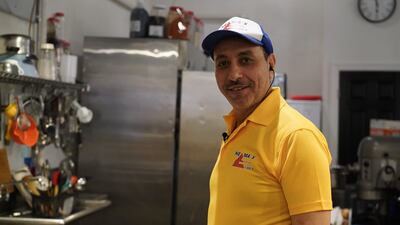
Youssef Ibrahim poses for a picture in the kitchen of his restaurant in York, Pennsylvania. Willy Lowry / The National. -
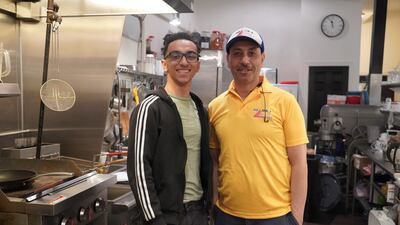
Youssef Ibrahim and his son Felo pose in the kitchen of their family restaurant in York, Pennsylvania. Willy Lowry / The National. -

Youssef Ibrahim chops a carrot in his restaurant's kitchen. Willy Lowry / The National. -
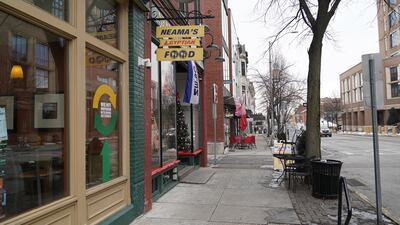
The exterior sign for Neama's Egyptian food in York, Pennsylvania. -
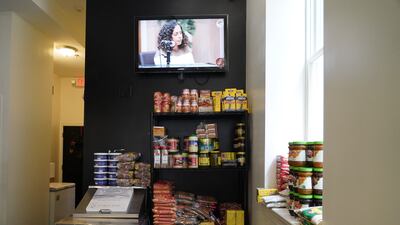
Middle Eastern ingredients line the shelves at Neama's Egyptian Food in York, Pennsylvania. Willy Lowry / The National -
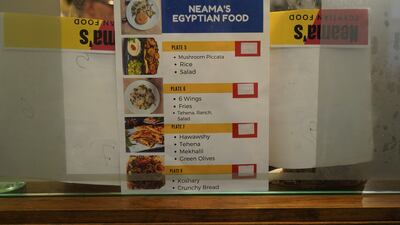
The menu at Neama's Egyptian Food in York, Pennsylvania. It include's Egyptian staples like Koshary. Willy Lowry / The National. -
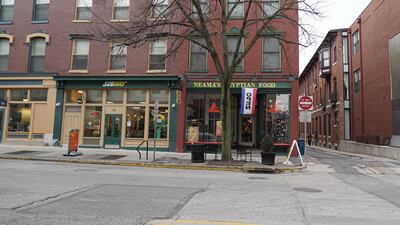
Neama's Egyptian Food is the first Egyptian Restaurant in York, Pennsylvania. Willy Lowry / The National. -
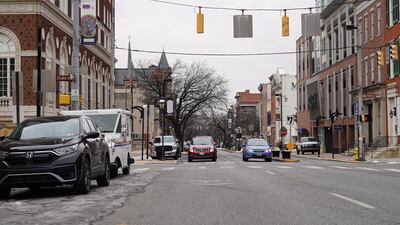
West Market Street in York, Pennsylvania. Willy Lowry / The National. -
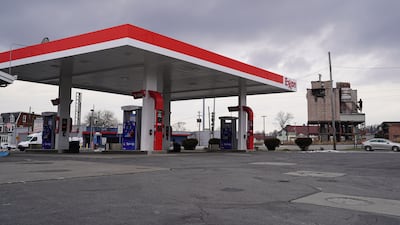
An Exxon Gas station is seen in York, Pennsylvania. Willy Lowry / The National -

Michael Rodenhaber works on a car in his garage in York, Pennsylvania. Willy Lowry / The National. -
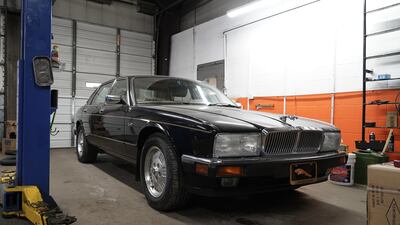
It took Michael Rodenhaber six months to repair this Jaguar because of massive supply chain delays. Willy Lowry / The National -
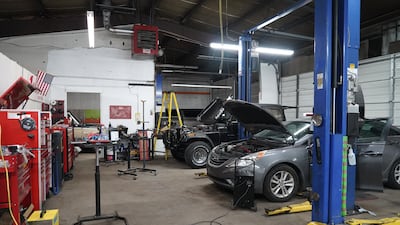
Cars waiting to be fixed in Michael Rodenhaber's garage. Willy Lowry / The National. -
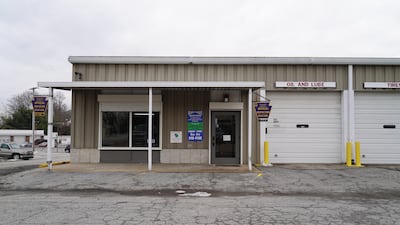
Michael Rodenhaber's garage in York, Pennsylvania. Willy Lowry / The National. -
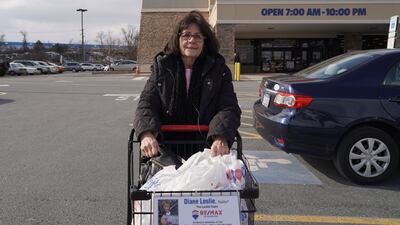
Joni Stuart shops on Tuesdays so she can get 5% senior discount at Karns Food in York County, Pennsylvania. Willy Lowry / The National -
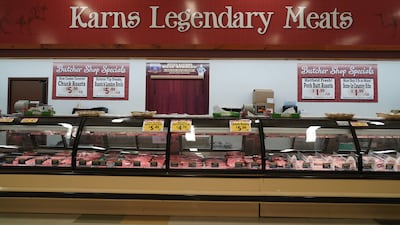
The meat section at Karns Foods in York County, Pennsylvania. Meat prices are soaring in the US. Willy Lowry / The National. -
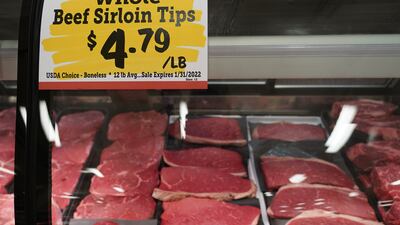
Meat prices have soared in the US. The price of beef is up 20% year on year. Willy Lowry / The National. -
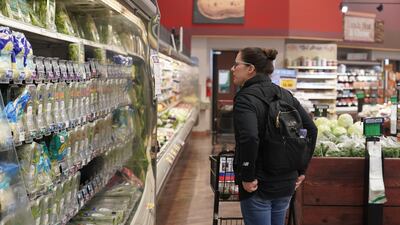
A woman shops for lettuce at Karns Foods in York, Pennsylvania. Willy Lowry / The National. -
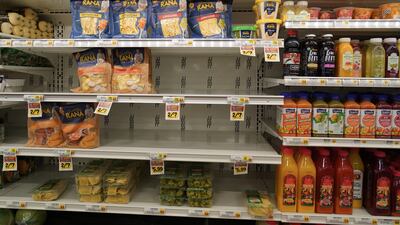
Empty shelves at Karns Foods in York County, Pennsylvania. Supply chain issues have made it more difficult for stores to keep their shelves stocked. Willy Lowry / The National. -
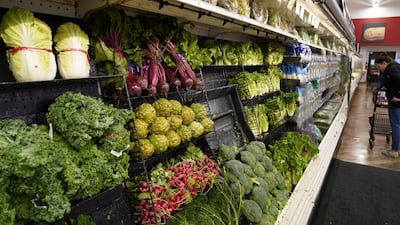
Vegetable line the shelves at Karns Foods, a family run supermarket chain in central Pennsylvania. Willy Lowry / The National. -
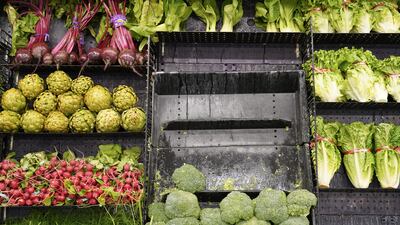
An empty vegetable shelf at Karns Foods in York County, Pennsylvania. Supermarkets across the US have struggled to keep their shelves stocked because of supply chain issues. -
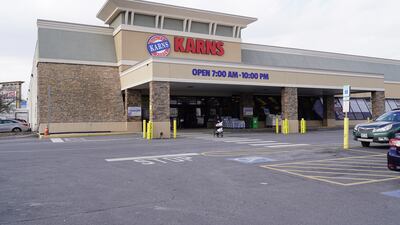
Karns Foods, a small supermarket chain in central Pennsylvania.


Brett Ryan, senior US economist at Deutsche Bank AG, said it made sense to price in some risk of a larger Fed move, but saw it as unlikely without explicit communication from the central bank.
“The hawks had to have agreed to the guidance of 50 to 75 [bps], with the understanding that if we got an upside print, 75 [bps] would be the number,” he said. “They have time to communicate if they want to put that message out there.”
The US central bank has pivoted to aggressive policy tightening to confront the highest inflation in 40 years. They raised rates by 75 bps last month — the largest increase since 1994 — despite previously signalling that they were on track for a smaller half-point move.
“You have to put 100 [bps] on the table for July,” said Andrew Hollenhorst, Citigroup chief US economist. “Everybody should be quite cautious about calling peak inflation — a few months ago the peak was supposed to be 8.3 per cent.”
Fed officials have said they want to push policy into restrictive territory, to a range of 3.25 per cent to 3.5 per cent by the end of this year, according to the median projection from the quarterly economic projections released in June. Futures markets Wednesday showed investors pricing in an even higher 3.5 per cent to 3.75 per cent range by the end of the year.
The Fed’s abrupt change to a 75 bps increase last month came on the back of a preliminary survey showing consumer expectations for future inflation were rising.
Subsequent updates to the data, which came after the Fed’s meeting, erased most of that sharp rise, but preliminary July figures, expected Friday, may provide policymakers with more ammunition to supersize this month’s increase.
Inflation expectations are particularly concerning to Mr Powell and his colleagues, who are trying to avoid a 1970s-style price spiral.
“After what happened in June, I do not rule anything out,’ said Stephen Stanley, chief economist at Amherst Pierpont Securities.
“I had been thinking that the Fed would decelerate to a 50 bps-per-meeting pace beginning in September, but if the next two monthly inflation numbers look like May’s and June’s, all bets are off.”

