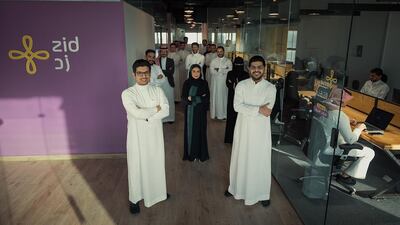
Sultan Al Asmi, co-founder and chief executive of Zid, left, with Mazen Al Darrab, right. The company aims to boost its presence in Saudi Arabia and expand into newer markets in the GCC. Zid

Generation Start-up: Saudi Arabia's Zid looks to help more businesses move online


Fareed Rahman
  • English
  • Arabic

Zid, a Riyadh-based start-up that helps businesses to set up online shops, is expanding across the GCC and Egypt after raising $2 million through an early stage funding round led by the UAE’s Global Ventures.

The company will use the capital to boost its presence in Saudi Arabia and expand into newer markets such as the UAE, Kuwait, Oman, Bahrain, Qatar and Egypt, co-founder and chief executive Sultan Al Asmi told The National.

Other investors in the round included Elm and Arzan Venture Capital.

“There is a huge potential for growth,” says Mr Al Asmi. “We can simplify starting a new business digitally and we can help traditional merchants upgrade their presence to online and offline at the same time.”

Online shopping gained momentum after governments around the world introduced movement restrictions to stop the spread of the Covid-19 pandemic. A number of retail companies in the region have invested heavily in their own online platforms to increase sales.

The Zid platform, which was unveiled in 2017, allows retailers to set up their own online shop through a few clicks. It integrates payment, warehousing and delivery systems to make it easier for companies to move online.

Mr Al Asmi says 80 businesses signed up for its services in its first year of operations. This jumped to about 700 businesses in the following year and the company now has more than 5,300 shops that trade through its platform to sell products ranging from clothes to perfumes and food products.

“In 2017, merchants did 4m Saudi riyals [$1.06m] in business and in 2018, we had 600 to 700 merchants who did 40m riyals, generated from 118,000 transactions. In 2020, we exceeded 2 billion riyals in business, with more than four million transactions.”

The company’s revenue also grew as the number of companies registered on the platform increased.

“In 2020, we achieved 1,000 per cent more revenue when compared to 2017,” he says, without giving a figure for the total revenue generated by the company during either period.

The company hired more customer-facing staff last year to boost online sales as demand grew during the pandemic.

“This team is about eight people. We go with them [customers] one to one. We go with them on webinars, create content, customise the content, do the analysis, understand what the obstacles are and try to facilitate and support.”

The company has raised $9m so far, including $2m in a 2019 round led by Riyadh-based Elm venture capital. It intends to raise additional funds to help it grow further but this “will be next year”, says Mr Al Asmi.

Start-ups in the Mena region secured record funding worth more than $1bn in 2020, according to data platform Magnitt.

The UAE, the Arab world’s second-biggest economy, had the lion’s share and was ranked first in terms of the number of deals while start-ups in Saudi Arabia, the Arab world’s biggest economy, clinched 18 per cent of the region’s deals and 15 per cent of total funding.

The kingdom is also supporting start-up companies with financial aid and other resources.

Saudi Arabia unveiled 142 stimulus initiatives worth more than 214bn riyals after the pandemic began last year. The Saudi Industrial Development Fund also provided $4.5bn in loans to mostly small and medium enterprises last year to support them amid the health crisis.

One of the challenges in the first two years of operations was finding the “right kind of talent”, says Mr Al Asmi.

“Nowadays, we have a lot of good talent in Saudi Arabia. Also, we are having customers who do not need any help and who are sophisticated enough to start and grow on their own.”

Zid currently employs 150 people. Most of them are in Riyadh but others work remotely from Egypt, the US, Vietnam and Syria.

The company offers two different e-commerce packages for businesses seeking to grow their online sales. A basic package, which costs 230 riyals a month, includes services such as registration of the domain name and handling of online payments.

A “growth” package, which costs 460 riyals a month, offers consulting services, accounting systems and improves visibility on Google Maps. On top of this, other services such as digital marketing, photography, packaging and co-working space are offered for a fee.

Mr Al Asmi owned gift and flower shops before he started Zid with his friend Mazen Al Darrab.

The company first focused on small businesses that were either working from home or had a single shop but lacked the resources or expertise to build their own websites. The platform was later expanded to house bigger businesses with more than one branch that were able to pay for additional services.

The potential for growth is “huge” in Saudi Arabia as many people shift to online shopping, says Mr Al Asmi.

However, Zid faces competition in the market from “one local company and a few regional companies”. Although only 4 per cent of total retail sales in the kingdom are made online, the medium “is fast catching up”, he says.

In a survey published last week, Saudi Arabia was identified by Mastercard as a country where e-commerce is growing rapidly, with the number of online shops that customers are buying from increasing by 33 per cent in 2020.

Q&A with Sultan Al Asmi, co-founder and chief executive of Zid

What is your vision for the company?

Being the agent of change for retail in emerging markets and offering a seamless experience and full-fledged service. All of the emerging markets in the region are in great need of such services and there is a promising future all over the world for modern retail. We aim to be the enabler and a booster for this change.

What new skills have you learnt in the process of launching your start-up?

Self-discipline, focus, teamwork and team building.

How has Covid-19 affected your business?

It has helped raise awareness of e-commerce and accelerated a transformation in the market. It has also helped innovation in the supply chain to overcome challenges.

Where do you see the company in five years?

We see Zid levelling up retail online and offline in several emerging markets. We are building FinTech, logistics and a gig platform within Zid.

What is your mantra for success?

Huge success is made by teams, not individuals.

Profile of Zid

Founders: Mazen Al Darrab and Sultan Al Asmi

Based: Riyadh, Saudi Arabia

Founded: 2017

Number of employees: 150

Sector: e-commerce

Funding: $9m from various investors including Saudi Arabia’s Elm Venture Capital, China’s MSA Capital, the UAE’s Global Ventures and Kuwait’s Agility Ventures and Arzan Venture Capital.

Countries: Currently Saudi Arabia, with future plans to expand across the GCC and Egypt

Islamophobia definition

A widely accepted definition was made by the All Party Parliamentary Group on British Muslims in 2019: “Islamophobia is rooted in racism and is a type of racism that targets expressions of Muslimness or perceived Muslimness.” It further defines it as “inciting hatred or violence against Muslims”.

The%20pillars%20of%20the%20Dubai%20Metaverse%20Strategy
%3Cp%3EEncourage%20innovation%20in%20the%20metaverse%20field%20and%20boost%20economic%20contribution%3C%2Fp%3E%0A%3Cp%3EDevelop%20outstanding%20talents%20through%20education%20and%20training%3C%2Fp%3E%0A%3Cp%3EDevelop%20applications%20and%20the%20way%20they%20are%20used%20in%20Dubai's%20government%20institutions%3C%2Fp%3E%0A%3Cp%3EAdopt%2C%20expand%20and%20promote%20secure%20platforms%20globally%3C%2Fp%3E%0A%3Cp%3EDevelop%20the%20infrastructure%20and%20regulations%3C%2Fp%3E%0A
Libya's Gold

UN Panel of Experts found regime secretly sold a fifth of the country's gold reserves. 

The panel’s 2017 report followed a trail to West Africa where large sums of cash and gold were hidden by Abdullah Al Senussi, Qaddafi’s former intelligence chief, in 2011.

Cases filled with cash that was said to amount to $560m in 100 dollar notes, that was kept by a group of Libyans in Ouagadougou, Burkina Faso.

A second stash was said to have been held in Accra, Ghana, inside boxes at the local offices of an international human rights organisation based in France.

If you go

Flight connections to Ulaanbaatar are available through a variety of hubs, including Seoul and Beijing, with airlines including Mongolian Airlines and Korean Air. While some nationalities, such as Americans, don’t need a tourist visa for Mongolia, others, including UAE citizens, can obtain a visa on arrival, while others including UK citizens, need to obtain a visa in advance. Contact the Mongolian Embassy in the UAE for more information.

Nomadic Road offers expedition-style trips to Mongolia in January and August, and other destinations during most other months. Its nine-day August 2020 Mongolia trip will cost from $5,250 per person based on two sharing, including airport transfers, two nights’ hotel accommodation in Ulaanbaatar, vehicle rental, fuel, third party vehicle liability insurance, the services of a guide and support team, accommodation, food and entrance fees; nomadicroad.com

A fully guided three-day, two-night itinerary at Three Camel Lodge costs from $2,420 per person based on two sharing, including airport transfers, accommodation, meals and excursions including the Yol Valley and Flaming Cliffs. A return internal flight from Ulaanbaatar to Dalanzadgad costs $300 per person and the flight takes 90 minutes each way; threecamellodge.com

'The Lost Daughter'

Director: Maggie Gyllenhaal

Starring: Olivia Colman, Jessie Buckley, Dakota Johnson

Rating: 4/5

UAE currency: the story behind the money in your pockets
hall of shame

SUNDERLAND 2002-03

No one has ended a Premier League season quite like Sunderland. They lost each of their final 15 games, taking no points after January. They ended up with 19 in total, sacking managers Peter Reid and Howard Wilkinson and losing 3-1 to Charlton when they scored three own goals in eight minutes.

SUNDERLAND 2005-06

Until Derby came along, Sunderland’s total of 15 points was the Premier League’s record low. They made it until May and their final home game before winning at the Stadium of Light while they lost a joint record 29 of their 38 league games.

HUDDERSFIELD 2018-19

Joined Derby as the only team to be relegated in March. No striker scored until January, while only two players got more assists than goalkeeper Jonas Lossl. The mid-season appointment Jan Siewert was to end his time as Huddersfield manager with a 5.3 per cent win rate.

ASTON VILLA 2015-16

Perhaps the most inexplicably bad season, considering they signed Idrissa Gueye and Adama Traore and still only got 17 points. Villa won their first league game, but none of the next 19. They ended an abominable campaign by taking one point from the last 39 available.

FULHAM 2018-19

Terrible in different ways. Fulham’s total of 26 points is not among the lowest ever but they contrived to get relegated after spending over £100 million (Dh457m) in the transfer market. Much of it went on defenders but they only kept two clean sheets in their first 33 games.

LA LIGA: Sporting Gijon, 13 points in 1997-98.

BUNDESLIGA: Tasmania Berlin, 10 points in 1965-66

Dengue%20fever%20symptoms
%3Cp%3EHigh%20fever%20(40%C2%B0C%2F104%C2%B0F)%3Cbr%3ESevere%20headache%3Cbr%3EPain%20behind%20the%20eyes%3Cbr%3EMuscle%20and%20joint%20pains%3Cbr%3ENausea%3Cbr%3EVomiting%3Cbr%3ESwollen%20glands%3Cbr%3ERash%26nbsp%3B%3C%2Fp%3E%0A
How to register as a donor

1) Organ donors can register on the Hayat app, run by the Ministry of Health and Prevention

2) There are about 11,000 patients in the country in need of organ transplants

3) People must be over 21. Emiratis and residents can register. 

4) The campaign uses the hashtag  #donate_hope

The Pope's itinerary

Sunday, February 3, 2019 - Rome to Abu Dhabi
1pm: departure by plane from Rome / Fiumicino to Abu Dhabi
10pm: arrival at Abu Dhabi Presidential Airport


Monday, February 4
12pm: welcome ceremony at the main entrance of the Presidential Palace
12.20pm: visit Abu Dhabi Crown Prince at Presidential Palace
5pm: private meeting with Muslim Council of Elders at Sheikh Zayed Grand Mosque
6.10pm: Inter-religious in the Founder's Memorial


Tuesday, February 5 - Abu Dhabi to Rome
9.15am: private visit to undisclosed cathedral
10.30am: public mass at Zayed Sports City – with a homily by Pope Francis
12.40pm: farewell at Abu Dhabi Presidential Airport
1pm: departure by plane to Rome
5pm: arrival at the Rome / Ciampino International Airport

Wicked: For Good

Director: Jon M Chu

Starring: Ariana Grande, Cynthia Erivo, Jonathan Bailey, Jeff Goldblum, Michelle Yeoh, Ethan Slater

Rating: 4/5

The specs

Engine: 3.0-litre six-cylinder MHEV

Power: 360bhp

Torque: 500Nm

Transmission: eight-speed automatic

Price: from Dh282,870

On sale: now

What is a robo-adviser?

Robo-advisers use an online sign-up process to gauge an investor’s risk tolerance by feeding information such as their age, income, saving goals and investment history into an algorithm, which then assigns them an investment portfolio, ranging from more conservative to higher risk ones.

These portfolios are made up of exchange traded funds (ETFs) with exposure to indices such as US and global equities, fixed-income products like bonds, though exposure to real estate, commodity ETFs or gold is also possible.

Investing in ETFs allows robo-advisers to offer fees far lower than traditional investments, such as actively managed mutual funds bought through a bank or broker. Investors can buy ETFs directly via a brokerage, but with robo-advisers they benefit from investment portfolios matched to their risk tolerance as well as being user friendly.

Many robo-advisers charge what are called wrap fees, meaning there are no additional fees such as subscription or withdrawal fees, success fees or fees for rebalancing.

UAE currency: the story behind the money in your pockets
APPLE IPAD MINI (A17 PRO)

Display: 21cm Liquid Retina Display, 2266 x 1488, 326ppi, 500 nits

Chip: Apple A17 Pro, 6-core CPU, 5-core GPU, 16-core Neural Engine

Storage: 128/256/512GB

Main camera: 12MP wide, f/1.8, digital zoom up to 5x, Smart HDR 4

Front camera: 12MP ultra-wide, f/2.4, Smart HDR 4, full-HD @ 25/30/60fps

Biometrics: Touch ID, Face ID

Colours: Blue, purple, space grey, starlight

In the box: iPad mini, USB-C cable, 20W USB-C power adapter

Price: From Dh2,099

Lexus LX700h specs

Engine: 3.4-litre twin-turbo V6 plus supplementary electric motor

Power: 464hp at 5,200rpm

Torque: 790Nm from 2,000-3,600rpm

Transmission: 10-speed auto

Fuel consumption: 11.7L/100km

On sale: Now

Price: From Dh590,000

The specs
  • Engine: 3.9-litre twin-turbo V8
  • Power: 640hp
  • Torque: 760nm
  • On sale: 2026
  • Price: Not announced yet
Real estate tokenisation project

Dubai launched the pilot phase of its real estate tokenisation project last month.

The initiative focuses on converting real estate assets into digital tokens recorded on blockchain technology and helps in streamlining the process of buying, selling and investing, the Dubai Land Department said.

Dubai’s real estate tokenisation market is projected to reach Dh60 billion ($16.33 billion) by 2033, representing 7 per cent of the emirate’s total property transactions, according to the DLD.
