

Power cuts across the southern US, which were caused by a rare winter storm, left millions stranded and officials in Texas red-faced and eager to point fingers.
The renewable industry, which accounts for about a quarter of the state’s energy mix, has largely been blamed, with pro-oil lobbyists and Republican officials circulating images of frozen turbines being “thawed” by helicopters. The images were later found to be from many years ago and depicted installations in northern Europe.
Texas derives much less power from renewables in winter, with wind sources generating 6 gigawatts of power, or 7 per cent of capacity, during the cold months.
Wind turbines accounted for 13 per cent of lost electric output after the deep freeze, according to the Electric Reliability Council of Texas, or Ercot, which operates the state’s grid.
Gas primarily meets winter power requirements and, together with coal and nuclear, accounts for 80 per cent of the overall mix.
With misinformation being circulated online, the renewables industry has come under unfair criticism about its viability in challenging environments.
In several parts of the world, renewable energy thrives in harsher climates. Solar power is used to generate electricity in Antarctica, the coldest region on earth, where temperatures can fall as low as minus 89.6°C. The continent has some of the harshest winds on the planet, with speeds exceeding 100 kilometres per hour for days at a time.
Power from the sun is also used to propel rocket ships, through the use of solar arrays, in the icy temperatures of space. Probes sent to Mars, where temperatures can fall as low as minus 63°C, also use solar energy and operate in a very arid and dust-filled environment.
On Earth, companies such as Germany’s Aleo Solar have set up solar panels at Antarctica’s Casey Station, where Australia manages power output with the help of Abu Dhabi’s Masdar.
“Wherever there is sunshine, you can enjoy the power from the sun,” said William Chen, chief executive at Aleo Solar.
The company manufactures solar panels that can withstand temperatures as low as minus 40°C and as high as 85°C. The panels can also withstand three times the industry standard for pressure. Aleo’s panels can resist up to 8,000 pascals, the standard measure for pressure, allowing them to work under extreme conditions created by events as typhoons.
Jeremy Crane of Dubai-based Yellow Door Energy, which provides solar panels across the UAE and Jordan, observed that as renewable energy sources become more widespread, they are being developed to suit different climates.
“There are solar panels and wind turbines from the Arctic to the equator, so there are no technical limitations,” said Mr Crane.
“Turbines installed in cold climates are equipped with de-icing equipment. For warm climates, where ice is a once-in-a-100-years event, the developer might not install such equipment,” he said.
The weather in Texas over the past week was unusual for the state, which enjoys a climate with highs of 34°C in August and lows of 7°C in January.
-
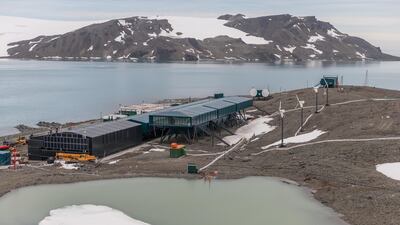
The North Lake supplies water to Comandante Ferraz Station, with a view of the solar power wall, wind power plant and internet module in King George Island, Antarctica. Getty Images -
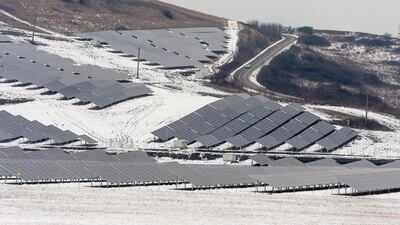
The solar park of Heliosys Hungary Group is seen near Matraverebely, Hungary. EPA -
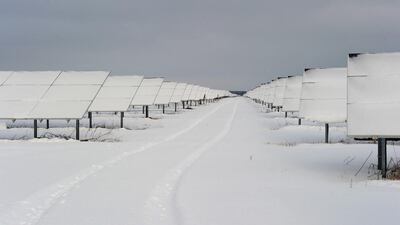
Snow covers solar panels at a solar park in Meuro, northeastern Germany. AFP -

A solar panel is seen in the snow at Summit Station in Greenland. Getty Images -
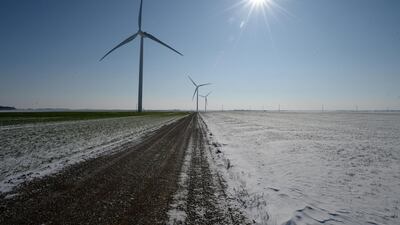
Wind turbines after overnight snowfall, near Illiers-Combray, central France. AFP -
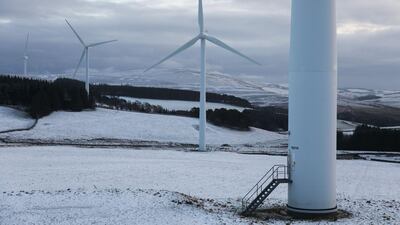
Wind turbines harness the natural green energy in the Scottish Borders in Galashiels, Scotland. Getty Images


The cold spell, which hit the southern US and the Midwest last week, plunged temperatures to as low as minus 18°C, the same as in Anchorage, Alaska, in the north.
Daniel Zywietz, chief executive at Enerwhere in the UAE, drew parallels between the Texas weather and the pandemic – both 100-year events that the industry was not prepared for.
“What is the cost of preventing a 100-year event?” he asked.
He said companies may have a 50-year plan in place but rarely does anyone in the industry plan for a century in advance.
A better solution to such crises would be to have adequate back-up capacity, allowing for electric loads to become more flexible, said Mr Zywietz.
Large industries could be given incentives by utilities to stop production for a few days and alleviate pressure on demand amid such a crisis.
In the Middle East, countries are looking at transcontinental power grids to manage possible future power cuts.
Saudi Arabia, through the GCC Interconnection Authority, has looked to tap Ethiopia’s hydroelectric power as way to reduce its reliance on fossil fuels.

Oman has considered offsetting possible gas shortages by planning for an underwater pipeline from Iran.
The projects are ambitious and expensive, taking years to build and requiring political will.
Mr Zywietz, who called the Texas power cuts a “wake up call” for the industry as a whole, said future crises around the world can be mitigated through smart demand-management strategies.
“Building an incentive scheme for industrial customers to say yes, 'I’ll take some money for delaying my production by a few days', is actually super cheap,” he said.
For now, the backlash against renewables could derail the momentum clean energy has gained in the US, one of the sweet spots for global investors in the sector.
Clean energy capacity accounted for 71 per cent of installations, or the equivalent of 14.7 gigawatts, last year.
The sector accounts for 18.2 per cent of total generation capacity in the US energy mix.
Texas is the largest contributor to the US power grid and accounted for 11 per cent of installations in the country, according to GlobalData.

Any changes to the energy mix in the state are expected to have wider ramifications for the US power industry.
“Texas is one of the hotter states in the US and the electricity generators are mainly prepared for the heat,” said Mohit Prasad, project manager for power at GlobalData.
To avoid high costs, generators in the state usually avoid winterproofing equipment, which refers to processes employed to ensure that they operate during extended periods of temperatures below zero.
Solar installations in Texas are expected to grow at a compounded annual rate of 17.3 per cent by 2030. Solar capacity is set to rise to 38 gigawatts, with wind growing at 5.3 per cent to reach 54 gigawatts by the end of the decade.
The clean energy momentum will focus more attention on weatherproofing the sector.
“With the Biden administration setting a goal of eliminating pollution from fossil fuel in the power sector by 2035 and becoming carbon neutral by 2050, a push in renewable energy sector can be witnessed,” said Mr Prasad.

