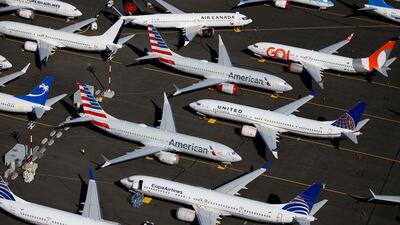
Parked planes amid the Covid-19 pandemic. Although there are signs of recovery and stability in oil markets as the travel industry goes slowly back to work, there are still several downsides to bear in mind. Reuters
Parked planes amid the Covid-19 pandemic. Although there are signs of recovery and stability in oil markets as the travel industry goes slowly back to work, there are still several downsides to bear i
In the first quarter of this year, business and leisure travel took a profound hit as a consequence of the coronavirus pandemic – a hit which knocked heavily on oil prices.
However, while there are still forceful headwinds for the travel and oil sectors, there are also signs of recovery.
The recovery stems from two main factors; supply cuts by Opec+ - an alliance headed by Saudi Arabia and Russia - and the gradual reopening of economies which have passed through the worst of the infection and are lifting coronavirus travel restrictions.
Although there are signs of recovery and stability in oil markets as the travel industry goes slowly back to work, there are still several downsides to bear in mind.
On the supply side, a timely move by Opec+ towards supply cuts has paid off in terms of a more stable oil market and prices in a range from $35 to $40.
At this stage the ability to make reasonable projections and rely on market factors like inventory levels, the level of the US dollar and other benchmarks are now returning to normal. This is in sharp contrast to earlier this year when oil prices entered negative territory and investors did not know which way to turn.
Opec’s cuts certainly helped to stabilise the market but also had the effect of building inventories to high levels, meaning a glut is still a risk and the oil markets are exposed to shocks.
The lockdowns worked to stem the coronavirus tide. The European Commission recently recommended that EU countries open their borders for travellers. The classic tourist destinations like Greece and Italy have already started accepting travellers, and within China, domestic tourism has soared.
While this is a welcome development for oil markets, airlines and other tourist businesses, there is still a threat of spikes in the number of new coronavirus infections. The stop-and-go approach continues to weigh on the recovery outlook, especially after China suspended many flights in and out of Beijing after a spike in new cases on June 17.
Having said that, China’s demand for oil has still revived strongly amid an increase in domestic tourism and consumer preference for private cars over public transportation because of the risk of contracting coronavirus.
Although the circumstances are wearing on business sentiment, they have pushed oil giants like BP towards efficiencies, positioning them for a recovery albeit with leaner operations down the road. Earlier this month, BP announced 10,000 job cuts and a shift towards a balance between fossil fuel energy and green energy.
The drive towards diversification triggered by the coronavirus pandemic deepens an already growing trend of oil companies adopting alternative energies. This may have a long-term dampening effect on crude prices but opens new prospects for alternative energy. Rystad Energy said it expects alternative energy and fossil fuel energy markets to reach parity in the medium-term, possibly as soon as 2021 or 2022.
On a wider scale, economic diversification is also the secret ingredient in the recipe for a strong recovery. The UAE is one such diversified bloc, a fact that Moody’s Ratings Agency sees as positive.
Although there are signs of recovery and stability in oil markets as the travel industry goes slowly back to work, there are still several downsides to bear in mind. Recessions threaten spending in Europe and the US, flights between China and the US are limited to four per day and Australia is unlikely to open its borders for travel until next year, according to the country's tourism minister Simon Birmingham.
On top of that, there is the risk of a second wave of infections leading to a return of lockdowns in key economies, pushing the fragile recoveries further into the future.
Based on the current circumstances, a full recovery in the travel market is unlikely to happen this year, meaning demand for jet fuel may stay subdued during the second half.
While closed borders inhibit the travel industry, consumers have started using their private cars to travel domestically. As car use rises rapidly, oil prices may see some more support in the near term as congestion levels rise in France, the UK, Sweden and other countries. However, the main obstacles to a rise in oil prices remain: the coronavirus pandemic, travel restrictions and the threat of a second wave of infections.
Hussein Sayed is the chief market strategist at FXTM

Goalkeepers: Francis Uzoho, Ikechukwu Ezenwa, Daniel Akpeyi Defenders: Olaoluwa Aina, Abdullahi Shehu, Chidozie Awaziem, William Ekong, Leon Balogun, Kenneth Omeruo, Jamilu Collins, Semi Ajayi Midfielders: John Obi Mikel, Wilfred Ndidi, Oghenekaro Etebo, John Ogu Forwards: Ahmed Musa, Victor Osimhen, Moses Simon, Henry Onyekuru, Odion Ighalo, Alexander Iwobi, Samuel Kalu, Paul Onuachu, Kelechi Iheanacho, Samuel Chukwueze
On Standby: Theophilus Afelokhai, Bryan Idowu, Ikouwem Utin, Mikel Agu, Junior Ajayi, Valentine Ozornwafor
UAE currency: the story behind the money in your pockets
Houthis: Iran-backed rebels who occupy Sanaa and run unrecognised government
Yemeni government: Exiled government in Aden led by eight-member Presidential Leadership Council
Southern Transitional Council: Faction in Yemeni government that seeks autonomy for the south
Habrish 'rebels': Tribal-backed forces feuding with STC over control of oil in government territory
THREE POSSIBLE REPLACEMENTS
Khalfan Mubarak
The Al Jazira playmaker has for some time been tipped for stardom within UAE football, with Quique Sanchez Flores, his former manager at Al Ahli, once labelling him a “genius”. He was only 17. Now 23, Mubarak has developed into a crafty supplier of chances, evidenced by his seven assists in six league matches this season. Still to display his class at international level, though.
Rayan Yaslam
The Al Ain attacking midfielder has become a regular starter for his club in the past 15 months. Yaslam, 23, is a tidy and intelligent player, technically proficient with an eye for opening up defences. Developed while alongside Abdulrahman in the Al Ain first-team and has progressed well since manager Zoran Mamic’s arrival. However, made his UAE debut only last December.
Ismail Matar
The Al Wahda forward is revered by teammates and a key contributor to the squad. At 35, his best days are behind him, but Matar is incredibly experienced and an example to his colleagues. His ability to cope with tournament football is a concern, though, despite Matar beginning the season well. Not a like-for-like replacement, although the system could be adjusted to suit.
TWISTERS
Director: Lee Isaac Chung
Starring: Glen Powell, Daisy Edgar-Jones, Anthony Ramos
Bournemouth 0-4 Liverpool
Arsenal 1-0 Huddersfield Town
Burnley 1-0 Brighton
Manchester United 4-1 Fulham
West Ham 3-2 Crystal Palace
Saturday fixtures:
Chelsea v Manchester City, 9.30pm (UAE)
Leicester City v Tottenham Hotspur, 11.45pm (UAE)
Cricket World Cup League 2
UAE results Lost to Oman by eight runs Beat Namibia by three wickets Lost to Oman by 12 runs Beat Namibia by 43 runs
UAE fixtures Free admission. All fixtures broadcast live on icc.tv
Tuesday March 15, v PNG at Sharjah Cricket Stadium Friday March 18, v Nepal at Dubai International Stadium Saturday March 19, v PNG at Dubai International Stadium Monday March 21, v Nepal at Dubai International Stadium
Du Football Champions
The fourth season of du Football Champions was launched at Gitex on Wednesday alongside the Middle East’s first sports-tech scouting platform.“du Talents”, which enables aspiring footballers to upload their profiles and highlights reels and communicate directly with coaches, is designed to extend the reach of the programme, which has already attracted more than 21,500 players in its first three years.
Formula Middle East Calendar (Formula Regional and Formula 4)
Round 1: January 17-19, Yas Marina Circuit – Abu Dhabi
Round 2: January 22-23, Yas Marina Circuit – Abu Dhabi
Round 3: February 7-9, Dubai Autodrome – Dubai
Round 4: February 14-16, Yas Marina Circuit – Abu Dhabi
Round 5: February 25-27, Jeddah Corniche Circuit – Saudi Arabia
The specs
Engine: 3.9-litre twin-turbo V8 Power: 620hp from 5,750-7,500rpm Torque: 760Nm from 3,000-5,750rpm Transmission: Eight-speed dual-clutch auto On sale: Now Price: From Dh1.05 million ($286,000)
The biog
Family: Parents and four sisters
Education: Bachelor’s degree in business management and marketing at American University of Sharjah
A self-confessed foodie, she enjoys trying out new cuisines, her current favourite is the poke superfood bowls
Likes reading: autobiographies and fiction
Favourite holiday destination: Italy
Posts information about challenges, events, runs in other emirates on the group's Instagram account @Anagowrunning
Has created a database of Emirati and GCC sportspeople on Instagram @abeermk, highlight: Athletes
Apart from training, also talks to women about nutrition, healthy lifestyle, diabetes, cholesterol, blood pressure
