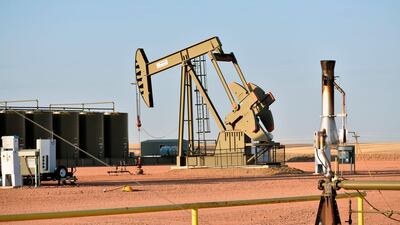
A pumpjack is seen extracting crude oil from a well on the Fort Berthold Indian Reservation. AP Photo

Oil rises on continued economic recovery and European travel outlook


Jennifer Gnana
  • English
  • Arabic

Oil prices gained on Monday, beginning the week on a positive note as continued bounce back in major economies and improved prospects of cross-border travel in Europe outweighed headwinds from a potential revival of the Iran nuclear deal.

Brent, the international benchmark, was up 0.66 per cent at $66.88 per barrel at 10.12am UAE time. West Texas Intermediate, which tracks US crude grades, was up 0.68 per cent at $64.01 per barrel.

The benchmarks rose after declines last week amid expectations of a revival of the nuclear pact between the US and Iran and potential supplies it could add to the global market.

"Brent crude is now near the middle of a wider $64.60 to $70 barrel range after last week's price actions" and Brent could "gradually edge higher" this week, said Jeffrey Halley, senior market analyst for Asia Pacific at Oanda.

Prices are supported by improving prospects of cross-border travel in European countries. A robust vaccination drive has brought infection rates under control and allowed for the reopening of public venues at some European destinations.

The rise in travel and tourism demand in Europe is in stark contrast to the plight of developing economies such as India, where cases have topped 26 million amid a devastating second wave of Covid-19.

India, Asia's third-largest economy, continues to record high daily death rates. On Sunday, the nation of 1.37 billion registered 4,455 deaths as the daily infections count reached 222,835.

On the supply side, a possible return of Iranian barrels to the market could upset the dynamics of Opec+, the supergroup of oil producers led by Saudi Arabia and Russia, which also includes Tehran.

Opec+ plans to incrementally add 2 million barrels per day by July despite a surge in Covid-19 infections in several markets, particularly India, which is the third largest oil consumer globally.

The next meeting to discuss the current supply dynamic is scheduled for the end of this month.

"Iran produced 2.4 million bpd in April and could ramp up its output to the pre-sanctions level of 3.8 million bpd," said Monica Malik, chief economist at Abu Dhabi Commercial Bank.

"It could take at least 3-4 months from the date of lifting sanctions for Iran to reach its pre-sanctions output level," she added.


SPECS
%3Cp%3E%3Cstrong%3EEngine%3A%3C%2Fstrong%3E%201.5-litre%204-cylinder%3Cbr%3E%3Cstrong%3EPower%3A%3C%2Fstrong%3E%20101hp%3Cbr%3E%3Cstrong%3ETorque%3A%3C%2Fstrong%3E%20135Nm%3Cbr%3E%3Cstrong%3ETransmission%3C%2Fstrong%3E%3A%20Six-speed%20auto%3Cbr%3E%3Cstrong%3EPrice%3A%3C%2Fstrong%3E%20From%20Dh79%2C900%3Cbr%3E%3Cstrong%3EOn%20sale%3A%3C%2Fstrong%3E%20Now%3C%2Fp%3E%0A
Company Fact Box

Company name/date started: Abwaab Technologies / September 2019

Founders: Hamdi Tabbaa, co-founder and CEO. Hussein Alsarabi, co-founder and CTO

Based: Amman, Jordan

Sector: Education Technology

Size (employees/revenue): Total team size: 65. Full-time employees: 25. Revenue undisclosed

Stage: early-stage startup 

Investors: Adam Tech Ventures, Endure Capital, Equitrust, the World Bank-backed Innovative Startups SMEs Fund, a London investment fund, a number of former and current executives from Uber and Netflix, among others.

RESULT

Argentina 0 Croatia 3
Croatia: 
Rebic (53'), Modric (80'), Rakitic (90' 1)

Ten tax points to be aware of in 2026

1. Domestic VAT refund amendments: request your refund within five years

If a business does not apply for the refund on time, they lose their credit.

2. E-invoicing in the UAE

Businesses should continue preparing for the implementation of e-invoicing in the UAE, with 2026 a preparation and transition period ahead of phased mandatory adoption. 

3. More tax audits

Tax authorities are increasingly using data already available across multiple filings to identify audit risks. 

4. More beneficial VAT and excise tax penalty regime

Tax disputes are expected to become more frequent and more structured, with clearer administrative objection and appeal processes. The UAE has adopted a new penalty regime for VAT and excise disputes, which now mirrors the penalty regime for corporate tax.

5. Greater emphasis on statutory audit

There is a greater need for the accuracy of financial statements. The International Financial Reporting Standards standards need to be strictly adhered to and, as a result, the quality of the audits will need to increase.

6. Further transfer pricing enforcement

Transfer pricing enforcement, which refers to the practice of establishing prices for internal transactions between related entities, is expected to broaden in scope. The UAE will shortly open the possibility to negotiate advance pricing agreements, or essentially rulings for transfer pricing purposes. 

7. Limited time periods for audits

Recent amendments also introduce a default five-year limitation period for tax audits and assessments, subject to specific statutory exceptions. While the standard audit and assessment period is five years, this may be extended to up to 15 years in cases involving fraud or tax evasion. 

8. Pillar 2 implementation 

Many multinational groups will begin to feel the practical effect of the Domestic Minimum Top-Up Tax (DMTT), the UAE's implementation of the OECD’s global minimum tax under Pillar 2. While the rules apply for financial years starting on or after January 1, 2025, it is 2026 that marks the transition to an operational phase.

9. Reduced compliance obligations for imported goods and services

Businesses that apply the reverse-charge mechanism for VAT purposes in the UAE may benefit from reduced compliance obligations. 

10. Substance and CbC reporting focus

Tax authorities are expected to continue strengthening the enforcement of economic substance and Country-by-Country (CbC) reporting frameworks. In the UAE, these regimes are increasingly being used as risk-assessment tools, providing tax authorities with a comprehensive view of multinational groups’ global footprints and enabling them to assess whether profits are aligned with real economic activity. 

Contributed by Thomas Vanhee and Hend Rashwan, Aurifer