

If a house divided against itself cannot stand, what are the chances for a house triply divided? On November 8, explosive drones slammed into the Khor Mor gasfield in the Kurdistan Region of Iraq, turning out the lights across the semi-autonomous territory. The Kurdish governing parties are at loggerheads; their debate with Baghdad continues, and the federal government is conflicted about bringing the perpetrators to justice.
The strike is far from the first on Khor Mor, which is run by the Pearl Petroleum consortium that includes Sharjah-based Crescent and Dana Gas. Dana Gas said on Saturday that “great damage has hit the Khor Mor gas facility, and at present no quantity of gas can be produced”.
The field is the main producer in Kurdistan and was expanded to 750 million cubic feet per day of gas capacity last October. Without it, Kurdistan has very limited alternative production, and its power plants quickly go dark. Electricity generation plunged to 1,000 megawatts from 3,700MW before the attack.
A domestic dispute
The attack was not directly a result of the US-Iran war, despite early claims that the drones came from Iran. If Iran wanted to target US interests, it would probably have attacked the Sarsang oilfield, run by American company HKN, led by Ross Perot Junior, son of Ross Perot, who ran as an independent candidate in the 1992 presidential election.
Indeed, Sarsang was damaged in March and April, early in the war. Cutting off oil is more to Tehran’s advantage right now in keeping pressure on global markets and the US administration.
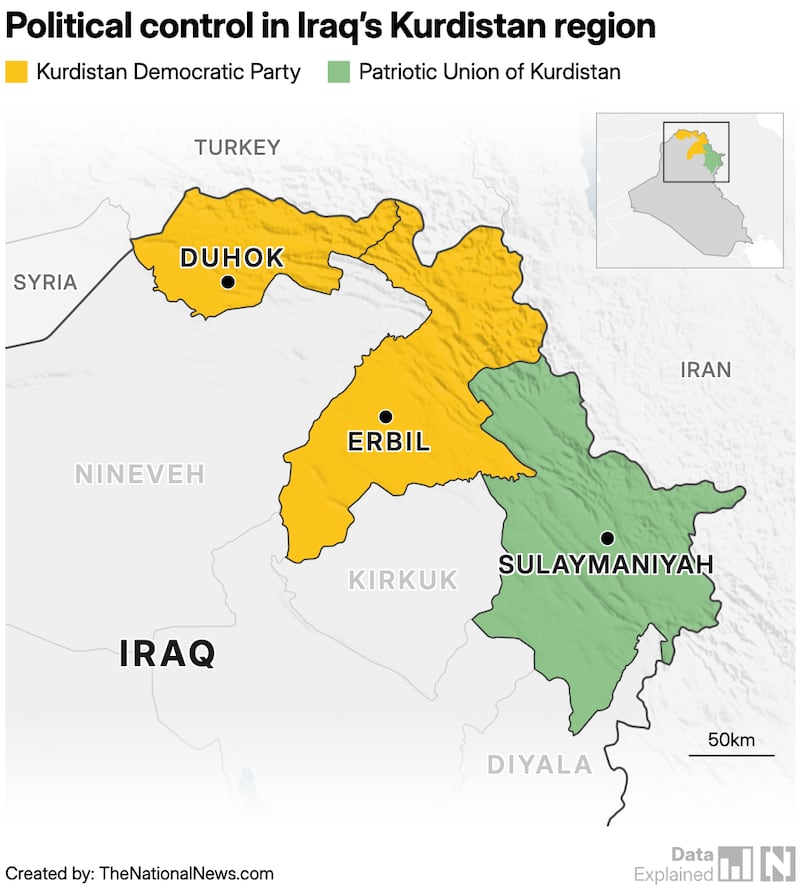
The Khor Mor attack stems instead from domestic politics. The Patriotic Union of Kurdistan (PUK), which controls the southern part of the region from Sulaymaniyah, has withdrawn from the regional government. It is threatening to set up its own separate administration, reversing the unification reached under American auspices in 2006. Its leader, Bafel Talabani, son of former Iraqi president Jalal Talabani, denied that he was “in Tehran’s pocket” and called this an “old perception”.
His party, which has steadily lost ground to the Kurdistan Democratic Party (KDP), based in Erbil, fears exclusion from its share of the oil industry. Mr Talabani said in October 2024 that “I will never hand over gas to them”. The US is not going to step in to resolve the squabble this time, special envoy Tom Barrack saying, “This is an Iraqi issue; this is not an American decision.”
Three sides, no solution
The Kurdistan–federal struggle has not gone away either, despite the deal finally reached in March to resume exporting the region’s oil through the pipeline to Turkey, this time under Baghdad’s authority. There are complaints of unauthorised exports from Kurdistan through Iran, and of the region not producing the amounts required.
The blockade of the Strait of Hormuz has made the Kurdistan region’s pipeline to Turkey even more important. It now moves about 500,000 barrels per day, including 200,000 bpd trucked from southern Iraq. The importance of the Kurdish line could diminish if Baghdad fulfills its plans to reconstruct the direct route from Kirkuk.
Pro-Iranian forces in federal Iraq are certainly behind the drones – and, before that, rockets – launched at Khor Mor. They have also been implicated in attacks on oil infrastructure in Saudi Arabia; these are more clearly linked to the US-Iran war and the conflict of Riyadh with Tehran’s allies in Yemen. The US withdrew its air defences from Kurdistan in September, and the regional government complains that Baghdad has not authorised promised anti-drone systems.
Iraqi Prime Minister Ali Al Zaidi, who took office in May, is locked in his own struggle with some of the militias, moving lately against lucrative oil smuggling activities run from the town of Jurf Al Sakhar, a base for Kataib Hezbollah. It is widely suspected the central government knows very well the culprits for the attacks on Kurdish oilfields, but cannot arrest them, or only detains some lackeys.
The Kurdistan region has no immediate solutions to the loss of its main gasfield. Pearl is developing the large Chemchemal field, with hopes of some output next year. In August, it began sending some Khor Mor gas to the federally governed Taza power plant in Kirkuk province, but the Kurdistan Regional Government complained this was in breach of its contract and not in accordance with the region’s priorities.
HKN was awarded Miran, another big field, last May. But its sour gas, with a high concentration of toxic, corrosive hydrogen sulphide, will take years to develop. It has already suffered years of commercial deadlock since discovery in 2009. These and other sizeable resources are all in the PUK-controlled zone. This contrasts with oil, concentrated in the KDP zone, with nature’s usual whims to foster trouble.
In the absence of major progress on new developments in Kurdistan, Baghdad has taken the chance to lure away investment. After a historic policy of blacklisting companies that worked in the region, it has welcomed first Crescent and, more recently, HKN into oil and gas projects. Two of the other leading operators in Kurdistan, Shamaran of Canada and the UK’s Gulf Keystone, are in the process of merging and entering HKN’s Hamrin field.
The Kurdistan region could greatly improve its strategic position by seizing opportunities. It holds almost the only big gas fields in Iraq that are not associated with oil, and so can be developed flexibly. If it had even one more major gas supplier, it would not be so exposed to the violent blackmail of Khor Mor.
Beyond gas dependence
Its Runaki initiative has been a worthy effort to ensure people pay their bills and rely on centralised electricity and not on the costly and dirty diesel generators that blight the streets of the rest of Iraq.
If it rehabilitated its hydroelectric plants, and advanced large-scale solar power, it would further ease reliance on gas. It could develop a larger power surplus and send gas or electricity to the rest of Iraq.
That would be a bargaining chip in further debates over oil. It would also give Baghdad more reason to safeguard Kurdish energy sites if another drone caused blackouts in Kirkuk or even Baghdad.
A gas link to Turkey has long been in the works, and the Turks have extended their grid up to the border. A bidirectional connection would further boost Kurdish energy resilience to sabotage.
Independent gas exports to Turkey, long a dream, now look checkmated by the oil pipeline negotiations. But the Kurdistan region, if still divided, could at least make itself part of a trilateral trade.

