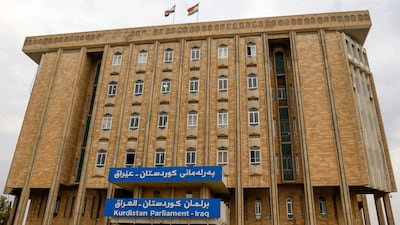

A powerful Kurdish party in Iraq announced it is to withdraw from the northern Kurdistan Regional Government (KRG), deepening a political crisis with its longtime rival and raising fears of a return to parallel administrations in the region.
The move came after the Kurdistan parliament convened for the first time in nearly two years and elected a Speaker despite a boycott by the Patriotic Union of Kurdistan (PUK) and allied parties, which had demanded further negotiations over the distribution of senior government positions.
Announcing the decision in a video statement, PUK leader Bafel Talabani said his party had decided to "withdraw from this failed government", accusing elements within the Kurdistan Democratic Party (KDP), the ruling party in Iraqi Kurdistan, of disregarding democratic principles and ignoring the will of voters.
"A minority within the KDP proved today that they do not know what democracy is, that they hold zero respect for you, the voters," said Mr Talabani. The PUK would not recognise the parliamentary session "or anything that emerges from this", he added.
He warned that any unilateral steps by the KDP to establish a new regional leadership would be met with reciprocal action by the PUK in its stronghold of Sulaimaniyah.
"If they appoint a president of the region, we will appoint a president of the region. If they appoint a prime minister, we will appoint a prime minister," Mr Talabani said. "Whatever you do over there, we will do right here."

The announcement comes a day after the KRG parliament session boycotted by the PUK and allied parties that had pushed for the KDP to postpone it until an agreement can be reached on the appointment of top cabinet positions.
The vote proceeded with 52 of the 100 politicians present, meeting the 51-member quorum requirement. Vala Farid, head of the KDP parliamentary bloc, was elected as Speaker.
A senior KRG official accused the PUK and its leader, Mr Talabani, of undermining democratic institutions and lacking the electoral mandate to advocate separating Sulaimaniyah from the autonomous region.
The official told The National that the PUK won only 11 percent of votes in Sulaimaniyah and Halabja and 23 percent across the Kurdistan Region, questioning "on what democratic or political basis" Mr Talabani could call for such a move.
Rejecting the use of armed influence in politics, the official said no party should gain additional power through military strength, describing efforts to secure political concessions through "threats, pressure, or militias" as political blackmail.
"The Kurdistan Region is not the property of any individual or political party, and no one has the right to decide its future unilaterally," the official told The National.
He called on the international community to support the democratic process, respect election results and ensure that the next Kurdish government is formed through the will of voters rather than coercion or political pressure.
The dispute threatens to unravel a power-sharing arrangement that has underpinned Kurdish self-rule since the rival factions formally reunited their administrations in 2006 after years of conflict.
The collapse of power-sharing talks is not simply the result of a recent disagreement, but the culmination of years of deep mistrust between the two dominant Kurdish parties, said Victoria Taylor, a former US deputy assistant secretary for Iraq and director of the Atlantic Council’s Iraq Initiative.
"I had numerous discussions with KDP and PUK leadership while I was still at the State Department and then with the Atlantic Council. At various points, the two sides appeared close to reaching a compromise. Put simply, they just don't trust each other," she said.
US President Donald Trump's administration took a different approach, Ms Taylor said. Washington became less interested in acting as an intermediary between Kurdish factions, leaving the parties to resolve their disputes alone.
Shayan Talabany, an analyst at the Tony Blair Institute, told The National, that the KRG is navigating uncertainty after the US troop withdrawal, conflict across the region, a more assertive Baghdad, and evolving political dynamics in Turkey, Syria and Iran, all of which affect Kurdish interests.
Warning against any return to separate administrations within the Kurdistan Region, Ms Talabany said such a step would "symbolically reverse decades of formal Kurdish unity in Iraq" and could undermine the foundations of the KRG itself.
Dividing the region into separate governing entities could encourage further fragmentation in the future, although "Erbil will remain the centre of any legitimate Kurdish governing body for now," she said.
The announcement comes at the time when Iraqi Prime Minister Ali Al Zaidi met Mr Trump's special envoy for Iraq, Tom Barrack, in Baghdad, on Friday. During the meeting, Mr Barrack said Washington "is proud to stand with Iraq by deepening economic and trade relations, opening doors for both American companies and Iraqi talent, and building prosperity that benefits everyone".
Iraq was choosing "sovereignty over dependency, investment over stagnation, and partnership over proxy", while pledging closer economic and commercial co-operation between the countries.

