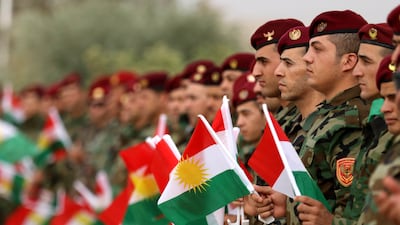

The Kurdistan region of Iraq announced on Monday the “historic” unification of Peshmerga forces under the command of the Ministry of Peshmerga Affairs, ending decades of division between forces affiliated with the two rival Kurdish ruling parties.
The Peshmerga, which means “those who face death”, are Kurdish fighters in northern Iraq. For decades, they have been the national armed force of the Kurdish people and engaged in wars with the military forces of central governments in Baghdad.
After the 2003 US-led invasion that toppled Saddam Hussein, they have been recognised as part of the national Iraqi security forces. Despite the formation of a Ministry of Peshmerga, loyalties have been divided between the region’s two main rivals: the Kurdistan Democratic Party (KDP) and the Patriotic Union of Kurdistan (PUK).
Each had maintained separate command chains, logistics and political loyalties. Previous unification efforts stalled repeatedly despite pressure from the Kurdish public. The unification has been one of the key US demands for military reform.
Nechirvan Barzani, President of Iraqi Kurdistan who also serves as commander-in-chief of the Peshmerga, and Prime Minister Masrour Barzani attended a formal ceremony in Erbil alongside senior Peshmerga commanders, US-led international coalition advisers and representatives from the Iraqi federal government.
“With this important step, no force will remain outside the framework of the Peshmerga ministry,” the President said in a speech.

He stressed that the reforms are designed to create a professional, national institution. “We said that the Peshmerga must be a national force far from party influence. Today, we have realised that objective,” he said. “It must be clear that this military institution will not become a zone for political wrangling.”

Paying tribute to fallen Kurdish fighters, he said: “During the most difficult times, the Peshmerga stood together, gave sacrifices and fought for one nation and one people.”
Masrour Barzani called Monday “a historic day for Kurdistan and for the Peshmerga, and is a special day for me, as I have worked for this from my first day [as Prime Minister]".
“The unification of the Kurdistan Region's Peshmerga has long been a demand of ours and of every patriotic Kurdistani,” he added. “Fortunately, we have succeeded today, and all forces have been put under the umbrella of the Peshmerga ministry.
“This unification is the first step of a long and important process, because as important as this unification is, it will serve an even greater role for future steps.”
US conditions for support
The unification is not only symbolic for Kurdish politics but a strategic requirement by Washington. For nearly a decade, the US, which has provided hundreds of millions of dollars in stipends, weapons, training and air support to the Peshmerga through the Ministry of Peshmerga Affairs, has made full unification a key condition for the continuation of direct military assistance.
US officials and coalition advisers have repeatedly warned that divided command structures undermined operational effectiveness against ISIS and raised concerns about accountability and party control of forces.
Nechirvan Barzani acknowledged that pressure, thanking the “United States and partner countries for supporting the Kurdistan Region and Iraq in the fight against ISIS and for supporting Peshmerga unification efforts”, and noting that “partner countries supporting Peshmerga reforms were supportive and very patient”.

Masrour Barzani also thanked the US-led coalition and said the next stage is “strengthening military capabilities and the provision of advanced weapons, and air defences”.
“A unified Peshmerga is part of the Iraqi defence system … and will serve the Kurdistan Region and all of Iraq. Today, the Peshmerga stands as a constitutional force and a great part of Iraq's national defence system,” he said, before thanking Iraqi Prime Minister Ali Al Zaidi for strengthening co-operation between the Peshmerga and the Iraqi army.
The Peshmerga unification comes as Baghdad faces its own, more contentious challenge – bringing the weapons of Iran-backed militias under state control.
Mr Al Zaidi's government has launched a new push in recent months to enforce the state's monopoly on arms, calling for the disarmament of these groups.
Two prominent pro-Tehran armed groups, Asaib Ahl Al Haq and Kataib Imam Ali, alongside cleric Moqtada Al Sadr’s Saraya Al Salam faction, claim they have placed their weapons under state authority. But hardline factions – mainly Kataib Hezbollah and Harakat Hezbollah Al Nujaba – have said they will not disarm until foreign troops leave.
While the Kurdish reform consolidates two long-standing political parties' forces into a ministry that is legally recognised under the Iraqi constitution, Baghdad's effort targets a more fragmented network of powerful armed factions with independent financing, political wings, and regional alliances. Both efforts, however, are framed by Iraqi and US officials as essential for Iraq's sovereignty and stability.

