
Minutes before he was shot dead last month, police commander Brig Gen Hisham Talla was standing at the door of a house in the Iraqi capital, trying to convince the man inside to leave.
“I have an arrest warrant against you,” Brig Gen Talla can be heard saying in shaky footage taken by the resident from behind the door. A policeman swings a brick and smashes the glass of the door.
The man refuses to move and keeps filming as a bulldozer knocks down an outer wall, before the clip ends. In another video, Brig Gen Talla is then seen on the ground beside a pool of blood. One of his aides was also killed, and five other policemen and civilian employees were injured.

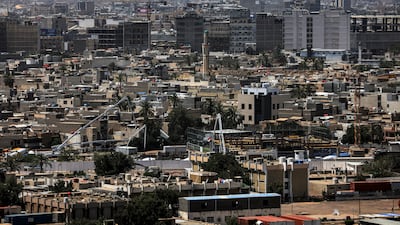
The raid on August 27 in the Dora area of southern Baghdad was not a random incident. It reflects the desperate shortage of housing that has developed since the 2003 US-led invasion that toppled Saddam Hussein.
The killings shocked the public and once again highlighted the problems of illegal encroachment on to public and private land, a property market dominated by land mafias mostly linked to politicians and militias, and the state's inconsistent approach to dealing with the issue.
By the end of 2022, the Iraqi government had registered 4,679 illegal settlements nationwide, according to Istabraq Sabah, spokesman for the Ministry of Construction, Housing and Public Municipalities. More than 1,000 of them were in the capital.

Those settlements contain more than 600,000 informal housing units, sheltering more than 3.7 million people, Mr Sabah told The National. The largest are in Baghdad and Basra in the south.
'I’m not a squatter'
Brig Gen Talla was killed during an operation to clear people living illegally on parcels of land in the Karara area of Dora that the government had allotted to hundreds of state employees, mainly military officers, in 2014. About 500 of the plots were taken over by squatters or sold by scammers using forged documents.
“We were busy fighting ISIS when the government granted us these lands, designated specifically for building homes and private dwellings,” said Mohammed Ali, one of the officers. He was referring to the campaign to drive the extremist militants out of the country from mid-2014 until late 2017.
“After 2017, we planned to build our homes, but we found encroachments, and whenever we went there, the squatters refused to leave and threatened us with weapons,” Mr Ali told The National.
After four years of legal procedures, the authorities began trying to reclaim the plots in 2021, issuing multiple orders to remove the squatters and demolish their homes, but to no avail.
According to officials and the people to whom the plots were allotted, the squatters have protection from two Sunni politicians, one of whom is now under arrest on corruption charges. Some occupants say they bought the plots they live on, but officials and the original owners say they were sold using forged documents.

“I sold a house in another area to build a bigger house for me and four sons, and all papers were authentic,” a man building a house on one of these plots told The National. “I’m not a squatter. They can take it, and they have to compensate me,” he added.
The clearance drive was called off after the shooting, but not before several houses were partly demolished, leaving piles of concrete and rebar on the street.
Growing housing crisis
Demand for housing has surged in the two decades since the US-led invasion, as Iraq's population grew from about 25 million then to 46 million in 2024, when the last census was held.
Baghdad and other cities have expanded to meet the demand for new homes. But without a strong state and clear policy, much of this growth has occurred on misappropriated public land.
Land mafias obtain state plots and agricultural areas through shady deals with officials or falsified records, then subdivide them into smaller parcels that they sell for substantial profit.
Instead of enforcing the law, successive governments have treated the residents of these illegal developments as a constituency to be courted. Demolition orders are issued, then frozen. Clearance campaigns are launched, then stopped at the first phone call from a politician.
“The result is a city where the authority of the state ends at the door of a house built without a deed,” said an official who took part in many aborted demolition drives.
The Dora killings also highlight another area where state control is lacking – the proliferation of unlicensed weapons. The police officers were shot with Kalashnikov rifles. The main suspect, who fled the scene, was found two days later at another house in Baghdad where he was living with a man wanted on terrorism charges in the northern province of Nineveh.
The government of Prime Minister Ali Al Zaidi has made it a priority to put all weapons under state control by September 30, particularly those held by Iran-aligned militias, but the Dora killings show how difficult a task this will be.

Numbers behind the rubble
To understand why a dispute over a house can cost police officers their lives, it is necessary to look at the scale of Iraq’s housing crisis.
Mr Sabah says the problem comes down to several factors. “First is the massive population growth and internal migration from rural areas to big cities to find work,” he said. “Second is the weak supply – the lack of housing projects for low-income people.”
Just over 70 per cent of the population lives in urban areas, according to the 2024 census. The annual growth rate is 2.53 per cent, meaning that more than 1 million Iraqis are added every year. With an average household size of 5.4 people, this means the country needs more than 216,000 new housing units each year, Mr Sabah said.
The state has come nowhere close to meeting that demand.
The ministry’s 2025-2030 housing policy estimates a housing shortfall of about 2.4 million units during this period. At current growth rates, the population is projected to exceed 50 million by 2030, and 70 million by 2040.
Mr Sabah's assessment of the situation is blunt. “I have a crisis, and I have consequences. We can say there is a challenge and there is a problem that requires policies and strategies, and real government effort to solve it.”
Foundation of corruption
For years, the Baghdad Mayoralty, provincial municipality departments and local administrative bodies have had their authority undermined by neglect, corruption and selective enforcement of rules. A plot of public land could be protected for a fee, a demolition delayed by a phone call.
Political parties learnt that defending an encroachment was cheaper than building a housing project, and also delivered immediate loyalty. So instead of planning, the system produced patronage.
That is why, officials say, every new government announces a campaign to restore state land and every campaign stalls. The political elite fear losing the street, or angering an influential faction.
Figures provided by Mr Sabah show the severe bottleneck in housing supply. The previous government planned 16 residential cities under a new programme in which developers would give it a certain number of housing units for free.
Only three are under construction, offering a total of 177,000 housing units. Out of these, around 46,000 units and 10,000 serviced plots will be handed over to the government for distribution, he added.
Separately, an expansion to Sadr City will eventually offer 60,000 housing units, he said.
The current government has approved a plan to distribute one million plots across the country for free to ease the demand for land for housing.
The ministry also approved 14 low-cost housing complexes with more than 7,600 units, he added. Many have stalled, but the ministry plans to revive them with funding allocations in the 2027 budget, he said.
Mr Sabah said they were designed to reduce population density in the heart of Baghdad and provincial centres, but noted that “work on such cities takes years”.
“They will reduce congestion, create jobs, create a second life with trade and light industry. In turn they will develop their surroundings and limit housing prices in those areas,” he said.
While the state builds for the future, the current lack of housing supply combined with rising demand has pushed up the cost of land, homes and rents. This puts huge pressure on Iraqi families, especially poor and vulnerable groups.
Lacking alternatives, they turn to the illegal property market – and when the police come knocking with demolition orders, it can feel like an existential threat.
“The result: a state that has no authority of law, a citizen who has no trust in the state, and a city that pays for the chaos in blood,” said Mr Ali.
Still unable to claim the plot in Dora that he was granted in 2014, he continues to live with his parents.

