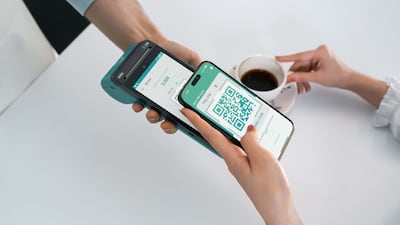

When Kawa Junad began building Iraq's first digital bank, the biggest challenge was not technology. It was persuading Iraqis of the value of banking itself when most of them had never needed one.
For Mr Junad, the founder of First Iraqi Bank, that meant tackling what he calls a “chicken and egg” problem: customers needed merchants to accept digital payments, but merchants needed customers before they had a reason to make the switch.
“It was a rough first six months or so as we pushed against all those elements, going door to door with both merchants and consumers,” Mr Junad told The National.

Eventually, he built a base of about 3,000 small and medium-sized businesses able to trade through the app by late 2021, several months after FIB launched its digital application in April that year. “That proved to be the tipping point, and it’s been steady growth from there,” he said.
FIB’s rise from a digital banking start-up to more than a million customers indicates how Iraq’s traditionally cash-based economy is changing as younger consumers and SMEs increasingly embrace digital payments.
The bank's journey from the early challenge of building a customer and merchant ecosystem to expanding into financial services also reflects a broader transformation in Iraq’s banking sector as regulators push for stronger compliance, greater financial inclusion and modern services.

FIB is a privately held Iraqi Islamic bank, which as been licensed by the Central Bank of Iraq since 2020, and operates primarily through a digital and mobile banking model. It initially built its presence in the Kurdistan region after launching its digital application in April 2021, before widening its focus to other major population centres, including Baghdad, Basra, Najaf and Nineveh. Despite being a digital-only institution, the bank is using physical branches as part of that expansion strategy.
"I enjoy the irony here," Mr Junad said. “Having that anchor, that physical presence you can look at, see, go into and touch, if need be, opens many people’s willingness to give us a try – and once they do, they’re hooked.”
FIB was built to eliminate obstacles to formal banking by offering streamlined onboarding, digital ID solutions, and payment tools. Using automated account opening, customers can establish a live account using a mobile phone and one or two identification documents in about five minutes.

It now has about 1.3 million registered customers, 90 per cent of whom had not previously held a bank account and instead relied mainly on cash, he said. Around 30,000 merchants are using its services, allowing businesses to accept payments through smartphones without investing in additional point-of-sale equipment, he added.
“This shows how hungry the market is for technologies that actually make life easier,” Mr Junad said. This growth has increasingly been driven by one of the simplest digital tools: QR payments, he added.
To illustrate that hunger, he said digital payment transactions through FIB had increased by more than 85 per cent from 2024 to 2025 and by more than 70 per cent in the first half of 2026. He did not provide the underlying transaction volumes or values.
For thousands of SMEs, the change has been particularly visible. He said some businesses using the bank's QR services have moved from almost entirely cash transactions to receiving only about 20 per cent of their payments in cash.
The bank’s evolution has gone beyond payments. Mr Junad added that about 30 per cent of its customer base now uses services such as savings, credit and salary accounts.
That transition is significant because it points to the next stage of Iraq’s digital banking experiment: moving customers from digital payments to deeper relationships with the banking system.
The next step, he says, is to turn that digital relationship into access to credit.
“We expect digital lending and credit to become a meaningful part of FIB’s business,” he said, predicting significant progress by the end of 2026 or early 2027, particularly for SMEs and customers who have historically had limited access to formal credit.
That would represent a much bigger change than simply making payments digital. It could give businesses that have operated largely in cash a pathway towards formal borrowing, while giving banks more data to assess customers.
Younger generation's impact
The change is particularly visible among younger Iraqis, who are increasingly encountering banking through their phones rather than through a branch.
For this generation, a banking service can mean paying a bill in a few taps, scanning a QR code at a shop or sending money without handling cash, while longer-term savings and investment products remain less developed, he said.
Most new customers have been aged between 18 and 35, with FIB estimating total new customer acquisitions at 600 billion to 700 billion Iraqi dinars (about $500 million) a month, Mr Junad said. Transactions have increased by 5 per cent month-on-month this year, with the vast majority involving the younger generation, he added.
Iraq's population grew from about 25 million in 2003 to about 46 million in 2024, when the last census was held. About 60 per cent of Iraqis are between 15 and 64 years old and around 36 per cent are below 15, the census showed.
As part of reforms, the Central Bank of Iraq issued new digital banking regulations in 2024 to provide the necessary structure for a rapidly growing marketplace. Last year, the central bank licensed several digital banks that are still being established.
Mr Junad described the shift brought by digital banking as a “game-changer in the near term, and not a far-off hope” for an economy where informal cash transactions remain widespread.

