

“Cut off the financial lifelines”, Reza Pahlavi, son of the deposed shah, told protesters in Iran from his exile in the US last Saturday. He urged key industries to go on strike. A labour standstill in the country's petroleum sector was a central part of the overthrow of his father in 1979.
Iran is again convulsed with unrest. This is the fifth major wave of protest Iran has endured since 2009’s Green Movement, and the most brutally repressed. The regime’s failures mean the only way out is through reinvention, reform or revolution. But whoever or whatever follows supreme leader Ali Khamenei will confront many of the same problems rooted in Iran’s energy sector.
These demonstrations may well be suppressed through violence and fear. The oil industry is not Mr Khamenei’s Achilles heel.

The regime has learnt many lessons from the shah’s fall, and has insured itself against a repeat of the 1978 oil industry strike. Fewer people are required to run the industry these days. Permanent staff at the National Iranian Oil Company are vetted for political reliability and well-paid. A larger periphery of contractors faces insecure employment, but they still earn more than the average Iranian worker, making them reluctant to risk job loss.
Iran’s oil exports grew from a Covid-era low of 0.82 million barrels a day in 2020, to 1.74 million bpd last year. This is still sharply down from a high of 2.52 million bpd in 2017 before stricter sanctions came into effect, leaving China as essentially Iran’s only paying customer. Nevertheless, on its own, this would be enough for the regime to muddle through.
But corruption in the petroleum sector is a major factor in economic failings and the root cause of popular anger.
Iranian oil sells for steep discounts versus international benchmarks even to China, because of the hassle of circumventing sanctions, and because of competition from also-sanctioned Russian crude. The head of the budget committee in the Majles informed parliamentarians that, of $21 billion of oil sales from March to November, only $13 billion was received by the government, the rest trapped abroad or pocketed by regime-linked middlemen.

Lower oil prices probably mean further reductions in earnings this year. Iran also has problems repatriating revenue, particularly since the “snapback” of UN sanctions in September.
A US clampdown on the Iraqi banking system shut off one avenue for Iran’s dollar transfers, and Iran’s gas exports to its western neighbour stopped entirely in December. This contributed to the collapse of regime-connected Ayandeh Bank, which required the government to print money for a bailout.
These factors have undermined the Iranian currency, which has lost more than half of its value against the dollar since the start of last year. In turn, the currency collapse and inflation are major contributors to the discontent behind the current protests.
If Mr Khamenei departs the scene, whether from natural causes, a domestic coup or external action, the regime has various political options. The Islamic Revolutionary Guard Corps could take power more overtly, perhaps behind a figurehead supreme leader, or a council of political, military and religious elements could run the affairs.
In the most optimistic case, the opposition might coalesce, the Islamic Republic collapse, as Bashar Al Assad’s rule over Syria did, and transition begin to a popular democracy.
Deepening energy woes
But old and new rule alike will confront Iran’s urgent and interlocking energy problems. Fuel subsidies account for eight-to-15 per cent of the country's gross domestic product, encourage wasteful consumption and are ever more unaffordable. Drivers pay just 1.3 US cents for their first 60 litres of monthly consumption, and 4 cents for larger amounts. Electricity and gas subsidies are also huge.
Repeated attempts at reform have triggered protests and been rolled back or erased by inflation. A weak new government would take a huge risk in raising domestic energy prices, even with some kind of compensation scheme.
Rampant gas consumption has erased most of Iran’s gas exports and led to increasingly serious shortages during cold winters and summer heatwaves, too. A phalanx of regime-linked industrial and petrochemical developments stand idle because of gas cut-offs. New gas developments have lagged, while declining pressure in the critical South Pars field threatens a slump in output.
The use of high-sulphur fuel oil – mazut – to replace gas in power plants, outdated vehicles burning lower-specification petrol, and dust from desertified areas, combine to produce terrible air pollution.
-

Horse and rider cross a bonfire to bless the animal with purifying smoke during the Luminarias celebration in San Bartolome de Pinares, Avila, Castile and Leon, Spain. EPA -
People flee Humaymah village, east of Aleppo city, and a January 16 deadline set by the Syrian army to tighten control of the area after driving Kurdish forces out. AFP -
A decommissioned cold war nuclear observation post, the Tunstall ROC bunker, slides from a cliff because of coastal erosion, near Hull in north-east England. AFP -
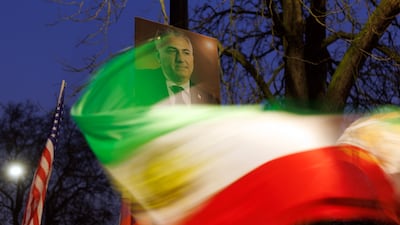
Supporters of Reza Pahlavi, son of deposed shah of Iran Mohammed Reza Pahlavi, gather outside the Iranian embassy in London. Getty Images -

An worker shows coffee beans during a harvest at the Santa Victoria coffee farm factory in Panajachel, Guatemala. AFP -

People onboard a rubber boat wait for crew members of the Ocean Viking ship in the search-and-rescue zone off the international waters of Libya. Four-six were trying to reach the shores of the Italian island of Lampedusa. AFP -
Casa Pia's Portuguese defender Jose Fonte goes to ground during the Portuguese League football match between Sporting Lisbon and Casa Pia at the Jose Alvalade Stadium in Lisbon. AFP -

Participants in the annual cold water endurance ceremony attempt to purify their souls and wish for good fortune in the new year at the Kanda Myojin shrine in Tokyo, Japan. Reuters -

Flowers are laid during a rally and a vigil to honour those killed during the nationwide protests in Iran, outside the White House in Washington. Reuters


Economic recovery
Engineering an economic recovery requires meeting national gas demand. This is one area where a new government could make a difference. If it could negotiate an easing of sanctions, it could spend the billions of dollars required to install compressors at South Pars to boost pipeline pressures.
Oil output is less problematic, if relaxation of sanctions would allow Iran to sell freely and without discounts. Still, international investment would help revitalise the old warhorse fields and boost production in the newer area of West Karun, near the Iraqi border.
A superficially new leadership might try to repeat the trick that Venezuela is trying after the abduction of Nicolas Maduro: offering concessions to Donald Trump, and a friendlier face to Israel and to American businesses, in return for being left alone.
But that would demand a sharp ideological reinvention. US oil companies have not operated in Iran for almost half a century, in contrast to Venezuela where Chevron has managed to hold on. Resource nationalism and pride in the local industry are strong. Pro-democracy Iranians praise prime minister Mohammad Mossadegh, who nationalised the oil sector in 1951, before being overthrown by a UK and US-backed coup in 1953.
Water crisis
Water is an even more crucial natural resource than hydrocarbons. In November, President Masoud Pezeshkian said the capital would have to be moved from Tehran because of an imminent water crisis. A six-year drought was followed by floods in December.
But over-extraction of groundwater, the sealing-off of rainwater recharge by urbanisation and the construction of poorly-sited dams by engineering companies run by the IRGC, mean shortages will worsen. It is notable that some of the most intense recent protests were in poor, drought-stricken provinces with large ethnic minority populations, such as Lorestan and Kordestan in the west and Sistan-Baluchestan in the south-east.
The structural factors of subsidies, entitlement, mismanagement, corruption and capture by insiders will be very hard for a rebadged government to fix. Even a truly new broom will take years to sweep away detritus from the energy and water sectors. Those aspiring to rule a new Iran can win popular goodwill only if they have good answers to these combustible problems.
Robin M Mills is chief executive of Qamar Energy, and author of The Myth of the Oil Crisis

