


“Unpleasant surprises in the greenhouse?” was the term of great pioneering climate scientist Wally Broecker in a crucial 1987 article in Nature. One of those unpleasant surprises may now be unfolding. And it brings cold, not warmth – but just as dangerously.
As so often, Dr Broecker was well ahead of his time. He wrote: “The Earth’s climatic system currently works in a way beneficial to northern Europe.” Berlin and London are as far north as parts of Alaska and Canada where polar bears roam. But they enjoy relatively warm and moderate climates because of a large system of ocean currents, the Atlantic Meridional Overturning Circulation.
The AMOC is driven by warm surface water moving from the tropics to northern Europe. Here it evaporates and warms the colder air above it. The remaining cold, saline water sinks kilometres into the ocean depths around Iceland and Greenland. Finally, it resurfaces around South America. A single drop of water will spend a thousand years in this cycle to return to its starting point.
The AMOC was particularly unstable during the end of the last Ice Age, which finished about 10,000 years ago. As the northern ice sheets melted, and periodically ice dams broke down and unleashed gigantic glacial lakes into the ocean, the pattern of currents repeatedly broke down. Most dramatically, in the “Younger Dryas” event of about 12,000 years ago, Europe cooled up to 6°C in a few decades. The woodlands, which had returned as the Ice Age ebbed, were killed off and replaced by tundra.
Global warming similarly threatens to disrupt this ocean circulation. More rain across the North Atlantic, and the fresh meltwater from Greenland, could stop the sinking of dense, cold water that drives the whole system.
A subplot features the famous Gulf Stream. This surface current is part of the AMOC system and is mainly driven by wind. It brings warm water from the Gulf of Mexico across the Atlantic. Recent research from University College London suggests that slowing winds, a global phenomenon, could weaken the Gulf Stream and also chill Europe.
Do we see any warning signs? Measurements show that while the oceans and land are warming virtually everywhere, there is one exception: a blob of cooling in the North Atlantic. The AMOC may be at its weakest now for a thousand years. Studies by Danish brother-and-sister researchers Peter and Susanne Ditlevsen used statistical methods to suggest the AMOC might collapse this century, with 2057 being the most probable year.
If the AMOC were to seize up, Europe could cool by 5 to 15°C. Winters would be much colder and snowier, with sea ice possibly extending to the southern UK, while summers become hotter and drier. Food production would be disastrously reduced. Cities and homes built for a moderately warm, wet climate would be hopelessly unsuitable for something more like Siberia.
This wouldn’t just affect Europe. Changes in winds would mean sea levels along the eastern US coast would rise by about a metre. The wet and dry seasons in the tropics may switch around, possibly dooming the Earth’s richest troves of biodiversity and carbon sinks, the Amazon and the African rainforests. More speculatively, the West African and South Asian monsoons might shift south, bringing drought and hunger to billions of people.
This is still quite speculative. It isn’t clear whether the AMOC would stop suddenly in just a few years, or continue weakening gradually. We also don’t know what, if any, warning signs we might see and how much advance notice we would get. Though the Ditlevsens’ research triggered criticism and great controversy, it did suggest there may be wilder oscillations before the AMOC breaks down entirely.
Once it has stopped, it might be impossible to revive even if global temperatures drop again. 2057 is well within the lifetimes of most people around today, and too soon to adapt to.
-

Internally displaced children Ali and Osman Abdulahi stand near carcasses of their family's livestock, killed by severe drought near Dollow, Somalia. Reuters -
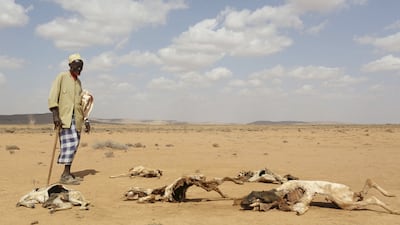
Quick distribution of climate funds agreed at Cop28 will help devastated populations get back on their feet, Somalia’s Deputy Prime Minister Salah Jama has said. Reuters -

Commuters ride on rickshaws on a flooded road after heavy rains in Dhaka, Bangladesh. Reuters -
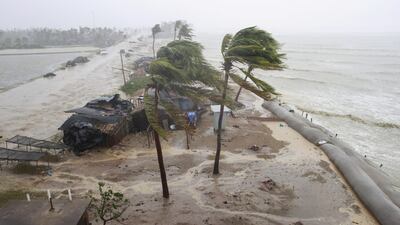
Cyclone Mocha makes landfall near Cox's Bazar, Bangladesh. A rise in extreme weather events around the world has been blamed on global warming caused by man-made greenhouse gases. EPA -
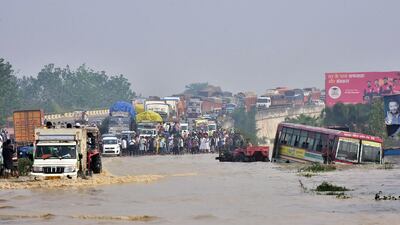
Commuters stand on a flyover, on a flooded motorway near Rampur, in India's Uttar Pradesh state, in 2021. AFP -
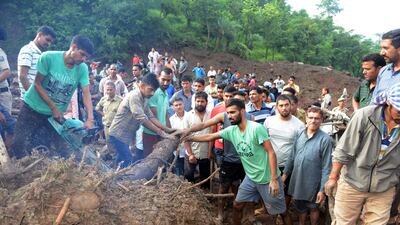
Monsoon floods and landslides killed about 100 people in Nepal and India earlier this year. AFP -
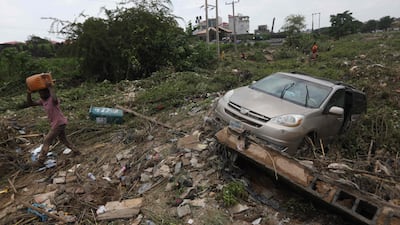
A man walks past a car swept by floodwaters in Abuja, Nigeria, in 2021. AFP -
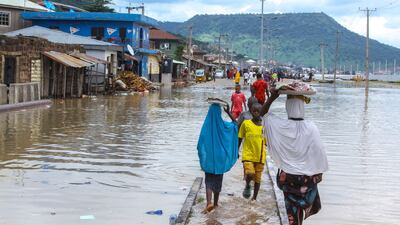
Flooding in Kogi, Nigeria, in October 2022. AP -
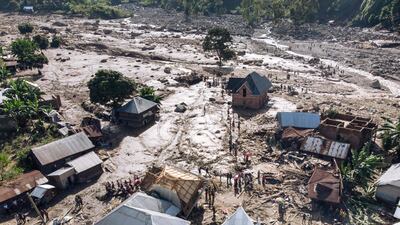
A landslide engulfs Nyamukubi village, eastern Democratic Republic of Congo. AFP -

A landslide in the Mont Ngafula district of Kinshasa, the capital of the Democratic Republic of Congo. AFP -
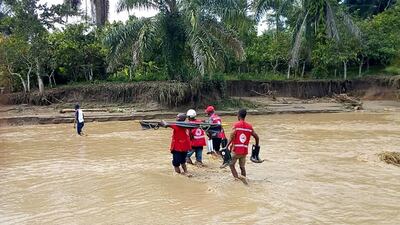
Aid workers crossing flooded areas in Bundibugyo, Uganda. Twitter/UgandaRedCross -
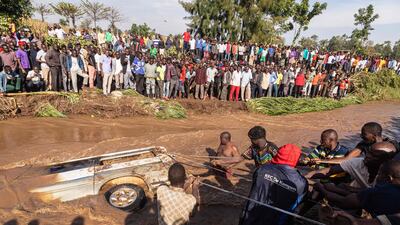
Villagers try to pull up a minibus in which 14 bodies were retrieved, in the river Nabuyonga in eastern Uganda, after flash floods. AFP


So, what should we do? First, this is an example of the kind of abrupt, catastrophic risk that comes with messing with the climate system. Economist Marty Weitzman already pointed out in 2009 that these are the biggest dangers and costs of climate change, not the steady increases in temperature that have preoccupied most policymakers and give a false sense of manageable change.
The freezing of Europe and the drying-up of the monsoon would unleash economic and political chaos, wars and refugee migrations, that would be even more ruinous than the climate change itself. Even if the chance of an AMOC breakdown this century is, say, “only” 10 per cent, we already take drastic and expensive action against far less serious or likely risks.
Second, we need to know if and when we are close to the collapse of the AMOC or Gulf Stream, what the consequences in detail will be, and whether they will recover if temperatures drop again. That in turn needs good data gathering across the oceans, more sophisticated modelling, and study of the causes and indications of historic events such as the Younger Dryas.
Third, we need, of course, to cut emissions quickly, to limit warming overall, and the risks of AMOC disruption and other abrupt climate deterioration or ecosystem collapses. This is a matter of extreme urgency. It is delayed on the one hand by science denial and complacency about the effects of climate change, and on the other hand by ideologies against capitalism, consumerism or certain disfavoured forms of energy, in favour of incomplete pet solutions.
Fourth, we need emergency measures to limit warming. That means moving quickly on techniques to remove carbon dioxide directly from the atmosphere. It means “geoengineering” methods to limit warming by reflecting the sun’s rays, for example, brightening marine clouds artificially, or injecting fine particles into the stratosphere.
Environmentalists have rejected carbon removal and geoengineering, even research into them, partly because of possible side effects, but more because they fear they detract from a single-minded campaign to end fossil fuel use. This is like rejecting seat belts and airbags, or even research into them because they would make drivers careless. But we are not talking here of the lives of some motorists, but a threat to a large part of humanity.
Robin M. Mills is chief executive of Qamar Energy and author of 'The Myth of the Oil Crisis'

