


British Prime Minister Rishi Sunak’s announcement of the general election to be held on July 4, as he was soaked by rain outside No 10 Downing Street, was appropriate. Climate change made last winter the second wettest on record, quite an achievement for British weather, causing flooding and damaging farmland.
Now, after 14 years of at best soggy progress on climate and energy, it’s up to the likely winners, the Labour Party, and other contenders to show they can do better.
What have the Conservatives got right? The signature achievement is that Britain has been the fastest-decarbonising major country. Between 2010, when the Conservative Party entered power in a coalition, and 2023, emissions dropped 37 per cent.
The government was tough on Russia following its invasion of Ukraine, after senior figures had previously flirted with Moscow. In September, it approved the development of Rosebank, the largest undeveloped oilfield on the UK’s continental shelf. Positive for British energy security and tax revenue, this will make little net difference to greenhouse gas emissions.
The decarbonisation achievement is less than it appears at first sight. It was aided by some warm winter weather in 2022-23 and 2023-24, and also reflects a sluggish economy, the after-effects of the Covid pandemic and soaring energy bills in the 2022 crisis.
-

Internally displaced children Ali and Osman Abdulahi stand near carcasses of their family's livestock, killed by severe drought near Dollow, Somalia. Reuters -
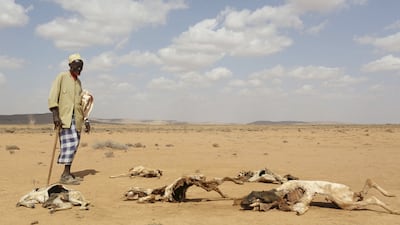
Quick distribution of climate funds agreed at Cop28 will help devastated populations get back on their feet, Somalia’s Deputy Prime Minister Salah Jama has said. Reuters -

Commuters ride on rickshaws on a flooded road after heavy rains in Dhaka, Bangladesh. Reuters -
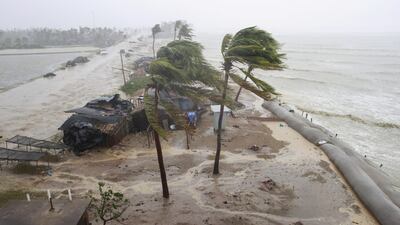
Cyclone Mocha makes landfall near Cox's Bazar, Bangladesh. A rise in extreme weather events around the world has been blamed on global warming caused by man-made greenhouse gases. EPA -
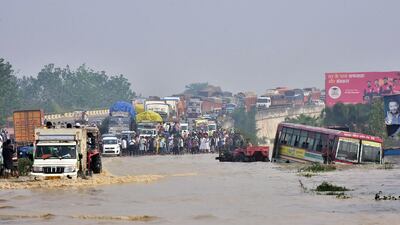
Commuters stand on a flyover, on a flooded motorway near Rampur, in India's Uttar Pradesh state, in 2021. AFP -

Monsoon floods and landslides killed about 100 people in Nepal and India earlier this year. AFP -
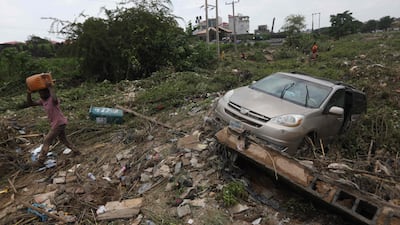
A man walks past a car swept by floodwaters in Abuja, Nigeria, in 2021. AFP -
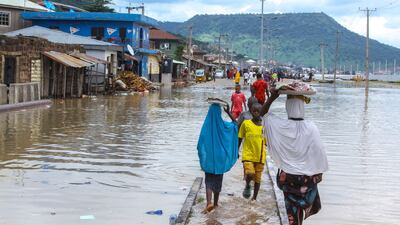
Flooding in Kogi, Nigeria, in October 2022. AP -
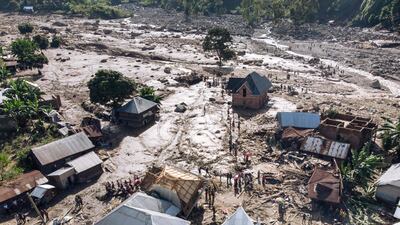
A landslide engulfs Nyamukubi village, eastern Democratic Republic of Congo. AFP -

A landslide in the Mont Ngafula district of Kinshasa, the capital of the Democratic Republic of Congo. AFP -

Aid workers crossing flooded areas in Bundibugyo, Uganda. Twitter/UgandaRedCross -

Villagers try to pull up a minibus in which 14 bodies were retrieved, in the river Nabuyonga in eastern Uganda, after flash floods. AFP


More importantly, it is mainly a result of eliminating coal from electricity generation in favour of gas and renewables – mostly onshore and offshore wind and bio-energy. This is a trick that only works once. After the recent flop of a badly planned offshore wind auction, it’s not clear how the country will keep the lights on and bills in check while cutting down the remaining use of gas.
And much less progress has been made on decarbonising transport, heavy industry or the Conservative-leaning farming business.
The biggest failings lie in a lack of ambition, a readiness to be blown around by the winds of fortune, or newspaper headlines. There have been more energy ministers than prime ministers – 11 in 14 years – in an ever-shifting portfolio that sometimes included business, industry or climate. Not surprisingly, major long-term and expensive projects such as new nuclear reactors and carbon capture and storage have made achingly slow progress, with frequent U-turns.
Having promised “the greenest government ever” on entering coalition in 2010, the first of a run of five Conservative prime ministers, David Cameron, decided in 2013 to slash a swathe of environmental policies from bills, such as support for renewable energy, insulation and heat pumps. Political donors in the housing industry wanted to cut construction costs.
What were then record energy bills of £1,400 ($1,780) per year for an average household soared to £2,500 in 2023, even including a substantial subsidy. Russia’s squeeze on European gas markets was not the British government’s fault, but its failure to improve Britain’s dismal home insulation and energy efficiency should be laid squarely at its door.
These rising concerns about the cost of living, and specifically energy, gave an opening to blame “net-zero” policies. This is not solely a British phenomenon, but a trend repeated across Europe. In November, the far-right PVV party came first in the Netherlands’s elections after promising “we will stop the hysterical reduction of CO2”.
In September, Mr Sunak put back a ban on the sales of new petrol and diesel cars by five years to 2035, and delayed the phase-out of gas boilers in favour of heat pumps in homes. The government theoretically reversed its long-standing effective ban on new onshore wind projects, but retained obstacles on local consultation that mean no new wind farms have been started.

The only one of 16 by-elections in the past two years won by the Conservatives was in suburban London where the party played on fears about mayor Sadiq Khan’s “ultra-low emission zone” for vehicles.
The Labour Party has a much more pro-environmental agenda. So do most of the other opposition parties, other than the hard-right Reform insurgents – the Liberals, the Scottish and Welsh nationalists and, of course, the Greens, who may secure two seats.
Labour’s challenges fall into four areas. First, to balance big ambitions with fiscal credibility, after February’s decision to water down an annual £28 billion ($35.66 billion) low-carbon transformation to £4.7 billion. Retaining or increasing the “windfall” tax on offshore oil and gas production is financially tempting but would be foolish for deterring investment, now that prices are nowhere near windfall levels.
Second, to define the roles of state, nationalised and private business. Great British Energy, a new state-owned renewable company, will be capitalised with £8.3 billion. But what is it really going to do – invest in proven renewable deployment that the private sector already does perfectly well? Scale up emerging technology, with potentially big pay-offs, but also risks and competition from the US, EU and China? Or enable new infrastructure such as grids and offshore wind connections, that could cut overall costs and bureaucracy? Would it also invest abroad, as the national champions it seems to emulate do, such as Denmark’s Ørsted, Norway’s Equinor, France’s EDF – or even the UAE’s Masdar?
Third, to manage the tension between traditional support from trade unions and industrial areas, and concerns from the general public about living costs and lifestyles, with the need to cut emissions in areas beyond the power sector. Home energy efficiency improvements can be piecemeal and disruptive, but are essential and ultimately beneficial.
-

Henrietta Moon, founder of Finnish start-up Carbo Culture, says carbon removal technology companies are valuable. Chris Whiteoak / The National -

Carbo Culture uses bio-char generated from dust pellets and waste wood to lock in carbon. Photo: Carbo Culture -
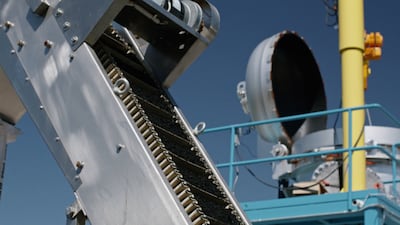
The company aims to extract 3,000 tonnes of carbon dioxide from the atmosphere. Photo: Carbo Culture -
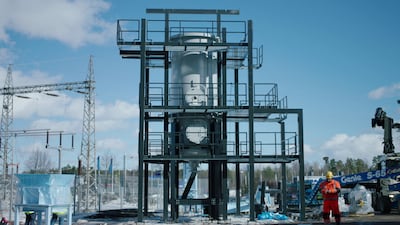
It has plants in the US and Europe and its bio-char can be used to improve soil quality. Photo: Carbo Culture -
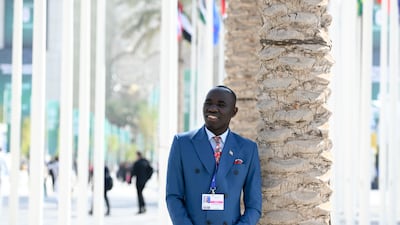
Jolis Nduwimana, an entrepreneur from Burundi, says he built connections at Cop28 to support his sustainability ambitions. Khushnum Bhandari / The National -

His start-up Wege collects plant, banana and paper waste from 15,200 small-scale farms that would otherwise be burnt. Photo: Jolis Nduwimana -

The waste is boiled in vats and transformed into eco-friendly bags. Photo: Jolis Nduwimana -

The company now makes 500 eco-friendly bags each day with ambition to grow to 2,000. Photo: Jolis Nduwimana -

A Burundi ban on plastic bags set Mr Nduwimana thinking about a solution. Photo: Jolis Nduwimana -

The team spends hours separating paper, banana and rice waste before its converted to pulp. Photo: Jolis Nduwimana -

The waste would otherwise be burnt or rot in landfills. Photo: Jolis Nduwimana -

The pulp is dried in the sun before being used to make bags. Photo: Jolis Nduwimana -

Wege sells the bags to boutiques and pharmaceutical companies Photo: Jolis Nduwimana


Fourth, to be pragmatic in the face of simplistic demands from climate campaigners. new oil and gas developments, even those that bring in jobs and tax revenue, are funded by private capital, and don’t add to net emissions. There will be reflexive opposition to carbon capture and storage, crucial for decarbonising heavy industry but seen as aligned with fossil fuel interests. Yet Britain, with Norway, has by far Europe’s best carbon dioxide storage potential.
Fifth, to rebuild the relationship with the EU. This goes far beyond energy and climate, of course, encompassing the whole Brexit debacle. The UK’s carbon price is well below that in the EU, exposing its exporters to penalties. Integrating renewable-heavy grids and competing with global giants in new energy technology in China and the US will need much more co-operation with the European single market.
The environment ranks about fourth on Britons’ top issues, well behind the economy, health and immigration. It may not change many voters’ minds. But if the next prime minister doesn’t want to appear a drip outside Downing Street, getting energy and climate right is essential.
Robin M. Mills is chief executive of Qamar Energy and author of 'The Myth of the Oil Crisis'

