

Abu Dhabi clean energy company Masdar and Germany’s Daimler Truck have signed an initial agreement to explore the feasibility of liquid green hydrogen exports from the UAE to Europe by 2030.
The partnership would represent a “significant advancement” in continuing efforts to tackle carbon-dioxide emissions in road freight transport, Masdar said in a statement on Thursday, without disclosing further details.
“Masdar’s ambition is to be one of the leading players in the development of green hydrogen globally and we believe that transportation is one of the most strategic markets for green hydrogen,” the company's chief executive Mohamed Al Ramahi said.

The UAE, the Arab world’s second-largest economy, aims to reach hydrogen production of 1.4 million tonnes annually by 2031. The target is then to reach 15 million tonnes of annual production by 2050.
The country is planning to develop at least two hydrogen production plants, or oases, by 2031.
Masdar is working towards a renewable energy portfolio capacity of at least 100 gigawatts by 2030 and an annual green hydrogen production capacity of up to one million tonnes by the same year.
“In order to decarbonise commercial vehicles, it is absolutely crucial to make green energy globally available,” said Martin Daum, chairman of the board and chief executive of Daimler Truck.
“Our initiative with Masdar marks an initial step for us to enable the supply of liquid green hydrogen in Europe.”
Daimler Truck is planning to make its entire range of lorries and buses carbon-neutral in driving operations across its global core markets by 2039.
The company is pursuing a “dual-track” strategy with hydrogen and battery-powered vehicles.
The demand for critical minerals such as lithium, cobalt and platinum has surged in recent years as electric vehicles (EVs) become increasingly popular, prompting car manufacturers and battery makers to look for alternatives.
EVs will make up about half of the new car sales worldwide by 2035 as the push for net-zero carbon emissions accelerates, according to Goldman Sachs Research.
-
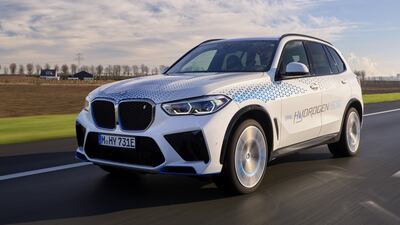
The National was invited to test-drive the BMW iX5 Hydrogen in Antwerp. All photos: BMW -

The two hydrogen tanks, which store 6kg of gas, were subjected to various integrity tests to ensure their safety -
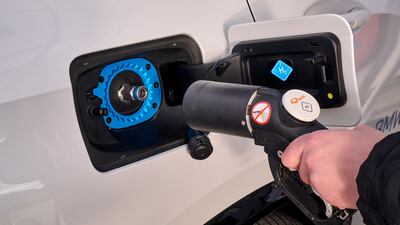
It takes three to four minutes to fill the tanks -
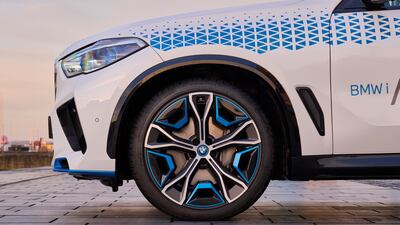
The X5-derived fuel-cell electric vehicle is relevant to the Gulf, which has ambitious plans for a hydrogen economy -
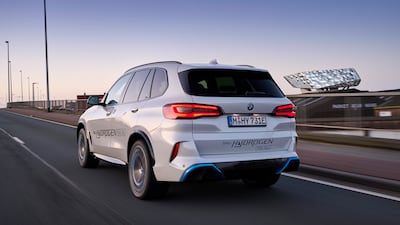
The 2.45-tonne vehicle goes from zero to 100kph in less than six seconds -
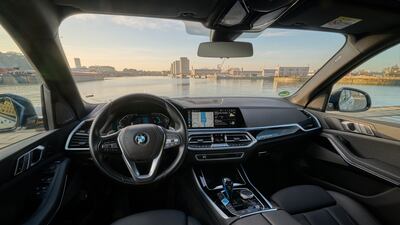
The iX5 Hydrogen has been conceived for a pilot programme for the time being


Liquid hydrogen can serve a similar purpose to petrol and diesel in internal combustion engines, eliminating the inefficiency associated with using hydrogen to generate electricity through a fuel-cell system.
Daimler’s prototype Mercedes-Benz GenH2 Truck completed a trip of more than 1,000km across Germany with one fill of liquid hydrogen, the company said.
It is building a customer-trial fleet of GenH2 Trucks, which are expected to be available in summer.
The global liquid hydrogen market is estimated to reach $66.3 billion by 2032, from $39 billion in 2022, according to Allied Market Research.
Hydrogen, which can be produced from renewable energy and natural gas, is expected to become a critical fuel as economies and industries transition to a low-carbon world.
It comes in various forms, including blue, green and grey. Blue and grey hydrogen are produced from natural gas, while green is derived from splitting water molecules through electrolysis.

