

The Opec+ alliance of 23 oil-producing countries is doing its "best" to maintain a healthy balance of supply and demand in the market, the UAE's Minister of Energy and Infrastructure said on Monday.
Suhail Al Mazrouei, who was speaking at Adipec, said the group was monitoring improvements or declines in major export markets and particularly in China, the world's second largest economy and top crude importer.
"Many dynamics are moving on and we hope that the growth in China picks up ... because the whole world economy is dependent on China," Mr Al Mazrouei said.
"My worry is not an undersupplied market in the short term. My worry is an undersupplied market in the longer and mid term."
The minister's comments come ahead of the Opec+ ministerial panel meeting on October 4, where Saudi Arabia and Russia may reassess their voluntary output cuts of 1.3 million barrels per day.
China's post-coronavirus economic recovery has lost momentum mainly due to a deepening property slump and weak consumer spending.
The Asian country has announced a string of stimulus measures over the past few weeks, including halving the stamp duty on stock transactions and easing mortgage rates.
Its oil demand in July grew by 2 million bpd for the third consecutive month, driven by higher demand for transport fuels and continuing recovery in air travel, Opec said in its latest monthly oil market report.
-
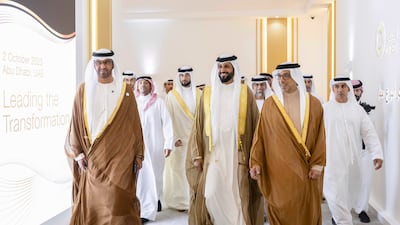
Sheikh Mansour bin Zayed, Vice President, Deputy Prime Minister and Chairman of the Presidential Court, opened the 39th edition of Adipec on October 2. Dr Sultan Al Jaber, Cop28 President-designate, Sheikh Nahyan bin Mubarak, Minister of Tolerance and Coexistence, and Suhail Al Mazrouei, Minister of Energy and Infrastructure, were also present. All photos: Wam -

Sheikh Mansour opened the event under the patronage of President Sheikh Mohamed -
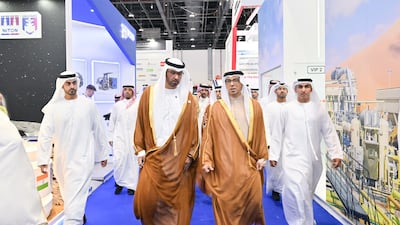
Sheikh Mansour with Dr Al Jaber, who is also Minister of Industry and Advanced Technology and managing director and group chief executive of Adnoc -

Sheikh Mansour hailed the huge efforts of Sheikh Mohamed to enhance the UAE's leading strategic position on energy -
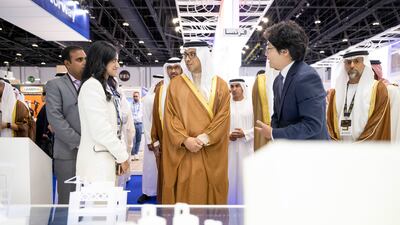
The UAE is playing a pioneering global role in reducing emissions, Sheikh Mansour said -
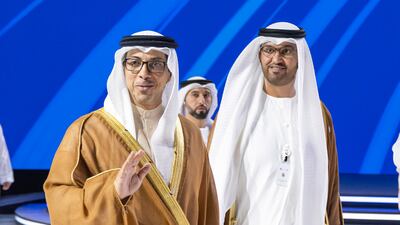
Sheikh Mansour at Adipec with Dr Al Jaber -

Sheikh Mansour urged the conference to achieve global strategic goals, enhance the energy system and support innovation and technology -
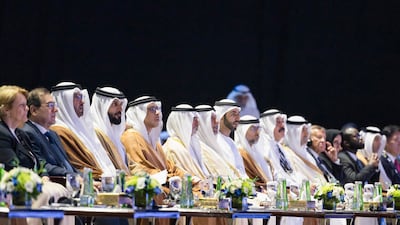
This, in addition to constructive co-operation, can contribute to radically reducing carbon emissions, Sheikh Mansour said -

Sheikh Mansour met several global leaders in the energy sector at the conference -
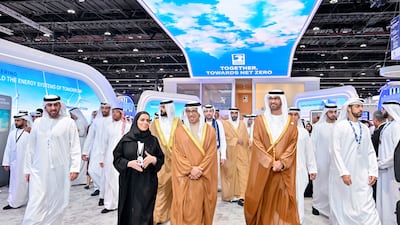
He also attended a key ministerial session under the theme of the conference, 'Decarbonising. Faster. Together'


This year’s Adipec comes weeks before the start of the Cop28 summit in November, where countries will assess where they stand with regards to climate goals as part of a process called the global stock take.
The UAE, which is investing heavily in clean energy projects, plans to triple its renewable energy capacity by 2030 to achieve its net-zero goals.
That combined with the planned ramp up at the Barakah nuclear plant will result in the Emirates having a clean energy capacity of 19.5 gigawatts by the end of the decade, Mr Al Mazrouei said.
The UAE is also aiming to double its liquefied natural gas (LNG) export capacity to meet rising global demand.
"There is a lack of investment worldwide in gas ... as long as there is demand, we have the capacity to produce because we are the world's lowest-cost producer," Mr Al Mazrouei said.
Last month, Adnoc Gas, estimated to have the seventh largest gas reserves globally, signed an agreement to supply LNG worth $450 million to $550 million to a subsidiary of state-owned energy giant PetroChina.
In August, it signed a five-year LNG supply agreement with Japan Petroleum Exploration (Japex), also valued at between $450 million and $550 million.
In July, the Adnoc subsidiary announced a 14-year supply agreement with Indian Oil Corporation, the South Asian country’s largest refiner.

