A worker producing photovoltaic modules used for solar panels in Huaian city, eastern China. AFP

China's solar capacity expected to double by the end of 2026


  • English
  • Arabic

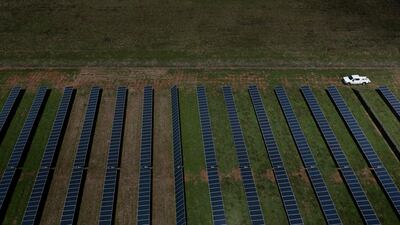
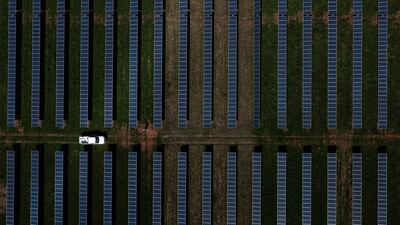
China’s solar capacity is expected to double in the next three years, driven by government-led initiatives.

Total solar photovoltaic (PV) capacity in the world’s second-largest economy is projected to cross 1,000 gigawatts by the end of 2026, compared with 500 gigawatts by the end of this year, Rystad Energy said in a report on Tuesday.

In 2023, new capacity is expected to exceed 150 gigawatts, nearly doubling the 87 gigawatts installed last year, the Norway-based consultancy said.

“China’s national programme to build our solar capacity, launched in June 2021, has led to a significant boost in large-scale projects,” said Yicong Zhu, senior renewables and power analyst at Rystad Energy.

“Although most distributed PV systems are installed on rooftops, not all of them are used for residential purposes,” she said.

“Around two-thirds of the distributed PV capacity in China is utilised by the commercial and industrial sectors and these projects can vary from tens to more than 100 megawatts.”

Currently, China’s installed solar capacity represents about 40 per cent of global total, with the US in second place, accounting for about 12 per cent.

Rystad expects US solar installations to increase with incentives from the Inflation Reduction Act, reaching 209 gigawatts in 2026, constituting 11 per cent of the global capacity.

The IRA, enacted last year, offers a series of tax incentives on wind, solar, hydropower and other renewables, as well as a push towards electric vehicle ownership.

It could spur about $3 trillion of investment in renewable energy technology, according to Goldman Sachs.

In China, large-scale energy projects are located in the country’s north-west region where solar and land resources are abundant.

However, power demand centres are in China’s south and eastern regions, where cities like Beijing, Shenzhen and Shanghai are located.

“The nation has made efforts to construct and expand its high-voltage transmission networks to move renewable power from areas rich in resources to demand centres,” Rystad said.

“However, there is limited land availability and costs are high in coastal regions, so large-scale utility solar PV developments are not feasible.”

Distributed solar energy, systems typically sited on rooftops, are a more “viable” alternative and China’s more populous provinces have experienced a “notable” increase in the advancement of such projects this year, Rystad said.

Among these provinces, Henan took the lead, with 7.6 gigawatts of new solar PV installations, of which 98 per cent were distributed solar PV. Shandong followed closely with 6.8 gigawatts of new installations.

China, which has set provincial-specific solar installation targets, plans to install 443 gigawatts of new capacity by the end of 2025.

As of June 30, a total of 206 gigawatts has been installed, achieving a completion rate of nearly 47 per cent, the consultancy said.

Investment in clean energy is set to hit $1.7 trillion this year, outpacing spending on fossil fuels, as countries look to address potential energy shortages, according to the International Energy Agency.

Global energy investment is projected to reach $2.8 trillion in 2023, with more than 60 per cent allocated to clean technology including renewables, electric vehicles, nuclear power and heat pumps, the Paris-based agency said in its World Energy Investment report in May.

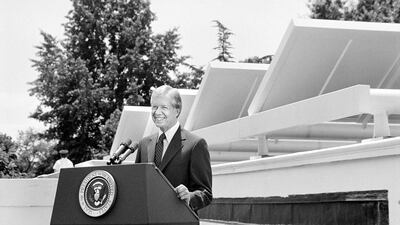
  • President Jimmy Carter unveils 32 solar panels that were installed on the roof of the West Wing of the White House on June 20, 1979. Photo: Universal History Archive via Getty
    President Jimmy Carter unveils 32 solar panels that were installed on the roof of the West Wing of the White House on June 20, 1979. Photo: Universal History Archive via Getty
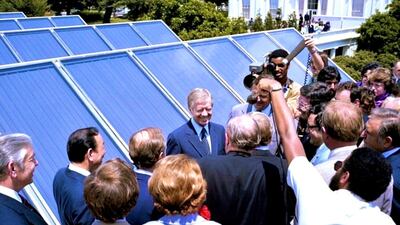
  • Mr Carter was the first US president to install solar panels at the White House. Photo: Jimmy Carter Presidential Library
    Mr Carter was the first US president to install solar panels at the White House. Photo: Jimmy Carter Presidential Library
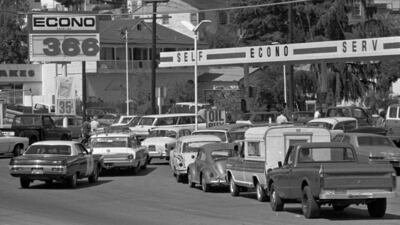
  • American drivers queue for petrol during the 1973 oil crisis. Mr Carter's term in office came at a time of several energy shocks. AP
    American drivers queue for petrol during the 1973 oil crisis. Mr Carter's term in office came at a time of several energy shocks. AP
  • Mr Carter unveils the solar panels at the White House. Photo: Jimmy Carter Presidential Library
    Mr Carter unveils the solar panels at the White House. Photo: Jimmy Carter Presidential Library
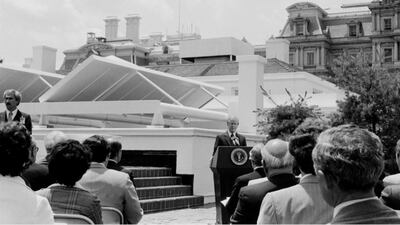
  • Mr Carter's successor, Ronald Reagan, immediately had the panels removed. Photo: Jimmy Carter Presidential Library
    Mr Carter's successor, Ronald Reagan, immediately had the panels removed. Photo: Jimmy Carter Presidential Library
  • Mr Reagan and Margaret Thatcher, the British prime minister at the time, at the White House in Washington in 1982. AP
    Mr Reagan and Margaret Thatcher, the British prime minister at the time, at the White House in Washington in 1982. AP
  • Former US president Jimmy Carter's solar farm in his hometown of Plains, Georgia. AFP
    Former US president Jimmy Carter's solar farm in his hometown of Plains, Georgia. AFP
  • The solar farm provides enough power for about half the tiny town of Plains. AFP
    The solar farm provides enough power for about half the tiny town of Plains. AFP
  • Mr Carter and his wife Rosalynn arrive for a ribbon-cutting ceremony for their solar panel project in Plains in 2017. AP
    Mr Carter and his wife Rosalynn arrive for a ribbon-cutting ceremony for their solar panel project in Plains in 2017. AP
  • The Carters at the ribbon-cutting ceremony. AP
    The Carters at the ribbon-cutting ceremony. AP
COMPANY%20PROFILE
%3Cp%3E%3Cstrong%3EName%3A%20%3C%2Fstrong%3ESmartCrowd%0D%3Cbr%3E%3Cstrong%3EStarted%3A%20%3C%2Fstrong%3E2018%0D%3Cbr%3E%3Cstrong%3EFounder%3A%20%3C%2Fstrong%3ESiddiq%20Farid%20and%20Musfique%20Ahmed%0D%3Cbr%3E%3Cstrong%3EBased%3A%20%3C%2Fstrong%3EDubai%0D%3Cbr%3E%3Cstrong%3ESector%3A%20%3C%2Fstrong%3EFinTech%20%2F%20PropTech%0D%3Cbr%3E%3Cstrong%3EInitial%20investment%3A%20%3C%2Fstrong%3E%24650%2C000%0D%3Cbr%3E%3Cstrong%3ECurrent%20number%20of%20staff%3A%3C%2Fstrong%3E%2035%0D%3Cbr%3E%3Cstrong%3EInvestment%20stage%3A%20%3C%2Fstrong%3ESeries%20A%0D%3Cbr%3E%3Cstrong%3EInvestors%3A%20%3C%2Fstrong%3EVarious%20institutional%20investors%20and%20notable%20angel%20investors%20(500%20MENA%2C%20Shurooq%2C%20Mada%2C%20Seedstar%2C%20Tricap)%3C%2Fp%3E%0A
Our family matters legal consultant

Name: Hassan Mohsen Elhais

Position: legal consultant with Al Rowaad Advocates and Legal Consultants.

Mercer, the investment consulting arm of US services company Marsh & McLennan, expects its wealth division to at least double its assets under management (AUM) in the Middle East as wealth in the region continues to grow despite economic headwinds, a company official said.

Mercer Wealth, which globally has $160 billion in AUM, plans to boost its AUM in the region to $2-$3bn in the next 2-3 years from the present $1bn, said Yasir AbuShaban, a Dubai-based principal with Mercer Wealth.

Within the next two to three years, we are looking at reaching $2 to $3 billion as a conservative estimate and we do see an opportunity to do so,” said Mr AbuShaban.

Mercer does not directly make investments, but allocates clients’ money they have discretion to, to professional asset managers. They also provide advice to clients.

“We have buying power. We can negotiate on their (client’s) behalf with asset managers to provide them lower fees than they otherwise would have to get on their own,” he added.

Mercer Wealth’s clients include sovereign wealth funds, family offices, and insurance companies among others.

From its office in Dubai, Mercer also looks after Africa, India and Turkey, where they also see opportunity for growth.

Wealth creation in Middle East and Africa (MEA) grew 8.5 per cent to $8.1 trillion last year from $7.5tn in 2015, higher than last year’s global average of 6 per cent and the second-highest growth in a region after Asia-Pacific which grew 9.9 per cent, according to consultancy Boston Consulting Group (BCG). In the region, where wealth grew just 1.9 per cent in 2015 compared with 2014, a pickup in oil prices has helped in wealth generation.

BCG is forecasting MEA wealth will rise to $12tn by 2021, growing at an annual average of 8 per cent.

Drivers of wealth generation in the region will be split evenly between new wealth creation and growth of performance of existing assets, according to BCG.

Another general trend in the region is clients’ looking for a comprehensive approach to investing, according to Mr AbuShaban.

“Institutional investors or some of the families are seeing a slowdown in the available capital they have to invest and in that sense they are looking at optimizing the way they manage their portfolios and making sure they are not investing haphazardly and different parts of their investment are working together,” said Mr AbuShaban.

Some clients also have a higher appetite for risk, given the low interest-rate environment that does not provide enough yield for some institutional investors. These clients are keen to invest in illiquid assets, such as private equity and infrastructure.

“What we have seen is a desire for higher returns in what has been a low-return environment specifically in various fixed income or bonds,” he said.

“In this environment, we have seen a de facto increase in the risk that clients are taking in things like illiquid investments, private equity investments, infrastructure and private debt, those kind of investments were higher illiquidity results in incrementally higher returns.”

The Abu Dhabi Investment Authority, one of the largest sovereign wealth funds, said in its 2016 report that has gradually increased its exposure in direct private equity and private credit transactions, mainly in Asian markets and especially in China and India. The authority’s private equity department focused on structured equities owing to “their defensive characteristics.”

Skoda Superb Specs

Engine: 2-litre TSI petrol

Power: 190hp

Torque: 320Nm

Price: From Dh147,000

Available: Now

The specs

Engine: 2.0-litre 4cyl turbo

Power: 261hp at 5,500rpm

Torque: 405Nm at 1,750-3,500rpm

Transmission: 9-speed auto

Fuel consumption: 6.9L/100km

On sale: Now

Price: From Dh117,059

Updated: September 13, 2023, 5:36 AM