

Live updates: follow the latest news on Russia-Ukraine
The European Commission may spare Hungary and Slovakia from an embargo on buying Russian oil, now under preparation, wary of how dependent the two countries are on Russian crude, two EU officials said on Monday.
The commission is expected to finalise on Tuesday work on a sixth package of EU sanctions against Russia over its actions in Ukraine, which would include a ban on buying Russian oil, exports of which are a major source of Moscow's revenue.
Hungary, heavily dependent on Russian oil, has repeatedly said it would not sign up to sanctions involving energy. Slovakia is also one of the EU countries most reliant on Russian fossil fuels.
To keep the 27-nation bloc united, the commission might offer Slovakia and Hungary "an exemption or a long transition period", one of the officials said.
The oil embargo is likely to be phased, most likely only taking full effect from the start of next year, officials said.
Europe is the destination for nearly half of Russia's crude and petroleum product exports — providing Moscow with a huge source of revenue that countries including Latvia and Poland say must be cut, to stop funding its military action in Ukraine.
EU countries have paid Russia nearly €20 billion ($21bn) since February 24, when it launched its invasion, according to the Centre for Research on Energy and Clean Air.
Overall, the EU depends on Russia for 26 per cent of its oil imports, but reliance varies between countries.
Slovakia and Hungary, both on the southern route of the Druzhba pipeline that pumps Russian oil to Europe, are especially dependent, receiving respectively 96 per cent and 58 per cent of their crude and oil products from Russia last year, according to the International Energy Agency.
Germany, the top buyer of Russian oil in the EU, has in recent days said it could manage an oil embargo, having initially resisted for fear of the economic cost.
At 555,000 barrels per day, Germany imported 35 per cent of its crude oil from Russia in 2021, but has in recent weeks reduced that to 12 per cent, the German economy ministry said in an update on energy security on Sunday.
"An oil embargo with a sufficient transitional period would now be manageable in Germany, subject to rising prices," it said.
The EU sanctions package is expected to be presented to ambassadors of EU governments on Wednesday.
-
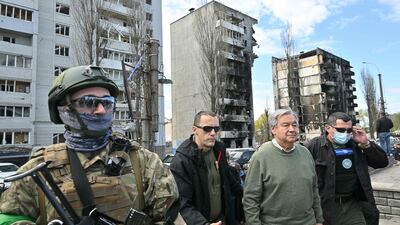
UN Secretary General Antonio Guterres during a visit in Borodianka, outside Kyiv, on April 28. AFP -
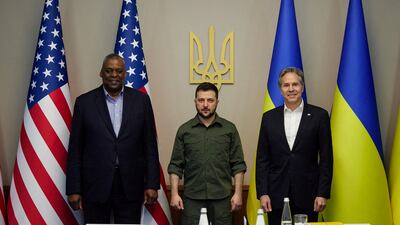
Ukrainian President Volodymyr Zelenskyy, centre, poses for a picture with US Secretary of State Antony Blinken, right, and US Defense Secretary Lloyd Austin in Kyiv on April 24. Reuters -
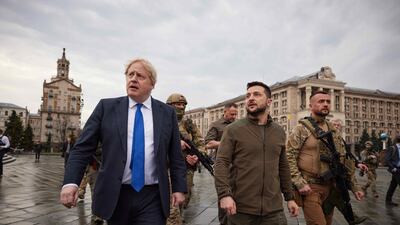
British Prime Minister Boris Johnson walks with Mr Zelenskyy in Independence Square during his visit to Kyiv on April 9. PA -
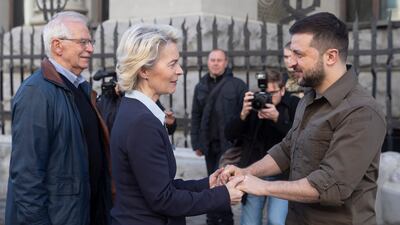
EU Commission chief Ursula von der Leyen shakes hands with Mr Zelenskyy as EU foreign affairs envoy Josep Borrell stands to her left, during their meeting in Kyiv on April 8. EPA -

European Council President Charles Michel greets a woman in Borodianka during a visit on April 20. Reuters -
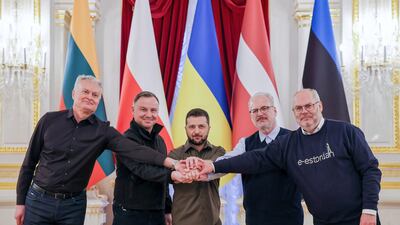
Left to right: President of Lithuania Gitanas Nauseda, Polish President Andrzej Duda, Ukraine's Mr Zelenskyy, President of Latvia Egils Levits, and Estonian President Alar Karis, in Kyiv on April 13. EPA -
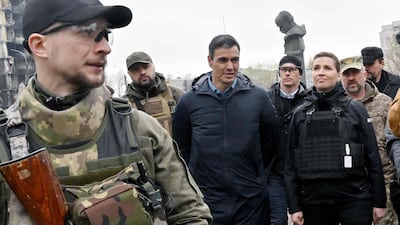
Spain's Prime Minister Pedro Sanchez and Denmark's Prime Minister Mette Frederiksen visiting Borodianka on April 21. AFP -
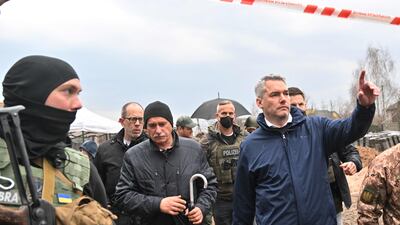
Austrian Chancellor Karl Nehammer, right, leaves after visiting the site of a mass grave in the Ukrainian town of Bucha, on April 9. AFP -
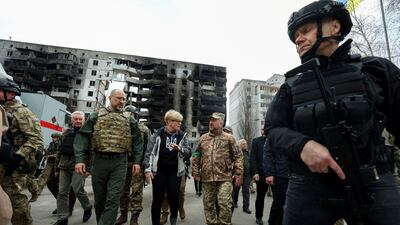
Lithuanian Prime Minister Ingrida Simonyte and Ukrainian counterpart Denys Shmyhal visiting Borodianka on April 11. Reuters -
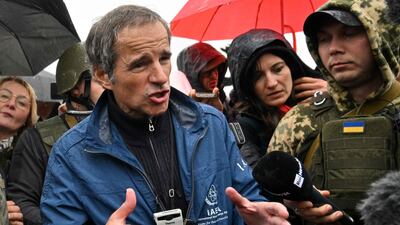
International Atomic Energy Agency Director General Rafael Mariano Grossi talks to journalists outside Chernobyl Nuclear Power Plant on April 26. AFP -

President of the Swiss National Assembly Irene Kaelin, surrounded by members of the Ukrainian military during her visit on April 27. EPA



