


Live updates: follow the latest news on Russia-Ukraine
Russia will seek payment in roubles for gas sales from "unfriendly" countries, President Vladimir Putin said on Wednesday.
The announcement sent European gas prices soaring on concerns that the move would exacerbate the region's energy crisis.
European countries' dependence on Russian gas to heat their homes and power their economies has been thrown into the spotlight since Moscow sent troops into Ukraine on February 24, and the imposition of western sanctions to isolate Russia economically.
With the financial noose tightening and the EU split on whether to impose sanctions on Russia's energy sector, Mr Putin hit back with a clear message: if you want our gas, buy our currency.
"Russia will continue, of course, to supply natural gas in accordance with volumes and prices ... fixed in previously concluded contracts," he said in a televised meeting with top government ministers.
"The changes will only affect the currency of payment, which will be changed to Russian roubles."
Russian gas accounts for about 40 per cent of Europe's total consumption and EU gas imports from Russia have fluctuated between €200 million to €800m ($880m) a day so far this year.
The possibility that a change of currency could throw that trade into disarray sent some European wholesale gas prices up to 30 per cent higher on Wednesday.
British and Dutch wholesale gas prices jumped by Wednesday's close of trade.
-
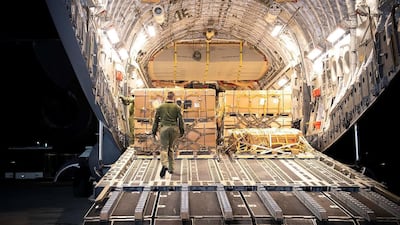
Workers unloading a Royal Canadian Air Force military transport plane to assist Ukraine at Lviv airport. AFP -
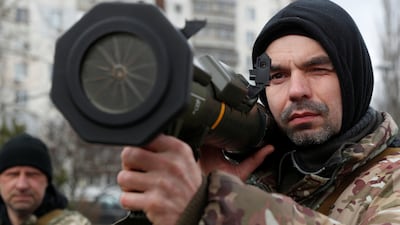
A new member of the Territorial Defence Forces trains to operate an AT4 anti-tank launcher in Kyiv. Reuters -
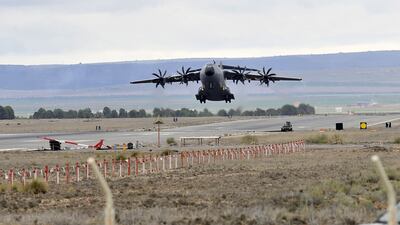
A plane loaded with military equipment for Ukrainian forces takes off from Albacete, Spain. EPA -
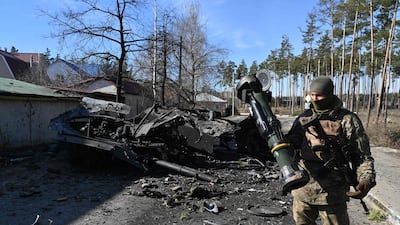
A Ukrainian soldier holds a Next Generation Light Anti-tank Weapon used to destroy a Russian armoured personal carrier in Irpin, north of Kyiv. AFP -
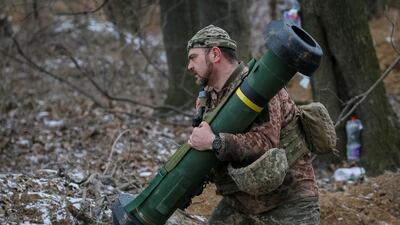
A Ukrainian serviceman with a Javelin missile system on the front line near Kyiv. Reuters -

A soldier holds a Panzerfaust 3 anti-tank rocket launcher at the Munster military training area in Germany in 2016. Getty Images -
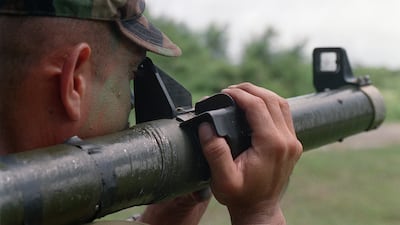
A US Marine Corps staff sergeant aims a M72 Light Anti-tank Weapon. Photo: US National Archives -

The Switchblade is a camera-equipped, remote-controlled flying bomb with a reputation for pinpoint delivery. AP Photo -

A coalition forces member fires a Carl Gustav recoilless rifle system during weapons practice on a range in Helmand province, Afghanistan, in 2013. US Army Photo -

A Starstreak surface-to-air missile system. PA


The Russian rouble briefly leapt to a three-week high past 95 against the US dollar and, despite paring some gains, stayed well below 100 after the shock announcement. The currency is down about 20 per cent since February 24.
"At face value this appears to be an attempt to prop up the rouble by compelling gas buyers to buy the previously free-falling currency in order to pay," said Vinicius Romano, senior analyst at consultancy Rystad Energy.
Mr Putin said the government and central bank had one week to come up with a solution on how to move these operations into the Russian currency, and that gas giant Gazprom would be ordered to make the corresponding changes to contracts.
With major banks reluctant to trade in Russian assets, some gas buyers in the EU were not immediately able to clarify how they might pay for it.
Companies including oil and gas majors Eni, Shell and BP, RWE and Uniper — Germany's biggest importer of Russian gas — declined to comment.
In gas markets on Wednesday, eastbound gas flows through the Yamal-Europe pipeline from Germany to Poland declined sharply, data from the Gascade pipeline operator showed.
Moscow calls its actions in Ukraine a "special military operation" to disarm and "de-Nazify" its neighbour. Ukraine. Western allies call this a baseless pretext that has raised fears of wider conflict in Europe.
Gazprom said 58 per cent of its sales of natural gas to Europe and other countries as of January 27 were settled in euros. US dollars accounted for about 39 per cent of gross sales and sterling about 3 per cent.
The European Commission has said it plans to cut EU dependency on Russian gas by two thirds this year and end its reliance on Russian supplies of the fuel "well before 2030".
But unlike the US and Britain, EU states have not agreed to impose sanctions on Russia's energy sector, given their dependency.
The Commission, the 27-country EU's executive, did not immediately respond to a request for comment.
German Economy Minister Robert Habeck said on Wednesday that he would discuss with European partners a possible answer to Moscow's announcement about the gas payments.
"It is unclear how easy it would be for European clients to switch their payments to roubles given the scale of these purchases," said Leon Izbicki, associate at consultancy Energy Aspects.
"However, there are no sanctions in place that would prohibit payments of Russian gas in roubles."
Mr Izbicki said that Russia's central bank could provide more liquidity to foreign exchange markets, which would enable European clients and banks to source the needed amount of roubles on the market.
But there are questions over whether Russia's decision would breach contracts, which were agreed to in euros.
"This would constitute a breach to payment rules included in the current contracts," said a senior Polish government source.
They said Poland had no intention of signing new contracts with Gazprom after their current long-term agreement expires at the end of this year.
Mr Habeck also said Mr Putin's demand was a breach of delivery contracts.
A representative for Dutch gas supplier Eneco, which buys 15 per cent of its gas from Gazprom's German subsidiary Wingas, said it had a long-term contract that was denominated in euros.
"I can't imagine we will agree to change the terms of that," they said.
Dutch Prime Minister Mark Rutte said on Wednesday that more time was needed to clarify Russia's demand and how it would relate to sanction rules.
"In general, it's up to market parties who buy Russian gas, how they deal with it," Mr Rutte said during a debate in Parliament.
"In their contracts it's usually specified in what currency it has to be paid, so it's not something you can change just like that."
Russia has drawn up a list of "unfriendly" countries that have imposed sanctions.
Among other things, deals with companies and people from those countries have to be approved by a government commission.
The list of countries includes the US, EU member states, Britain, Japan, Canada, Norway, Singapore, South Korea, Switzerland and Ukraine.
Some of these countries, including the US and Norway, do not buy Russian gas.

