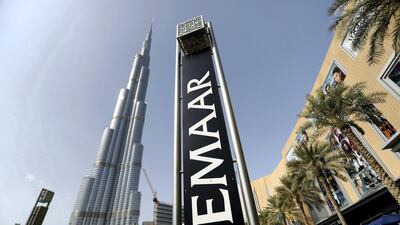
Emaar Properties reported a 35 per cent drop in its first-half net profit. Chris Ratcliffe/Bloomberg

Emaar Properties’ first-half profit drops on lower revenue amid pandemic


Fareed Rahman
  • English
  • Arabic

Emaar Properties, Dubai's largest listed developer by market capitalisation, reported a 35 per cent drop in its first-half profit as revenue fell amid a coronavirus-induced economic slowdown.

Net profit for the six months ending June 30 declined to Dh2 billion, the company said in a statement to the Dubai Financial Market, where its shares trade. Revenue during the period slid 22 per cent to Dh9bn. Selling, marketing, general and administration expenses also fell 5 per cent to Dh2bn.

“Our performance in the first half of 2020 has demonstrated our fundamental ability to retain strength and act with agility and speed in the face of the challenges presented by Covid-19,” Mohamed Alabbar, founder and chairman of Emaar Properties, said. “By acting boldly, innovating, revisiting our talent and retaining cash liquidity, I truly believe we have delivered a strong result despite the many challenges we faced.”

The company, known for building landmark projects like Burj Khalifa and Dubai Mall, reported property sales of Dh5.1bn during the period.

As of June, Emaar had delivered a cumulative 64,700 residential units. It is currently developing more than 29,000 residences in the UAE and over 11,000 units across other global markets.

Emaar has a sales backlog of Dh41.7bn, of which Dh29.5bn is in the UAE, to be recognised as revenue in the coming years, the developer said on Wednesday.

Subsidiary Emaar Development reported a net profit of Dh1bn and revenue of Dh4.8bn during the first-half, which were 25 per cent and 23 per cent lower than the respective figures filed in the same period last year.

Emaar Malls’ profit slid 69 per cent to Dh345 million as revenue dropped 26 per cent to Dh1.6bn.

“As the world emerges from Covid-19, I am confident that we will use our strength, talent and business diversity, that we have focused even more intensively on during these challenging times, to face the future stronger than ever,” Mr Alabbar added.

Emaar's international property arm recorded half-yearly revenue of Dh1.72bn, similar to last year's first-half revenue, on the back of “continued successful operations in Egypt and Pakistan, including the launches of [the] Cairo Gate mixed-use development and Panorama tower in Karachi.”

Dubai’s residential property sector faced a challenging second quarter, with social distancing measures, coupled with Covid-19’s economic impact, affecting market performance, according to a recent report by Chestertons. On an annual basis, average apartment prices declined 9.8 per cent, while villa prices fell 7.1 per cent.

“The outlook for Dubai’s residential market will be closely tied to the performance of the wider economy,” the agency said in its report.


Who has lived at The Bishops Avenue?
  • George Sainsbury of the supermarket dynasty, sugar magnate William Park Lyle and actress Dame Gracie Fields were residents in the 1930s when the street was only known as ‘Millionaires’ Row’.
  • Then came the international super rich, including the last king of Greece, Constantine II, the Sultan of Brunei and Indian steel magnate Lakshmi Mittal who was at one point ranked the third richest person in the world.
  • Turkish tycoon Halis Torprak sold his mansion for £50m in 2008 after spending just two days there. The House of Saud sold 10 properties on the road in 2013 for almost £80m.
  • Other residents have included Iraqi businessman Nemir Kirdar, singer Ariana Grande, holiday camp impresario Sir Billy Butlin, businessman Asil Nadir, Paul McCartney’s former wife Heather Mills. 
Hunting park to luxury living
  • Land was originally the Bishop of London's hunting park, hence the name
  • The road was laid out in the mid 19th Century, meandering through woodland and farmland
  • Its earliest houses at the turn of the 20th Century were substantial detached properties with extensive grounds


The specs: Rolls-Royce Cullinan

Price, base: Dh1 million (estimate)

Engine: 6.75-litre twin-turbo V12

Transmission: Eight-speed automatic

Power: 563hp @ 5,000rpm

Torque: 850Nm @ 1,600rpm

Fuel economy, combined: 15L / 100km

UAE%20SQUAD
%3Cp%3E%0DJemma%20Eley%2C%20Maria%20Michailidou%2C%20Molly%20Fuller%2C%20Chloe%20Andrews%20(of%20Dubai%20College)%2C%20Eliza%20Petricola%2C%20Holly%20Guerin%2C%20Yasmin%20Craig%2C%20Caitlin%20Gowdy%20(Dubai%20English%20Speaking%20College)%2C%20Claire%20Janssen%2C%20Cristiana%20Morall%20(Jumeirah%20English%20Speaking%20School)%2C%20Tessa%20Mies%20(Jebel%20Ali%20School)%2C%20Mila%20Morgan%20(Cranleigh%20Abu%20Dhabi).%3C%2Fp%3E%0A
Strait of Hormuz

Fujairah is a crucial hub for fuel storage and is just outside the Strait of Hormuz, a vital shipping route linking Middle East oil producers to markets in Asia, Europe, North America and beyond.

The strait is 33 km wide at its narrowest point, but the shipping lane is just three km wide in either direction. Almost a fifth of oil consumed across the world passes through the strait.

Iran has repeatedly threatened to close the strait, a move that would risk inviting geopolitical and economic turmoil.

Last month, Iran issued a new warning that it would block the strait, if it was prevented from using the waterway following a US decision to end exemptions from sanctions for major Iranian oil importers.

RESULTS

Lightweight (female)
Sara El Bakkali bt Anisha Kadka
Bantamweight
Mohammed Adil Al Debi bt Moaz Abdelgawad
Welterweight
Amir Boureslan bt Mahmoud Zanouny
Featherweight
Mohammed Al Katheeri bt Abrorbek Madaminbekov
Super featherweight
Ibrahem Bilal bt Emad Arafa
Middleweight
Ahmed Abdolaziz bt Imad Essassi
Bantamweight (female)
Ilham Bourakkadi bt Milena Martinou
Welterweight
Mohamed Mardi bt Noureddine El Agouti
Middleweight
Nabil Ouach bt Ymad Atrous
Welterweight
Nouredine Samir bt Marlon Ribeiro
Super welterweight
Brad Stanton bt Mohamed El Boukhari

Conflict, drought, famine

Estimates of the number of deaths caused by the famine range from 400,000 to 1 million, according to a document prepared for the UK House of Lords in 2024.
It has been claimed that the policies of the Ethiopian government, which took control after deposing Emperor Haile Selassie in a military-led revolution in 1974, contributed to the scale of the famine.
Dr Miriam Bradley, senior lecturer in humanitarian studies at the University of Manchester, has argued that, by the early 1980s, “several government policies combined to cause, rather than prevent, a famine which lasted from 1983 to 1985. Mengistu’s government imposed Stalinist-model agricultural policies involving forced collectivisation and villagisation [relocation of communities into planned villages].
The West became aware of the catastrophe through a series of BBC News reports by journalist Michael Buerk in October 1984 describing a “biblical famine” and containing graphic images of thousands of people, including children, facing starvation.

Band Aid

Bob Geldof, singer with the Irish rock group The Boomtown Rats, formed Band Aid in response to the horrific images shown in the news broadcasts.
With Midge Ure of the band Ultravox, he wrote the hit charity single Do They Know it’s Christmas in December 1984, featuring a string of high-profile musicians.
Following the single’s success, the idea to stage a rock concert evolved.
Live Aid was a series of simultaneous concerts that took place at Wembley Stadium in London, John F Kennedy Stadium in Philadelphia, the US, and at various other venues across the world.
The combined event was broadcast to an estimated worldwide audience of 1.5 billion.

Who was Alfred Nobel?

The Nobel Prize was created by wealthy Swedish chemist and entrepreneur Alfred Nobel.

  • In his will he dictated that the bulk of his estate should be used to fund "prizes to those who, during the preceding year, have conferred the greatest benefit to humankind".
  • Nobel is best known as the inventor of dynamite, but also wrote poetry and drama and could speak Russian, French, English and German by the age of 17. The five original prize categories reflect the interests closest to his heart.
  • Nobel died in 1896 but it took until 1901, following a legal battle over his will, before the first prizes were awarded.