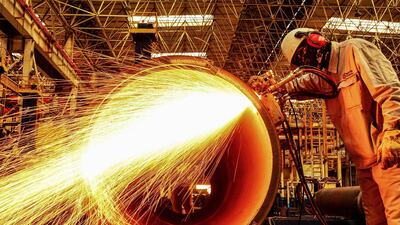
Profits at China's industrial firms grew for the fourth straight month in August, buoyed in part by a rebound in commodities prices and equipment manufacturing, the statistics bureau said on Sunday.
China's recovery has been gaining momentum as pent-up demand, government stimulus and surprisingly resilient exports propel a rebound.
Industrial firm profits grew 19.1 per cent year-on-year in August to 612.81 billion yuan ($89.8bn/Dh329.56bn), the statistics bureau said.
That compares with a 19.6 per cent increase in July and is the fourth straight month of profit growth.
However, industrial firms' profits still face external pressures as rising tensions between Washington and Beijing cloud the global trade outlook.
Raw material manufacturing profits increased by 32.5 per cent in August, up from 14.7 per cent in July, according to Zhu Hong, an official at the statistics bureau. This was driven in part by a rebound in the prices of international commodities such as crude oil and iron ore, he added.
Meanwhile, profits of the general equipment manufacturing sector rose 37 per cent in August from the same period last year, with electrical machinery up by 13.3 per cent over the same period.
Economic indicators in August, ranging from exports to producer prices and factory output, all pointed to a further pickup in the industrial sector.
However, factory activity grew at a slower pace with smaller firms facing sluggish market demand and financial strain.
The country has introduced a slew of measures to kick-start the economy, from tax and fee reductions to grace periods for the calling in of debt.
China's economy may stagnate if it fails to lift the value chain, as it faces increasing competition from countries with advanced technologies and lower labour costs, economists warned.
Authorities have pledged to boost investment in strategic industries including core tech sectors such as 5G, artificial intelligence and semiconductors, and accelerate new material development to ensure stable supply chains.
For the January to August period, industrial firms' profits fell 4.4 per cent from a year earlier to 3.72tn yuan.
Liabilities at industrial firms rose 6.6 per cent -year-on-year at the end of August, edging higher than the 6.5 per cent at the end of July.
Earnings at state-owned industrial firms were down 17 per cent on an annual basis for the first eight months of the year, versus a 23.5 per cent decline in the first seven months.
Private-sector profits fell 3.3 per cent in the January to August period, narrowing from January-July period's 5.3 per cent fall.

Four reasons global stock markets are falling right now
There are many factors worrying investors right now and triggering a rush out of stock markets. Here are four of the biggest:
1. Rising US interest rates
The US Federal Reserve has increased interest rates three times this year in a bid to prevent its buoyant economy from overheating. They now stand at between 2 and 2.25 per cent and markets are pencilling in three more rises next year.
Kim Catechis, manager of the Legg Mason Martin Currie Global Emerging Markets Fund, says US inflation is rising and the Fed will continue to raise rates in 2019. “With inflationary pressures growing, an increasing number of corporates are guiding profitability expectations downwards for 2018 and 2019, citing the negative impact of rising costs.”
At the same time as rates are rising, central bankers in the US and Europe have been ending quantitative easing, bringing the era of cheap money to an end.
2. Stronger dollar
High US rates have driven up the value of the dollar and bond yields, and this is putting pressure on emerging market countries that took advantage of low interest rates to run up trillions in dollar-denominated debt. They have also suffered capital outflows as international investors have switched to the US, driving markets lower. Omar Negyal, portfolio manager of the JP Morgan Global Emerging Markets Income Trust, says this looks like a buying opportunity. “Despite short-term volatility we remain positive about long-term prospects and profitability for emerging markets.”
3. Global trade war
Ritu Vohora, investment director at fund manager M&G, says markets fear that US President Donald Trump’s spat with China will escalate into a full-blown global trade war, with both sides suffering. “The US economy is robust enough to absorb higher input costs now, but this may not be the case as tariffs escalate. However, with a host of factors hitting investor sentiment, this is becoming a stock picker’s market.”
4. Eurozone uncertainty
Europe faces two challenges right now in the shape of Brexit and the new populist government in eurozone member Italy.
Chris Beauchamp, chief market analyst at IG, which has offices in Dubai, says the stand-off between between Rome and Brussels threatens to become much more serious. "As with Brexit, neither side appears willing to step back from the edge, threatening more trouble down the line.”
The European economy may also be slowing, Mr Beauchamp warns. “A four-year low in eurozone manufacturing confidence highlights the fact that producers see a bumpy road ahead, with US-EU trade talks remaining a major question-mark for exporters.”
