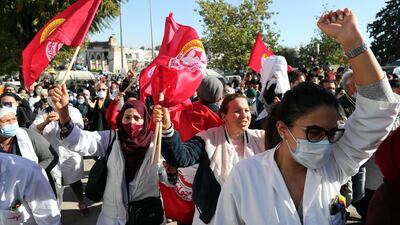
Tunisian health professionals take part in a demonstration demanding better working conditions in front of the Ministry of Health. Moody's says its downgrade of Tunisia's ratings reflects weak governance in the face of rising social constraints in the country. EPA
Tunisian health professionals take part in a demonstration demanding better working conditions in front of the Ministry of Health. Moody's says its downgrade of Tunisia's ratings reflects weak governa

Moody's cuts Tunisia's rating on slow pace of reforms amid weakening governance


Sarmad Khan
  • English
  • Arabic

Moody’s Investors Service downgraded Tunisia’s credit rating to B3, six notches below investment grade, as a result of the government’s weakening ability to implement fiscal and public sector reforms amid rising political tensions in the country.

The downgrade reflects weaker governance in the face of rising social constraints in impediment to reforms that are needed to
stabilise, and eventually reverse a marked increase in Tunisia's debt burden, the ratings agency said late Tuesday.

The government’s push to revive the economy requires a broad agreement with civil society institutions, however, parliamentary fragmentation and the increasingly contentious political environment weighs on the government's decision-making capacity.

“Reforms are critical to rebalance Tunisia's fiscal accounts and ensure debt sustainability in the future, amid a subdued growth outlook,” Moody’s said. “The reforms are also challenging in that they will involve both protecting the most vulnerable part of the population while achieving financially significant results that help the government regain some fiscal flexibility.”

Tunisia’s negative outlook also reflects downside risks related to further delays with the negotiation and implementation of an International Monetary Fund programme, an objective outlined by the government.

Renewed social protests, ahead of the announcement of specific measures by the Tunisian government suggest that the implementation of fiscal consolidation and public sector reforms is likely to be a highly protracted process, Moody's said.

“Such delays would increase uncertainty around the government's capacity to secure continued access to official external funding sources and maintain international capital market access at affordable terms in order to meet high funding requirements over the next few years,” it said.

Last April, the IMF approved a $745 million emergency loan for Tunisia to help the country mitigate the impact of the Covid-19 crisis on its economy.

However, the North African nation’s economy is estimated to have contracted 8.2 per cent in 2020, resulting in higher poverty and unemployment. Its fiscal deficit is also projected to have widened to 11.5 per cent of its gross domestic product, the IMF said in January.

The fund has called for “credible” reforms in civil service wage bill, which has increased to over 17 per cent of GDP in 2020 and is among the largest globally. Subsidy structure, the role of state-owned enterprises in the economy, the informal sector, tax equity, anti-corruption efforts and improvement in the country’s business environment are among the other reforms urged by the IMF.

It expects Tunisia’s GDP growth to rebound to 3.8 per cent this year, which is in line with Moody’s estimates of about 4 per cent expansion in 2021. The ratings agency expects growth to average 2-3 per cent per year thereafter.

Tunisia’s, which is largely reliant on tourism, has taken a hit in the wake of the Covid-19 crisis. Its debt-to-GDP ratio is set to rise to about 90 per cent this year from 84.7 per cent in 2020 and 72.3 per cent in 2019, according to Moody's. It will continue to edge higher in the next few years.

The country has upcoming debt service payments and maturities of over $1 billion in 2021 and 2024 and financing needs that account for 15-17 per cent of GDP, compared with 10 per cent before the pandemic, according to Moody’s.

10 tips for entry-level job seekers
  • Have an up-to-date, professional LinkedIn profile. If you don’t have a LinkedIn account, set one up today. Avoid poor-quality profile pictures with distracting backgrounds. Include a professional summary and begin to grow your network.
  • Keep track of the job trends in your sector through the news. Apply for job alerts at your dream organisations and the types of jobs you want – LinkedIn uses AI to share similar relevant jobs based on your selections.
  • Double check that you’ve highlighted relevant skills on your resume and LinkedIn profile.
  • For most entry-level jobs, your resume will first be filtered by an applicant tracking system for keywords. Look closely at the description of the job you are applying for and mirror the language as much as possible (while being honest and accurate about your skills and experience).
  • Keep your CV professional and in a simple format – make sure you tailor your cover letter and application to the company and role.
  • Go online and look for details on job specifications for your target position. Make a list of skills required and set yourself some learning goals to tick off all the necessary skills one by one.
  • Don’t be afraid to reach outside your immediate friends and family to other acquaintances and let them know you are looking for new opportunities.
  • Make sure you’ve set your LinkedIn profile to signal that you are “open to opportunities”. Also be sure to use LinkedIn to search for people who are still actively hiring by searching for those that have the headline “I’m hiring” or “We’re hiring” in their profile.
  • Prepare for online interviews using mock interview tools. Even before landing interviews, it can be useful to start practising.
  • Be professional and patient. Always be professional with whoever you are interacting with throughout your search process, this will be remembered. You need to be patient, dedicated and not give up on your search. Candidates need to make sure they are following up appropriately for roles they have applied.

Arda Atalay, head of Mena private sector at LinkedIn Talent Solutions, Rudy Bier, managing partner of Kinetic Business Solutions and Ben Kinerman Daltrey, co-founder of KinFitz

6 UNDERGROUND

Director: Michael Bay

Stars: Ryan Reynolds, Adria Arjona, Dave Franco

2.5 / 5 stars
