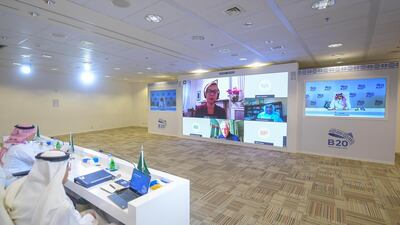

Business leaders and financial policymakers across the world need to come together to design a more robust post-pandemic economy, according to executives who spoke at a virtual plenary session of the Business 20 (B20), a representative forum for companies from G20 countries.
Changes are needed to create an economy that is greener, more inclusive, technologically advanced and more robust in terms of financial and healthcare infrastructure to deal with shocks such as the Covid-19 pandemic, the group said. Global mechanisms are needed specifically to protect supply chains and prevent countries from imposing export restrictions in times of crises, they added.
“The priority after that [post-pandemic era] would be to build something better. Many countries are now looking at exit scenarios … it is not a question of restarting the economy as I hear people say, it is question of redesigning the economy,” Paul Polman, chairman of the International Chamber of Commerce, told delegates on Tuesday evening.
“We need better health systems, we need to protect biodiversity, we need more green growth and we need to make that growth more inclusive. Frankly, it makes a lot of sense … [to] design right for the future.”
The Covid-19 outbreak, he said, has exposed the flaws of the gig, or informal, economy due to the lack of a social safety net.
Businesses and the global community at large were ill-prepared for the pandemic shock, but have generally risen to the challenge, according to the B20 leaders. There are however, exceptions – including companies operating out of tax havens or those that have spent their cash reserves on share buybacks and special dividends for shareholders who are now seeking bailouts from their respective governments.
Mr Polman and David Nabarro, special envoy on Covid-19 for the World Health Organisation, criticised governments who did not learn from countries such as Singapore or Germany that had effective virus-handling strategies, and those who downplayed the severity of the pandemic.
Mr Nabarro said the pandemic would prove to be a “catalyst” for enhanced global coordination in the future.
Since the outbreak of Covid-19, about 75 countries across the globe have imposed export barriers on materials for personal protective equipment such as masks, gowns and face shields for healthcare workers. At the same time, many have eased their restrictions, which is “asocial behaviour when you have a global crisis”, Mr Polman noted.
There is currently no global mechanism in place to deal with such issues, but measures against protectionism should be considered in the post-pandemic economy, he added.
The Covid-19 outbreak has infected more than 2.5 million globally and fatalities have topped 178,000 as of Wednesday, according to Johns Hopkins University, which is tracking the disease.
The global economy is facing its deepest recession since the Great Depression in the 1930s and is projected to shrink 3 per cent in 2020, the International Monetary Fund said earlier this month.
The bleak forecast from the Washington-based lender is a more than 6 percentage point revision, relative to its October 2019 estimates and updated January 2020 projections of a 3.3 per cent expansion in global gross domestic product. The outlook now is worse than the 2008 financial crisis and the IMF does not expect recovery to take place before 2021.
Governments and central banks across the globe have poured an estimated $8 trillion (Dh29.4tn) into the global economy to ensure financial stability and soften the impact of the outbreak. The G20 countries have so far poured more than $5tn into their economies to prop up the corporate sector, protect jobs and support small and medium-sized businesses.
“The $5tn injection already announced by the G20 is a good initial response, but more yet may be required,” Yousef Al Benyan, vice chairman and chief executive of Sabic, who is also the chair of the B20, said. “Together businesses and governments should decide which are the next steps we will follow … to restart the [global] economy safely.”
As the official voice of the business community in the G20 countries, B20 is calling for “urgent and coordinated efforts” to contain the impact of Covid-19 on businesses and the global workforce. The B20 will continue to explore the issues faced by businesses and will submit “action-oriented policy recommendation[s]” to the G20 leadership, he said.
The lockdown and social distancing measures that are in place in most countries around the world have forced businesses to adapt and operate remotely, which Nasser Al Nasser, chief executive of Saudi Telecom Company, said will be the new normal in the post- pandemic world.
“I believe even after the coronavirus, between 50 to 70 per cent of the companies, especially in the technology sector, would be working remotely,” Mr Nasser said, adding that “virtual working” will become the new norm.
Technology will be invaluable in controlling and predicting further outbreaks of diseases. It will also be vital in enforcing physical distancing and helping governments to decide when and where to enforce lockdowns and when to ease restrictions, he noted.
Governments and the private sector, however, will have to come together to make the technology-driven new economy more inclusive as there are about 3 billion people who currently do not have access to the internet, he noted.

