
"Diamonds are a girl's best friend," Marilyn Monroe famously sang in the 1953 film Gentlemen Prefer Blondes.
Fast forward 65 years, and the ladies appear as smitten with the stone as ever, judging by the numerous photos of friends’ diamond engagement rings on Instagram and Facebook feeds.
When it comes to gemstone traders in search of a profit, however, gentlemen (and ladies, of course) now seem to prefer coloured stones like rubies and emeralds, given the superior profit that can be made compared with their clear carbon cousins.
While global demand remains high, ample supply and a clear set of industry standards governing quality mean that diamonds have become increasingly commoditised, resulting in thin margins compared with coloured stones.
“[Standardisation] has allowed many people in the trade, as well as consumers, to feel they can make a purchase based on a grading report without actually handling the stone,” says Stuart Robertson, research director at Gemworld International.
“That’s not at all the case with coloured gemstones because there are such variables in colour tones that they really don’t lend well to selling solely on the basis of what a laboratory report says about the stone.”
Dev Shetty, chief executive of Dubai-based Fura Gems, estimates that the global market for coloured gemstones stones - encompassing rubies, emeralds and sapphires - will grow to $5 billion within five years from its current level of $2bn.
Emeralds in particular are likely to see a significant rise in demand in the coming years, boosted by an uptick in demand from the Middle East, according to Mr Shetty.
“Emeralds play a very important part role in this part of the world. Their colour makes them very auspicious in the Middle East,” he says, noting the colour green’s importance within Islam.
Saudi Arabia - whose flag consists of the Islamic shahada and a sword on a green background - accounts for about half of the emerald market within the Arabian Gulf, Mr Shetty notes, with the UAE representing the region’s second-largest market.
The Middle East is the third-largest market worldwide for emeralds behind the US and China, he adds.
While demand for emeralds has been muted in recent years due to intermittent supply, the market for the green gems is set to rise by around 20 per cent in the coming two years, according to Mr Robertson.
_______________
Read more:
Rare pink diamond sells for $32m
Men accused of stealing emeralds worth Dh10m from Dubai dealer
_______________
"We see them as one of the more popular gemstones right now, and there seems to be growing demand once again and good supply coming out of South America, Central America and Africa," he tells The National.
Mr Shetty hopes that much of this demand will be met from Colombia’s Coscuez emerald mine, in which Fura acquired a 90 per cent stake in January.
“50 per cent of the world’s emeralds supply comes from Colombia,” he says.
“We have 240 people on the ground working with us in the country, and we’ll be scaling up [operations] as we go along.”
Alongside its emerald interests, Fura is bullish on the prospects for rubies, spurred on by demand from markets such as China, the US, Europe and India.
_______________
View more:
Some of the world's most valuable cut and uncut emeralds and rubies
-
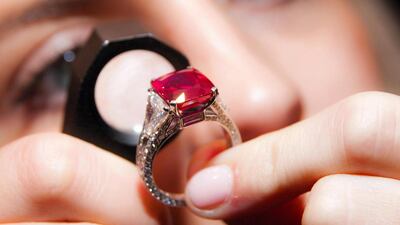
The Graff Ruby Ring – $8,600,410: Another expensive ruby ring sold at a Sotheby’s Geneva auction is the Graff Ruby. The cushion-cut, Burmese ruby, also of “pigeon blood red” colour, weighs 8.62 carats and is set between diamonds in a white metal mounting accompanied by bead-set round brilliant cut diamonds. Alamy Live News -
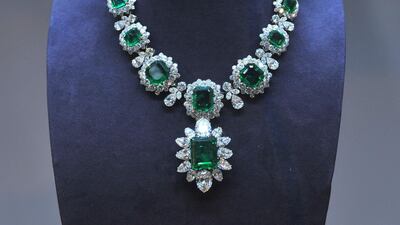
Taylor Emerald: Elizabeth Taylor, the late British actress, owned the world’s most expensive emerald created by Bvlgari. A 23.46-carat Colombian emerald set in a diamond brooch was sold for a then record price of $6.1 million at a Christie’s auction in New York in December 2011, a few months after Taylor's death. The gem was gifted to her by actor Richard Burton. AFP -
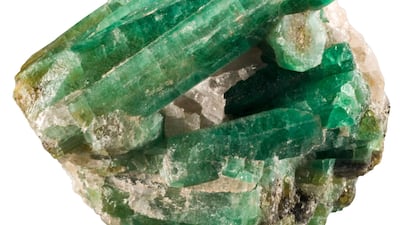
Bahia Emerald. $250 million to $925m: The world’s largest emerald ever uncovered in a single shard, the Bahia Emerald weighs approximately 1.7 million carats, or 752 lbs. It was discovered in the Bahia region of eastern Brazil. Today the uncut lump it sits in an evidence vault at the LA sheriff’s office after a legal battle in which a US federal judge in 2015 ordered it remain under lock and key, barring anyone, including those who won their claim to the stone, from moving or even seeing it. -

Guinness Emerald - $500 million: The 1759-carat emerald was discovered at the Coscuez mine, owned by Fura Gems. It was for several years the largest uncut emerald on earth, and made it into the Guinness Book of Records. But once it’s been cut, it could be worth more than $500m to the right buyer. Today, the stone is resting comfortably in the Banco Nacional in Colombia. AFP -
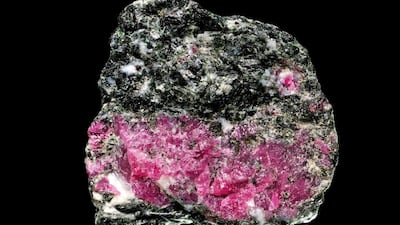
Chaiyo Ruby - $448 million: The Chaiyo Ruby is an enormous uncut gemstone weighing 109,000 carats: that’s about the same weight as a seven or eight-year old child. The ruby came out of a mine in south Asiaand both Myanmar and Thailand dispute ownership. Its current whereabouts are unknown. It vanished in the early 2000s. Some rumours speculate it was stolen by members of the Myanmar military. -
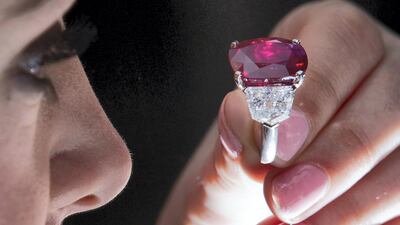
Sunrise Ruby - $30 million: In May 2015, the Sunrise cut ruby was sold for $30m becoming the most expensive coloured gemstone ever to be sold at an auction at the time. The Sunrise weighed 25.59 carats was sold at Sotheby’s auction in Geneva. It hails from Mogok in Burma and is one of the rare rubies that has been graded as "Pigeon blood" red. It has the perfect saturation and intensity of red. AFP


_______________
The company, which is listed on the Toronto Stock Exchange, acquired nine new ruby mines in Mozambique in July, combining with existing assets in the country giving it what it describes as the largest ruby land package in the country.
Yet while the market for rubies has been robust over the past years, margins are set to fall as additional supply comes online, according to Mr Robertson.
“The market’s probably stabilised after a decade of very strong production from Mozambique. We’re seeing a levelling off in the market, there’s [now] a lot of material in the market way above historical levels,” he says.
Fura plans to start marketing emeralds in the second quarter of 2019, with rubies coming on line the following quarter.
In addition to its mining interests, Fura Gems plans to market rough stones from its headquarters in JLT in Dubai.
“Marketing is going to play a very important role in our business,” Mr Shetty says.
“We’re operating in a sector that is highly unorganised; people increasingly want to know the source of the stones, and we intend to specialise in building an ethical route to market, via a culture of disclosure and transparency.”
Fura is already in discussions with diamond traders within the Dubai Multi Commodities Centre about rubies and emeralds, with Mr Shetty reporting positive feedback thus far.
“A lot of the diamond guys who are making thin margins are looking to get into coloured gemstones,” he says.
Fura has 10 staff in Dubai, a figure it expects to grow by 30 by the end of next year. Mr Shetty hopes to increase staff at the company’s office, including a treatment for emeralds and rubies, to around 100 staff within two to three years.

