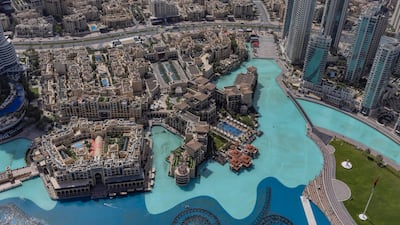

Dubai and Abu Dhabi have been ranked among the top 10 destinations for next-generation wealth despite the fallout from geopolitical tensions, according to Savills.
Dubai was ranked eighth and the UAE capital was 10th among favoured cities for the $84 trillion of wealth expected to be transferred between generations over the next two decades, the London-based consultancy said in its Spotlight on Wealth Trends report on Wednesday.
Next-generation wealth refers to individuals under 40 who have inherited significant wealth or have accumulated it through entrepreneurial success.
Dubai and Abu Dhabi benefitted from a slew of government initiatives that support economic and societal growth, including favourable tax environments, business-friendly policies and significant infrastructure investment “with a sophisticated luxury offering”, Savills said.
In particular, Dubai's entrepreneurial ecosystem, global connectivity and lifestyle appeal attract international talent and capital. Abu Dhabi complements this with its growing financial centre, a rising number of family offices, expanding economic opportunities and a high quality of life, the study said.
Those are “reinforcing the UAE's position as a compelling destination for globally mobile wealth”, Kelcie Sellers, associate director for world research at Savills, wrote in the report.
In the wider Gulf, “economic diversification and succession planning are becoming more prominent, with growing focus on family governance, next-generation involvement and the long-term deployment of capital within the region”, Ms Sellers said.
Despite the geopolitical uncertainty and economic headwinds, wealth generation and the flow of new money to the UAE continues. The country is a magnet for the ultra-wealthy, as well as for global wealth managers and trillion-dollar asset managers.
A base in the country offers global investors and money managers opportunities to expand regional operations and work with some of the largest sovereign wealth funds, as well as institutional partners.
Net wealth in the UAE is set to jump to $6 trillion by the end of this decade despite the short-term volatility caused by conflict in the Middle East, a report this week by Boston Consulting Group found.
In the five years to the end of 2030, net wealth in the Emirates is set to increase by more than $2.3 trillion, at annual growth of 10.6 per cent, the report said.
Last year alone, net wealth in the Arab world’s second-largest economy grew by almost 13 per cent on an annual basis to reach $3.6 trillion.
New York leads globally
New York topped the Savills list, followed by Miami, London, San Francisco, Los Angeles, Singapore, Hong Kong and Monaco at ninth. Dubai and Abu Dhabi were the only Gulf cities on the list, which ranked more than 100 destinations worldwide.
Cities in Europe, the Middle East and Africa accounted for 16 of the index’s top 30 locations, driven by lifestyle and sporting events, which include major golf and tennis tournaments and Formula One races.
In terms of the number of sporting events, Dubai was number one in the Emea region, while Abu Dhabi, home of the season-ending F1 race, was sixth.
“The defining characteristic of Emea is the diversity of its wealth proposition. Global business centres, leading educational institutions, major sporting and cultural events, coastal retreats and mountain resorts are all within reach,” Ms Sellers said.
Global wealth continues to grow rapidly. Total personal wealth jumped by nearly 11 per cent in 2025 to create about one million more millionaires, according to industry tracker Altrata.
More than 510,800 are now ultra-high net worth individuals, or those with a net worth of $30 million or more, holding around $60 trillion in combined wealth – which is greater than the combined economies of the US and China, Altrata said.
“Location decisions are becoming a core component of wealth planning … at the same time, new fortunes generated by technology and artificial intelligence are reshaping global wealth hubs,” Ms Sellers said.
“As a result, many wealthy families are adopting multi-jurisdictional lifestyles, balancing residence, education and wealth structures across multiple markets.”

