
Traders expect the US Federal Reserve to raise interest rates this week to clamp down on energy-induced inflation driven by the Iran war.
Nearly 90 per cent of traders believe the US central bank will raise interest rates by 25 basis points on Wednesday, snapping a nine-month holding pattern, CME Group data shows. The UAE Central Bank is likely to mirror the Fed's decision.
“People are finally waking up to the risk that the Iran war will be prolonged, and so relief is no longer in sight for energy prices,” said Derek Tang, an economist at MPA Macro.

Oil prices gained nearly 8 per cent last week on escalating tension in the Gulf, including Yemen's Houthi rebels seizing the port city of Mokha on the Red Sea. Brent crude settled at $104.50 per barrel on Friday before Saudi Arabia's Energy Ministry announced it had shut down the East-West Pipeline after it sustained several attacks. The pipeline is one of the kingdom's most valuable crude export routes with a full pumping capacity of seven million barrels per day, official statistics show.
The pipeline's closure could mark a defining moment in the six-month conflict. Tanker traffic in the Strait of Hormuz, where about 20 per cent of global energy supplies transited before the war began, remains significantly below its pre-conflict levels, the IMF's PortWatch tool shows.

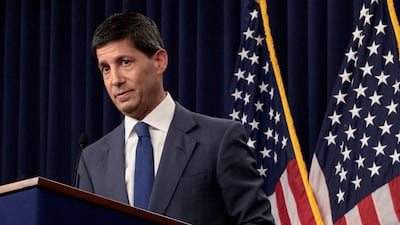
Price pressures have eased in recent months after reaching 4.2 per cent in May following the energy-driven inflation surge from the Iran war, but the question facing Fed chairman Kevin Warsh is how confident he is inflation is moving towards the central bank's 2 per cent target.
Michael Pearce, chief US economist at Oxford Economics, compared the current situation to the Fed to sitting on a “knife edge”.
“It's just a broader-picture question of are you comfortable with the pace at which that inflation is coming down, or do you think a rate hike might better balance the risks around the economy,” he said.
US government data showed headline inflation held firm at a 3.4 per cent annualised rate in August, in line with expectations. Core inflation, which removes the volatile food and energy indexes, rose 2.4 per cent year-on-year, also in line with expectations.
The same report showed petrol prices are up 27.4 per cent compared with the same time last year, and rose 3.9 per cent on a monthly basis in August. While the report is not “hot”, it was considered enough to tip the scales towards a quarter-point rate increase.
Prices at the pump in the US are also rising. The average driver is now paying $4.29 per gallon, compared with last year's average of $3.19. US diesel prices have climbed above $6 per gallon, compared with $3.70 at this time last year, making it more expensive for freight networks to deliver everyday goods. Those costs could soon be passed on to consumers.

The latest inflation reading also puts Mr Warsh in a corner. He told the Jackson Hole symposium last month that he was unconvinced by recent better-than-expected inflation readings.
“Together with oil prices that have moved sharply higher in recent weeks, we think the recent run of inflation data meet the low bar to hike that Chair Warsh laid out in his speech at Jackson Hole,” Wells Fargo economists wrote in a note. “We are deeply sceptical of tighter monetary policy as an antidote to energy-induced inflation, but right now it's the Fed's world and we're just living in it."
Bond market rout comes for Fed
Policymakers also enter this week's meeting facing pressure from a recent increase in global bond yields.
US long-term yields have recently hit a near two-decade high on inflation fears and rising government debt. That could make it more expensive for countries in the Gulf that might have to borrow to offset lost revenue from the Iran war.
The Treasury Department this week moved to ease the cost of borrowing by announcing the US would buy back $6 billion worth of government debt to calm the sell-off in the US bond market. Instead, the yield on the 10-year Treasury hit its highest level since 2023.

“All of these challenges essentially mean that policymakers are going to need to be both nimble and credible,” IMF communications director Julie Kozack told reporters during a briefing last week.
Bond markets will be paying close attention to Mr Warsh after he delivered what Fed watchers considered to be an unconvincing press conference in July. At the time, he suggested the bond market could tighten conditions for him, leaving markets questioning his inflation credibility.
“In the past he's put it put in his mouth a little bit by sort of using the rises in bond yield as an excuse for not hiking,” Mr Tang said. “It'll be informative how he answers that question.”

