
The US Treasury Department announced on Wednesday it will buy back up to $6 billion of government debt as it seeks to contain long-term borrowing costs.
The move, which is triple the size of its normal operations, comes as Treasury yields have been rising in recent months, making borrowing costs higher for consumers. US Treasury yields are linked closely to Gulf states, where most currencies are directly pegged to the US dollar.
The Treasury Department previewed the action last month after long-term yields rose to near two-decade highs over fears of rising US government debt – which recently passed $40 trillion – and oil-driven inflation.
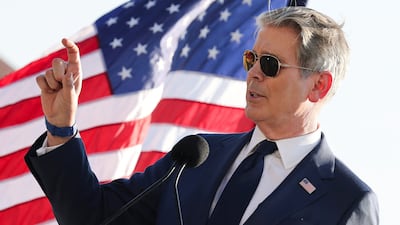
“There was like this fever that was building,” Treasury Secretary Scott Bessent said during a Breitbart News event on Tuesday.
He said the programme was aimed to calm a "fever" in the bonds market. Long-term yields have been steadily rising since the Federal Reserve held interest rates steady in July and when traders were not convinced that Fed Chairman Kevin Warsh offered a clear path to return inflation to 2 per cent.
Despite Mr Bessent’s remarks, Treasury yields rose after Wednesday’s announcement. The yield on the benchmark 10-year Treasury note rose more than 3 basis points to 4.835 per cent, while the 30-year Treasury note was up more than 2 basis points at 5.289 per cent. The two-year Treasury, which is closely linked to Federal Reserve policy moves, was trading more than two basis points higher at 4.423 per cent.
The rise in yields come amid escalating tension in the Middle East, where Iran and the US have been trading attacks on tankers in the Gulf. Oil prices rose on the attacks, with Brent crude gaining more than $2 to pass the $100-a-barrel threshold once again.
The rise in US Treasury yields also comes as the war forces some Gulf states to borrow more money to offset loss in oil revenue from the closure of the Strait of Hormuz and Iranian attacks on key energy sites.
Justin Alexander, director of Khalij Economics, said during an event at the Arab Gulf States Institute that while spreads for most Gulf sovereigns over US Treasuries have either tightened or moved little during the war so far, a more prolonged conflict could lead to those spreads widening.
“That all increases the financing cost for the region at a time when countries … like Kuwait and Qatar and Bahrain, they potentially have to borrow a large amount of money. So that that does make it more expensive for Gulf companies,” Mr Alexander said during a panel session at the Arab Gulf States Institute in Washington.
He also said that few Gulf states have issued debt during the war.
Saudi Arabia returned to the international debt market last week, announcing it had raised $3.25 billion during a two-tranche sukuk, while Kuwait sold $6 billion of bonds in July. Bahrain raised $1 billion through a bond issuance in June.
Mr Bessent has recently taken a more activist approach in his role, including through his intervention to support the Japanese yen. He has opposed recent criticism of the measures, including from his mentor and US investor, Stanley Druckenmiller.
"I am the house now,” Mr Bessent said on Tuesday in Texas. “And you can bet against me if you want.”

