
Brent crude is back above $100 a barrel, returning to a level last seen about six weeks ago, as a fresh escalation in the Middle East puts the world’s most important oil routes back in focus.
For consumers and the global economy, the question is whether this is another short-lived spike or the start of a longer period of triple-digit oil prices.
So why have prices jumped again? There are two immediate reasons: escalating Houthi attacks on energy infrastructure in Saudi Arabia, Opec’s biggest oil exporter, and renewed tit-for-tat strikes by the US and Iran on oil tankers in the Gulf.

Together, they have revived the concern that has driven some of oil’s biggest moves this year: that the conflict could disrupt the physical supply of crude, rather than simply threaten it.
At the centre of those fears is the Strait of Hormuz. About a fifth of the world’s oil and gas used to pass through the narrow waterway, making any disruption there a potential problem far beyond the Gulf.
“The immediate driver is renewed tension across Middle Eastern energy and shipping routes, where attacks on energy infrastructure, tanker disruptions and threats around major transit corridors have increased the risk that physical barrels become harder to move even if production capacity remains available,” Naeem Aslam, chief investment officer at London-based Zaye Capital Markets, said.
There is another pressure point, too: Bab Al Mandeb, the waterway linking the Red Sea and Gulf of Aden.
More attacks on Saudi crude tankers sailing through Bab Al Mandeb strait could make it harder for the kingdom to use alternative export routes, further complicating global energy supplies.
And analysts say the pressure on prices may not disappear even if the latest attacks stop.
Even if the exchange of like-for-like hits on crude oil tankers by the US and Iran stops immediately and the Houthi campaign against Saudi Arabia ebbs, oil prices could remain elevated, according to Swiss lender UBS and Wall Street investment bank Goldman Sachs.
The latter sees the possibility of a prolonged Middle East conflict and disruptions to traffic through Hormuz extending into the next year.
How did oil get back to $100?
Brent, the international benchmark, rose 2.14 per cent to $100.02 a barrel at 11.35am UAE time, while US crude measure West Texas Intermediate gained 1.8 per cent to $94.70.
But the return to $100 is only the latest swing in an unusually volatile year for oil.
Oil prices, which climbed above $100 per barrel in July, have gained more than 4 per cent this week so far, a relatively modest move compared with some of the dramatic swings seen earlier in the conflict, according to analysts.
Crude rose as much as 19.6 per cent on March 8, during the early days of the US-Israel war with Iran.
A 10 per cent single-day gain in the first week of March and more than 6 per cent jump on July 23 are among Brent’s biggest moves during the conflict, now in its seventh month.
Before the war, Brent was trading at about $72 a barrel. It has since come close to $120 and is up about 60 per cent this year.
The pattern is clear: when the regional conflict escalates, oil prices tend to jump. When tensions ease and crude continues to flow, some of that risk premium comes out of the market.
Is this a return to tanker warfare?
The latest rise has been driven not only by the threat of disruption, but also by attacks on the vessels that physically move oil out of the region.
The attacks on oil tankers by both the US and Iran this week ended a period of relative restraint between the two countries.
The two sides exercised restraint after the US said it would build economic pressure by imposing sanctions on Iran instead of broadening its military campaign in the region.
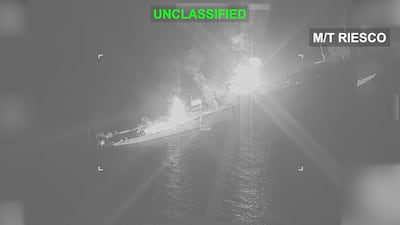
On Tuesday, US forces destroyed five Iranian crude oil carriers after Iran's Islamic Revolutionary Guard Corps attacked an American warship with ballistic missiles, the US Central Command said.
Iranian carriers Kaviz, Charminar, Horizon 1 and Riesco were destroyed in the Gulf of Oman, and Derya was hit near Kharg Island, Centcom said.
Iranian state media had earlier reported explosions on or near the island, Tehran's main crude export hub.
Tuesday's US hit on crude carriers followed strikes on three Iranian tankers on Saturday after the IRGC tried to attack an American aircraft carrier and guided-missile destroyer.
“Iran continues to try to hit US naval ships, and every time they do that, or try to do that, they're going to lose tankers,” US Secretary of State Marco Rubio warned on Tuesday.
The important point for oil markets is that crude is still moving – but doing so has become considerably riskier.
Although some crude oil is still transiting Hormuz, often via vessels operating without transponders, shipping risks remain acute, Soojin Kim, Dubai-based analyst at Japanese lender MUFG, said.
“With military action increasingly targeting tankers and energy infrastructure, the threat of deeper disruption to Gulf exports risks tightening markets further and pushing Brent back towards triple-digit levels,” she said.
Is it safe to transit Hormuz?
Safe passage through the strait is one of the biggest questions hanging over the oil market.
Iran on Tuesday retaliated with what it claimed were strikes on commercial and naval vessels, and waves of missile attacks on a US military base in Jordan.
The IRGC, in a statement, said it had targeted two US naval vessels, eight oil tankers and 10 other ships in the Gulf that it claimed had violated a designated “unsafe” zone around the Strait of Hormuz.
Iranian oil tankers had suffered significant damage in US attacks, the IRGC added on Telegram.
Jordan’s armed forces said their air defence systems had engaged 20 ballistic missiles fired towards the country from Iranian territory.
“Eighteen missiles were successfully intercepted and destroyed,” a representative said, while two fell in unpopulated areas.
Traders are bracing for more disruption to crude flows through Hormuz after Iran threatened to attack more commercial vessels.
The Iranian navy has told crews aboard oil tankers in or near Bahrain and Kuwait to leave their vessels, saying the ships will be targeted.
“We warn all tanker crews in the vicinity of the ports and harbours of Kuwait and Bahrain, which host these terrorists and are complicit in their hostile actions, to immediately leave their vessels, whether they are at anchor or berthed at port, as they will be targeted,” the IRGC said on Telegram.

Giovanni Staunovo, energy strategist at UBS, said the continued strikes on vessels attempting to transit the strait via the southern lane, even with US military escorts, “leave flows vulnerable to renewed disruption”.
Saudi Arabia's role
Iran-backed Houthi militants attacked Saudi Arabia’s energy infrastructure on Tuesday, including its 400,000 barrel-a-day Jazan refinery and other facilities serving the country's domestic market.
The Saudi-led coalition in Yemen said Houthi attacks on Abha, Khamis Mushait, Jazan and Najran wounded 73 people, and struck Aramco's Jazan facilities. It called the assaults a “dangerous escalation”.
The Yemeni militia group has blockaded Saudi Arabia’s ports and restricted the flow of crude oil transiting through Bab Al Mandeb strait.
It has hit several Saudi crude carriers in recent weeks and has launched attacks on Saudi territory in response to what it claims is Riyadh’s siege of the Yemeni capital, Sanaa.
The Houthi campaign against the kingdom, Opec's biggest oil exporter, complicates the global energy supply dynamics and adds to Iran war concerns.
“Markets are increasingly pricing a prolonged Mideast conflict,” Goldman Sachs analysts said in a note.
The investment banking company raised its oil price estimate from $80 to $90 per barrel for 2026, and said it might exceed $120 per barrel next year.
UBS has also raised its price estimate. It expects Brent to trade at $95 a barrel by year-end, revising the forecast from $85 per barrel previously.
“The key decision-making signal is whether actual supply disruption, falling inventories and resilient demand begin moving together,” Mr Aslam said.
“If they do, oil can sustain a higher trading range; if physical flows remain intact while inventories rebuild and demand weakens, the current rally becomes far more vulnerable to reversal.”