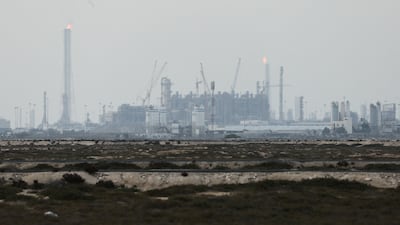

Global agency Fitch Ratings has affirmed Qatar's credit rating at “AA” because of its strong economy and expects its liquefied natural gas exports to reach pre-war levels in the second half of next year.
The agency also removed the Gulf nation from “Rating Watch Negative”, citing reduced risks to its liquefied natural gas units since March, while the outlook is kept at “negative”, with LNG exports disrupted by the closure of the Strait of Hormuz.
“The AA rating reflects gross domestic product per capita among the world's highest, large sovereign assets, our expectation that additional gas production will further strengthen public finances,” Fitch said on Saturday.

An AA rating is the third-highest on Fitch's rating scale, just two notches below the top prime grade. Investment grade makes it easier to access capital markets and raise funding when the need to borrow arises.
The ratings agency removal of the Gulf nation from the Rating Watch Negative alert comes as it expects less fewer risks to LNG facilities following attacks by Iran on Ras Laffan, the world's largest LNG refinery, in March.
“While the geographic concentration and high complexity of Qatar's LNG facilities is a vulnerability, the risks of further severe damage have reduced since March and the impact of the war on the credit profile will take longer to discern,” Fitch said.
Iranian missile strikes in March destroyed parts of the Ras Laffan industrial complex that supplies one-fifth of the world's super-chilled fuel. Iranian strikes damaged Trains 4 and 6, removing 12.8 million tonnes a year (mtpa), equivalent to about 17 per cent of Qatar's LNG exports from the market.
QatarEnergy declared long-term force majeure on contracts with buyers in China, South Korea, Italy and Belgium. The company’s chief executive, Saad Al Kaabi, put annual lost revenue at $20 billion and estimated repairs would take three to five years.
Closure of the Strait of Hormuz, through which more than 20 per cent of the global supply of crude oil and LNG used to transit before the conflict broke out, impacted Qatar's ability to export the latter.
LNG export forecast
However, exports are projected to reach pre-war levels in the second half of next year.
“We assume that some form of deal will enable conditions conducive to the resumption of exports through the strait in the first quarter of next year, after which it will take about six months to reach the pre-war level minus the 17 per cent of capacity damaged by the Iranian attack on Ras Laffan,” Fitch said.
Gulf and Middle East states are constantly assessing the situation between the US and Iran as the war between the two countries has continued since February 28.
The two countries exchanged fresh strikes this week, with the US attacking some sites near the Strait of Hormuz, and Tehran launching missiles and drones at Jordan and Kuwait.
The Middle East economies continue to suffer as the war drags on.
Earlier this year, the International Monetary Fund cut its 2026 growth forecast for the Middle East to 0.7 per cent, a 1.2 percentage point downgrade from April, due to the fallout from the Strait of Hormuz closure on regional energy exports.
However, the growth is projected to rebound to 6.5 per cent in 2027, an increase of 1.9 percentage points from its previous assessment.
The IMF said the three oil producers most affected by the disruptions – Iraq, Kuwait and Qatar – are expected to face sharp contractions this year, followed by “double-digit expansions” next year.