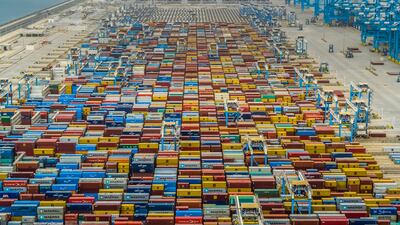

AD Ports Group, which operates industrial cities and free zones in Abu Dhabi, reported a 43 per cent annual jump in its first-quarter profit as the company focused on diversifying its trade routes amid the Iran conflict.
Net profit attributable to owners of the company for the three months to the end of March climbed to Dh497.4 million ($135.4 million), AD Ports said on Wednesday in a filing to the Abu Dhabi Securities Exchange, where its shares trade.
Revenue surged 25 per cent year on year to Dh5.75 billion. Finance costs also fell during the period, boosting the profit of the company.

The company said it has been able to maintain uninterrupted services throughout the challenges posed by the Iran war.
“Faced with rapidly evolving regional developments with global macroeconomic and supply chain implications, AD Ports Group responded decisively in first quarter, demonstrating the agility, resilience, and forward-thinking,” said managing director and group chief executive Capt Mohamed Al Shamisi.
The Middle East conflict has tipped the region into its worst geopolitical crisis in decades. The war that began on February 28 with Israel and US bombing Iran, and Tehran lashing out at its Arab neighbours in retaliation, has disrupted business across the region.
With the Strait of Hormuz, the vital global energy and trade route, effectively closed since the start of the conflict, logistical supply chains have been disrupted severely.
AD Ports focused on rerouting of cargo operations and feeder services to Fujairah Terminals and Khor Fakkan Port, and establishment of new land and air bridges, complemented by additional warehousing and storage sites to maintain the continuity of operations, it said.
It launched new regional feeder shipping services to connect ports in India, Pakistan and Oman, as well as Red Sea ports, and ports along the Upper Arabian Gulf region to maintain continuity of supply chain.

The group also set up a land bridge to transport cargo from Fujairah and Khor Fakkan through customs corridors across the UAE to Khalifa Port, Jebel Ali Port and Sharjah, using 800 lorries and four new daily Etihad Rail services. It also expanded warehousing and storage capacity for essential goods, currently exceeding 76,000 square metres, with plans to more than double it to 188,000 square metres.
AD Ports' portfolio comprises 38 terminals, with a presence in over 50 countries, and more than 570 square kilometres of economic zones within Kezad Group.
Last month, it also signed an agreement with authorities of the Black Sea's biggest port that will help it to boost its strategy in the Middle Corridor trade route.
It teamed up with the National Company Maritime Ports Administration, which oversees the Port of Constanta in Romania, allowing it to also tap into Eastern and Central Europe, the company said at the time.

