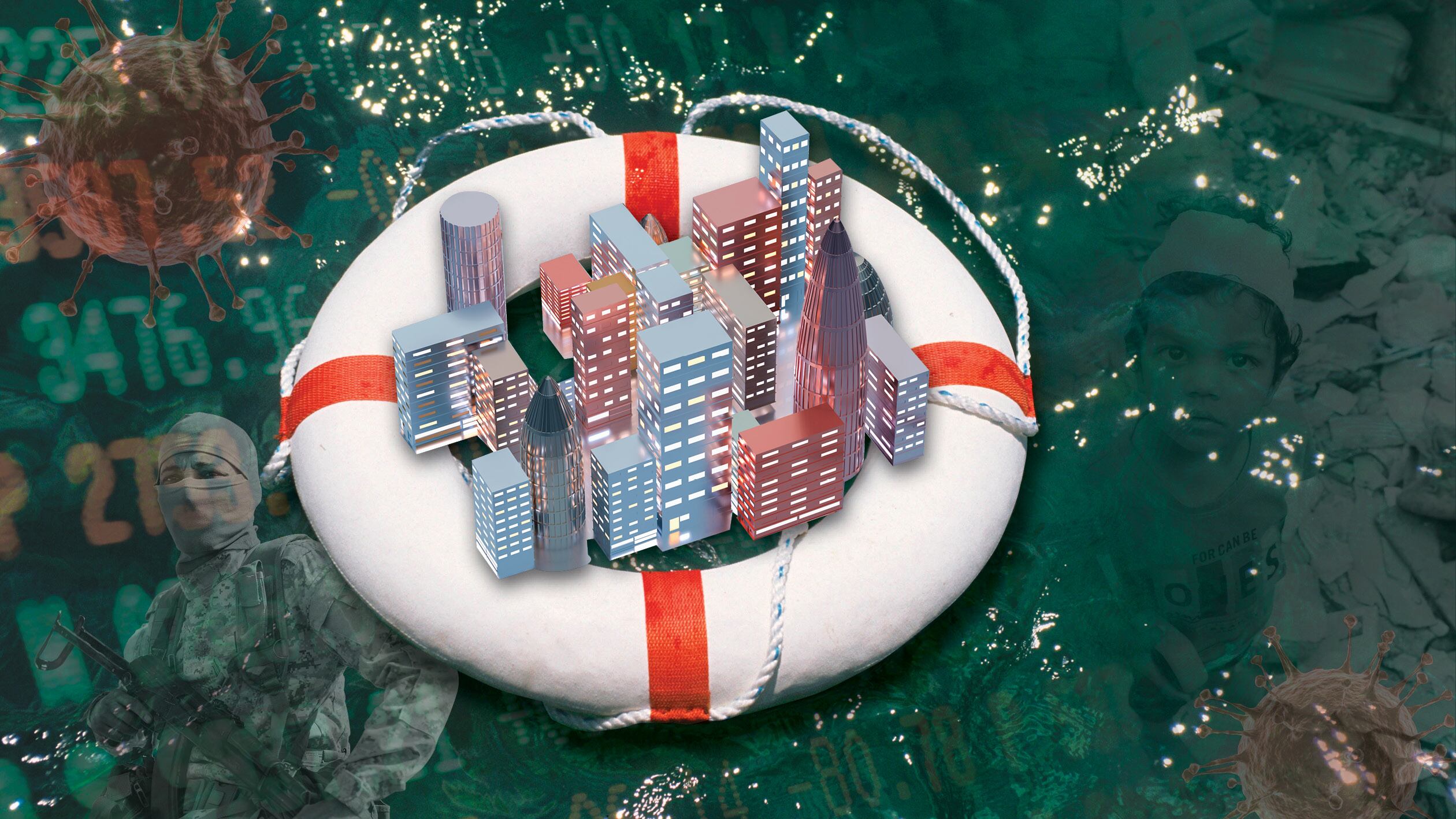

Cities around the world are moving into an era of “polycrisis”, where pandemics, climate shocks, wars, financial stress and technological disruptions have all become the norm, and all at the same time, a report on future-ready urban planning has found.
Rather than isolated emergencies, the barrage of problems being faced by highly concentrated and interconnected modern cities are more intensified economically and socially, according to the Future-Proofing Cities in the Age of Polycrisis report shared with The National before publishing by Dubai-based global management consulting firm Roland Berger.
High inflation, low employment rates and rising gold prices combined with increasing temperatures and limited access to health care, are exacerbated by wars, whether physical like the Russia-Ukraine conflict or economic as in the US imposition of tariffs on the rest of the world.
“All these combined will drastically lower the quality of life of people and limit the ability of these countries to strive,” Mohamed Yamout, a partner at Roland Berger, said.
While the idea of a “polycrisis” is not new – the term was coined by French sociologist Edgar Morin in the 1990s – its heightened form in today's world was popularised by British economic historian Adam Tooze after the pandemic.
Since then, we've also seen technological crises with widespread impact such as cuts to critical Red Sea underwater cables in September causing cross-continent internet disruption for weeks, and thousands of planes being grounded along with banks ceasing operations in mid-2024 due to a software update by cyber security company CrowdStrike.
“The word itself really describes a situation that has been happening forever,” said Mr Yamout. What makes it more visible today is a world more connected with globalisation and social media, he added.
Roland Berger's report argues that traditional responses to crises will not work with today's problems, and cities must adopt “foresight-based governance” to survive or face the rippling repercussions.
Gulf readiness
The report identifies that several global cities are already demonstrating foresight by embedding long-term thinking into everyday governance.
From Tokyo’s data-driven infrastructure resilience to Singapore’s institutionalised futures planning, anticipation has become policy rather than reaction, according to Roland Berger.
In Europe, Copenhagen is pairing climate adaptation with nature-based design, while Zurich has built digital intelligence into city management to respond in real time to emerging risks.
Gulf cities are uniquely positioned to lead the shift towards future-ready urbanism, the report found.
Rapid urbanisation, state-backed investment and technology-first development powered by oil wealth and focused leadership have transformed regional cities into what the authors describe as laboratories for adaptive governance.
They are also urged by environmental pressures, from extreme heat to water scarcity, to move beyond sustainability and towards regenerative urban design.
Abu Dhabi's Bayanat is using advanced AI and geospatial technology to monitor floods and environmental risks in real time to prevent damage to homes and infrastructure before disasters unfold. Such initiatives are driven by the UAE capital's 2030 economic vision and longer-term investment in robust systems.
Riyadh’s Royal Commission is co-ordinating major projects like the Riyadh Metro, King Salman Park and Green Riyadh using predictive analytics and scenario-based planning to support rapid growth, the report stated.
Dubai is advancing its 2040 Urban Master Plan with driverless transit, smart grids and district cooling, while continuing to close gaps in climate resilience and modular design.
Doha, after its rapid infrastructure delivery for the 2022 World Cup, is transitioning towards continuous, data-driven adaptation through predictive asset management and circular urban design.
Measuring the region's readiness for financial crises, Abu Dhabi released the Financial Centre Competitiveness Index, a comprehensive global index that saw certain Arab countries rise in rank given the ability of their financial centres to adapt to future needs.
With that said, Gulf residents are probably also feeling the strain more than others. The report estimates more than 80 per cent of people in the region live in cities, while on average, 55 per cent of the world’s population lives in urban areas, according to the UN, and this is meant to increase to 68 per cent by 2050.
This rapid growth comes with drawbacks, with the report citing the fast pace of growth leading to vulnerabilities related to climate stress, water scarcity, social complexity and more, resulting in polycrisis.
Embracing uncertainty
The report introduces an “Urban Foresight and Adaptability Framework” built around five pillars: adaptive infrastructure, foresight-based governance, environmental regeneration, social well-being and digital innovation. Rather than measuring how cities recover from disruption, the framework focuses on their ability to continuously adapt.
The motivation for this shift towards future ready cities is driven by what experts describe as a world that is no longer predictable.
“Any attempt to forecast is … futile,” Arturo Bris, a professor of finance at the IMD Business School, told The National. “The next big thing that is going to be our next shock is something that we don't know.”
Rather than trying to prevent specific risks, governments should focus on building existing policies and institutions that welcome adaptability to crises that are still unknown, Mr Bris said.
“We need laws and regulations, but also systems that are adaptable to a new reality,” he said, citing the pandemic as a classic example.
Instead of ordering mass lockdowns in a hotels or homes restricting access to food and health care, governments should have systems that permit safe movement or remote access to resources, he said.
Mr Bris also said that when preparing for the unknown, there's no reward without risk.
“We need to make big gambles on the future,” he said, with major financial investments to see results. “Everybody will tell you this is crazy, but if they (investments) happen on a small scale they're not going to raise your country up.”
"Countries like the UAE make big gambles," he said. "European countries, they don't," while at the World Governments Summit in Dubai.
Mr Bris said the UAE was one of the first countries to establish a Minister of State for Artificial Intelligence, in 2017. The Emirates also established a ministerial post for happiness the year before to address society's quality of life, although it was transferred to a different department in 2020.
“We thought happiness would be the next big thing, after GDP, and it has not happened,” Mr Bris said. But it was worth the risk, he added.

