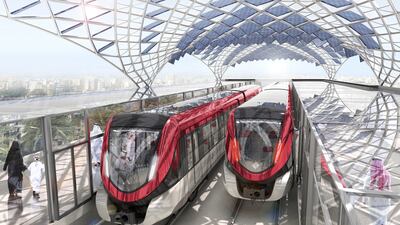
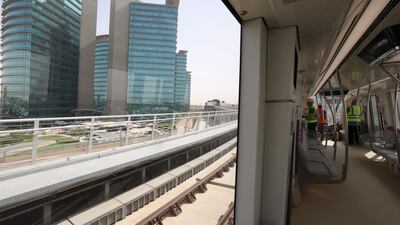
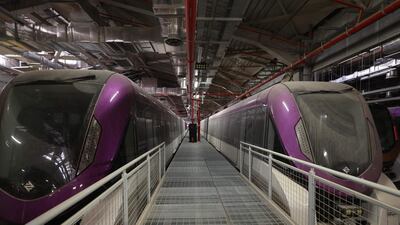
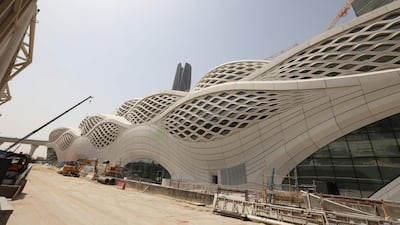
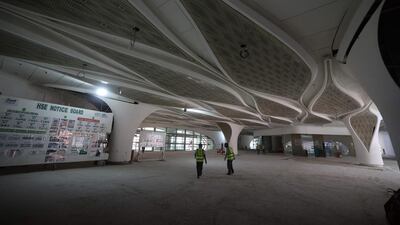
The Royal Commission for Riyadh City launched the orange line of Riyadh Metro on Sunday. Photo: SPA

Riyadh Metro complete and operational with launch of orange line


  • English
  • Arabic

The Riyadh Metro’s orange line began operations on Sunday, marking the completion of the phased roll-out of its entire six-line network, as the city works on developing its urban infrastructure.

The east-west line extends from Jeddah Road to the Second Eastern Ring Road, running parallel to Khashm Al Aan in the east, covering a total distance of 41km, the Royal Commission for Riyadh City said.

The commission also announced the opening of three new stations on the blue line: Al Murooj, Bank Al Bilad, and King Fahad Library.

“The operationalisation of all six lines of the Riyadh Metro network will improve connectivity across the capital and ease travel for both residents and visitors,” the commission said.

  • For a total of €1.5 billion, Siemens will supply a turnkey rail system for two driverless metro lines in Saudi Arabia's capital Riyadh. Photo: Siemens AG
    For a total of €1.5 billion, Siemens will supply a turnkey rail system for two driverless metro lines in Saudi Arabia's capital Riyadh. Photo: Siemens AG
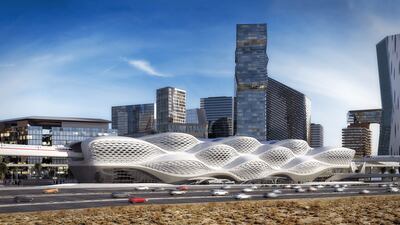
  • The metro will be connected to an expanded bus network and is expected to open by 2024. Photo: Zaha Hadid Architects
    The metro will be connected to an expanded bus network and is expected to open by 2024. Photo: Zaha Hadid Architects
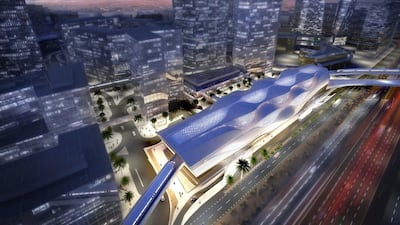
  • Arriyadh Development Authority has launched a naming rights programme for 15 stations. Photo: Parsons
    Arriyadh Development Authority has launched a naming rights programme for 15 stations. Photo: Parsons
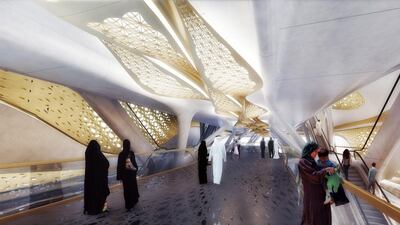
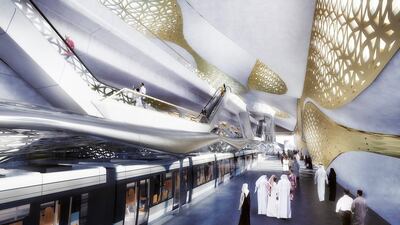
  • A station in the Riyadh Metro system. Photo: Zaha Hadid Architects
    A station in the Riyadh Metro system. Photo: Zaha Hadid Architects
  • The six metro lines will serve as the backbone for public transport in Riyadh. Photo: Zaha Hadid Architects
    The six metro lines will serve as the backbone for public transport in Riyadh. Photo: Zaha Hadid Architects
  • A train leaves on a test drive to the King Abdullah Financial District station in the Saudi capital. AFP
    A train leaves on a test drive to the King Abdullah Financial District station in the Saudi capital. AFP
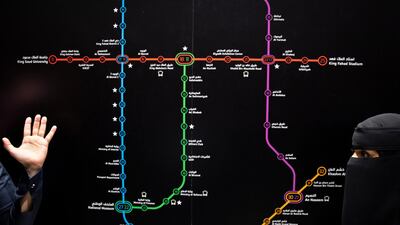
  • A map of the Riyadh Metro system. EPA
    A map of the Riyadh Metro system. EPA
  • The metro is expected to boost the value of real estate in the Saudi capital because of transport connectivity to secondary locations. Reuters
    The metro is expected to boost the value of real estate in the Saudi capital because of transport connectivity to secondary locations. Reuters
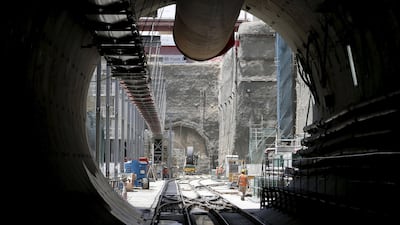
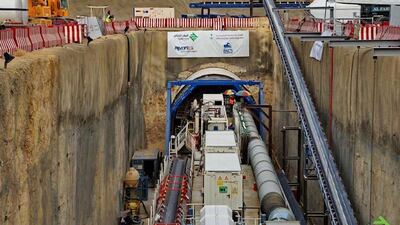
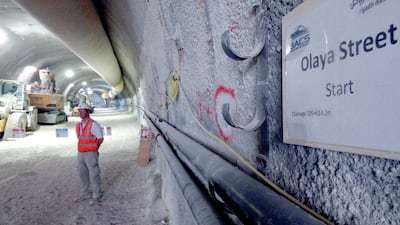
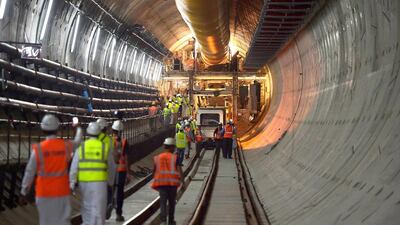
  • Construction workers working in a tunnel at the Riyadh Metro project. Reuters
    Construction workers working in a tunnel at the Riyadh Metro project. Reuters
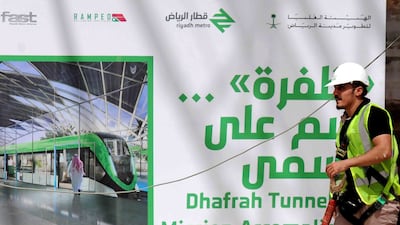
  • A worker walks past a poster at a metro construction site. AFP
    A worker walks past a poster at a metro construction site. AFP
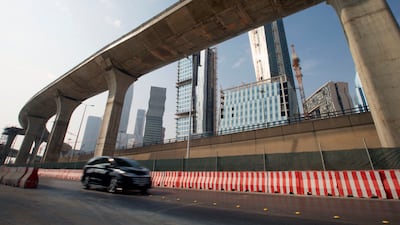
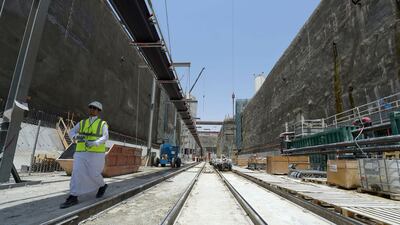
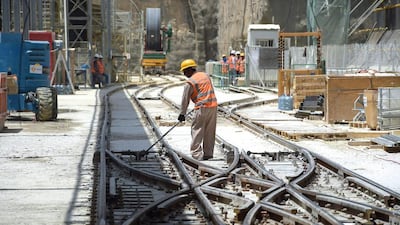
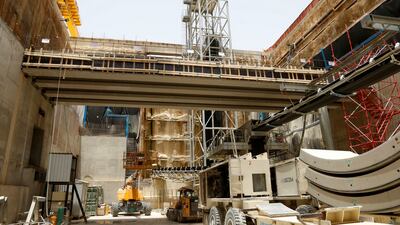
  • A construction site at the Riyadh Metro. AFP
    A construction site at the Riyadh Metro. AFP
  • The Riyadh Metro is set to contain six lines of driverless trains. Photo: PRNewsFoto / Bechtel
    The Riyadh Metro is set to contain six lines of driverless trains. Photo: PRNewsFoto / Bechtel
  • It will cover 176km of the city and have 85 stations. AFP
    It will cover 176km of the city and have 85 stations. AFP
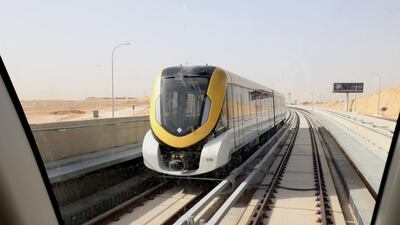
  • A train on one of the track lines of the Riyadh Metro network. AFP
    A train on one of the track lines of the Riyadh Metro network. AFP
  • Trains on the track lines of the metro network. AFP
    Trains on the track lines of the metro network. AFP
  • A train terminal under construction. AFP
    A train terminal under construction. AFP
  • A train terminal under construction in Riyadh. AFP
    A train terminal under construction in Riyadh. AFP
  • Line 3, the Red Line, will run from Madina Al Munawra to Rahman Al Awal Road. AFP
    Line 3, the Red Line, will run from Madina Al Munawra to Rahman Al Awal Road. AFP
  • Saudi Arabia is spending billions of dollars annually on roads, ports, airports, hospitals and schools. AFP
    Saudi Arabia is spending billions of dollars annually on roads, ports, airports, hospitals and schools. AFP
  • A construction site on the Riyadh Metro. Reuters
    A construction site on the Riyadh Metro. Reuters
  • Line 5, the Yellow Line, will start from King Abdul Aziz Road. AFP
    Line 5, the Yellow Line, will start from King Abdul Aziz Road. AFP

The driverless metro network's operations were launched at the end of November, starting with the blue, yellow, and purple lines on December 1, followed by the red and green lines.

It now has six lines and 85 stations across 176km, connecting key areas, including business districts and cultural landmarks.

The Riyadh metro offers various fare options, including a two-hour pass priced at 4 Saudi riyals ($1), a three-day pass priced at 20 riyals, a seven-day pass costing 40 riyals and a 30-day pass at 140 riyals, according to the website of Riyadh Public Transport.

The metro transport network aims to keep up with Riyadh's growing population, which is expected to reach 15 to 20 million by 2030, from 7.5 million last year. It will include 80 bus routes, passing through 2,860 stops with 842 buses.

The metro is expected to enhance the value of commercial and residential real estate in the Saudi capital, especially in areas where it is immediately accessible.

Saudi Arabia, the Arab world's biggest economy, continues to introduce large projects to support its ambitious goals as it prepares for the economy of the future, underpinned by substantial infrastructure backed by technology.

The kingdom is set to host a series of major events in the future, including, the Asian Winter Games 2029, Expo 2030 and the Fifa World Cup 2034.

The completion of the Riyadh Metro comes as Middle Eastern governments increasingly focus on enhancing urban mobility to reduce congestion, lower emissions, and improve economic growth.

Riyadh topped the list of cities with the most traffic congestion in the Middle East and North Africa region in 2023, with drivers losing about 87 hours annually, Statista said in a report last year. Cairo followed closely with 72 hours and Sharjah reported 44 hours of traffic delays.

Saudi Arabia and the UAE, both of which have seen substantial population growth over the past decade, are expected to invest nearly $50 billion in smart city projects by 2025, Frost & Sullivan said in a 2023 report. They are investing heavily in boosting urban infrastructure, including public transport.

Dubai, which launched its metro network in 2009, awarded a Dh20.5 billion ($5.6 billion) contract to build the Metro blue line. The line will cover 30km and have 14 stations. The project is scheduled to be completed in 2029, with construction set to start in April.

The UAE and Oman are also developing a railway line known as Hafeet Rail, a joint venture between Mubadala, Oman Rail and Etihad Rail. It will link the UAE with the Port of Sohar.


The years Ramadan fell in May

1987

1954

1921

1888

The biog

Born: Kuwait in 1986
Family: She is the youngest of seven siblings
Time in the UAE: 10 years
Hobbies: audiobooks and fitness: she works out every day, enjoying kickboxing and basketball

Ain Dubai in numbers

126: The length in metres of the legs supporting the structure

1 football pitch: The length of each permanent spoke is longer than a professional soccer pitch

16 A380 Airbuses: The equivalent weight of the wheel rim.

9,000 tonnes: The amount of steel used to construct the project.

5 tonnes: The weight of each permanent spoke that is holding the wheel rim in place

192: The amount of cable wires used to create the wheel. They measure a distance of 2,4000km in total, the equivalent of the distance between Dubai and Cairo.

Timeline

2012-2015

The company offers payments/bribes to win key contracts in the Middle East

May 2017

The UK SFO officially opens investigation into Petrofac’s use of agents, corruption, and potential bribery to secure contracts

September 2021

Petrofac pleads guilty to seven counts of failing to prevent bribery under the UK Bribery Act

October 2021

Court fines Petrofac £77 million for bribery. Former executive receives a two-year suspended sentence 

December 2024

Petrofac enters into comprehensive restructuring to strengthen the financial position of the group

May 2025

The High Court of England and Wales approves the company’s restructuring plan

July 2025

The Court of Appeal issues a judgment challenging parts of the restructuring plan

August 2025

Petrofac issues a business update to execute the restructuring and confirms it will appeal the Court of Appeal decision

October 2025

Petrofac loses a major TenneT offshore wind contract worth €13 billion. Holding company files for administration in the UK. Petrofac delisted from the London Stock Exchange

November 2025

180 Petrofac employees laid off in the UAE

Ziina users can donate to relief efforts in Beirut

Ziina users will be able to use the app to help relief efforts in Beirut, which has been left reeling after an August blast caused an estimated $15 billion in damage and left thousands homeless. Ziina has partnered with the United Nations High Commissioner for Refugees to raise money for the Lebanese capital, co-founder Faisal Toukan says. “As of October 1, the UNHCR has the first certified badge on Ziina and is automatically part of user's top friends' list during this campaign. Users can now donate any amount to the Beirut relief with two clicks. The money raised will go towards rebuilding houses for the families that were impacted by the explosion.”

Indoor cricket in a nutshell

Indoor Cricket World Cup - Sep 16-20, Insportz, Dubai

16 Indoor cricket matches are 16 overs per side

8 There are eight players per team

There have been nine Indoor Cricket World Cups for men. Australia have won every one.

5 Five runs are deducted from the score when a wickets falls

Batsmen bat in pairs, facing four overs per partnership

Scoring In indoor cricket, runs are scored by way of both physical and bonus runs. Physical runs are scored by both batsmen completing a run from one crease to the other. Bonus runs are scored when the ball hits a net in different zones, but only when at least one physical run is score.

Zones

A Front net, behind the striker and wicketkeeper: 0 runs

B Side nets, between the striker and halfway down the pitch: 1 run

Side nets between halfway and the bowlers end: 2 runs

Back net: 4 runs on the bounce, 6 runs on the full

Updated: January 05, 2025, 12:43 PM