


Saudi Arabia's hosting of the Fifa World Cup in 2034 is expected to provide a major push to its economic diversification strategy, driven by increased activity in the real estate, infrastructure, and tourism sectors, according to analysts.
The kingdom, which on Wednesday was announced as the host of the showpiece event a decade from now, would be able to accelerate its focus on the non-oil economy as the engine of economic growth, job creation and tourism, they said.
An expected boom in property development – covering stadiums and other infrastructure linked to the World Cup – would potentially lift Saudi gross domestic product to more than 5 per cent annually in the lead-up to the event, Nassib Ghobril, chief economist of Lebanon's Byblos Bank Group, told The National. The kingdom's non-oil economy has grown consistently between 4 per cent to 5 per cent each year since 2017.
Economists have projected non-oil sector growth of 4.4 per cent in 2024 and 4.6 per cent in 2025. "This trend should accelerate with the addition of the Fifa World Cup, as the infrastructure and other required work will add to the contribution of the non-oil sector to economic activity," he said, noting how Qatar benefitted from the 2022 Fifa World Cup.
Its hosting of the event boosted the country's economy by 8 per cent on an annual basis in the fourth quarter of 2022, S&P Global Market Intelligence said earlier.
Developments rise
Last month, Saudi Arabia unveiled design plans for a grand 92,000-capacity King Salman Stadium in Riyadh, which will stage the opening match and the final of the 2034 tournament. It is one of the 15 stadiums earmarked for the World Cup – four have already been built, three are under construction and eight are in the planning stages.
In addition, 185,000 hotel rooms are to be either built or renovated. The time between now and the World Cup should provide the authorities with significant time and experience to be ready for the event, Mr Ghobril said.
In addition to the already planned developments, it is also expected that more infrastructure relevant to the World Cup such as roads and hotels to cater to the influx of visitors, are to be built, adding to the estimated $1.3 trillion worth of projects and developments under the government's Vision 2030 plans.
While there might not be a significant deviation from Riyadh's existing investment plan, it will cement the prioritisation of developments with strategic importance to the country's long-term vision, said Matthew Green, head of research for the Middle East and North Africa at property consultancy CBRE.
"The event will have a massive positive impact on tourism in the run up to and during the event, both from a business and leisure tourism perspective," he told The National. "But the long-standing positive impact is likely to be on the country's infrastructure, which will see significant improvements as a result of the competition."
A possible by-product of the Saudi World Cup is oversupply of hotel rooms, which would allow the country to offer more competitive prices, just as Doha has become one of the most affordable hospitality markets in the GCC.
"Key factors include significant growth in the residential market, particularly in cities like Riyadh and Jeddah, along with a rise in foreign investment due to regulatory reforms such as the premium residency visa," Milad Azar, a market analyst at broker XTB Mena, told The National. "These initiatives are likely to elevate Saudi Arabia’s position in the Mena region."
'Very manageable'
Saudi Arabia, which is diversifying its economy away from oil, continues to maintain its appeal as a foreign direct investment destination, and sports has increasingly become part of this strategy. The kingdom, through its Public Investment Fund, has embarked on a flurry of investments into sports, viewed as part of Riyadh's strategy to strengthen its national economic diversification agenda.
The Arab world's largest economy has delved into sports partnerships, including in tennis, golf, boxing and football, in which the kingdom's local professional league has reeled in big-ticket names such as Karim Benzema, Neymar and Cristiano Ronaldo, who reportedly signed the most lucrative deal in sports.
Hosting the World Cup, then, makes sense. In terms of spending on the related infrastructure, Saudi Arabia has enough fiscal space to cover these costs, Mr Ghobril said.
-
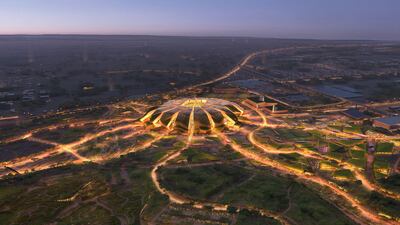
A digital rendering of the planned King Salman Stadium in Riyadh, Saudi Arabia. With a proposed capacity of 92,000, the stadium is expected to host the opening game and the final. Getty Images -

A digital image of the proposed King Salman Stadium in Riyadh, Saudi Arabia. Getty Images -

A digital rendering of the interior of the planned King Salman Stadium in Riyadh, Saudi Arabia. Getty Images -

The proposed King Salman Stadium in Riyadh, Saudi Arabia. Getty Images -
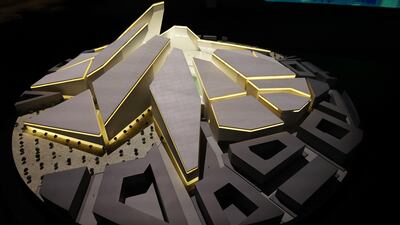
A model of the proposed Roshn Stadium is seen inside the Saudi Arabia World Cup bid exhibition. Reuters -
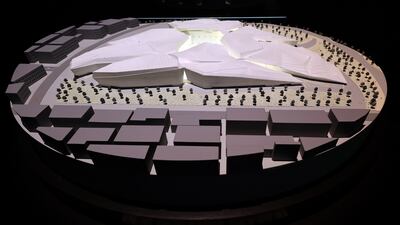
A model of the proposed New Murabba Stadium displayed at the Saudi Arabia World Cup bid exhibition. Reuters -

A model of the proposed King Salman International Stadium. Reuters -

A model of the proposed Aramco Stadium. Reuters -
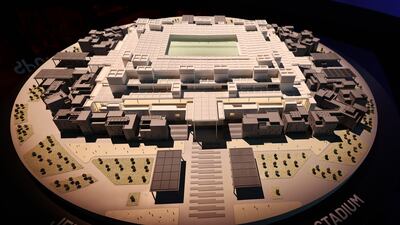
A model of the proposed Jeddah Central Development Stadium. Reuters -
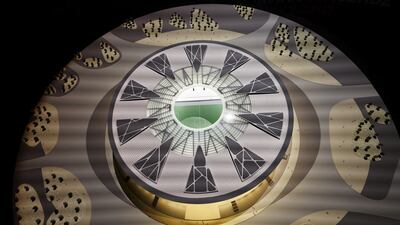
A model of the proposed King Abdullah Economic City Stadium. Reuters -
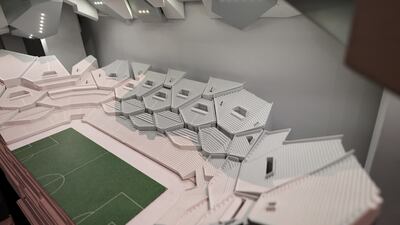
A model of the proposed NEOM Stadium. Reuters -
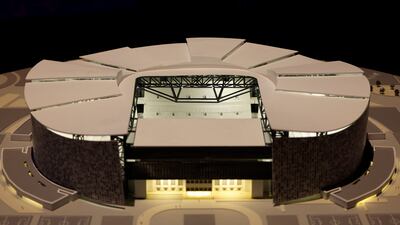
A model of the proposed King Khalid University Stadium. Reuters


This will be possible due to the kingdom's fiscal deficits projected at a very manageable between 2 per cent to 3 per cent of GDP in the coming years and its public debt level among the lowest in the world, he added. "Riyadh can easily cope with oil prices at around $70 per barrel, because of its ability to tap the global capital markets," Mr Ghobril said.
Digital venue
Meanwhile, in conjunction with fan interest in the World Cup, the development of digital stadiums is expected to further boost the potential of the Saudi sports sector, PwC has said. Streaming sporting events, made faster with improvements in 5G, cloud computing and extended reality technologies will be able to redefine operational dynamics that would reach more audiences, the consultancy said in a new study on Thursday.
"By transforming the overall fan experience for live sports and operational efficiency of stadiums through digitalisation, Saudi Arabia stands to position itself as a global leader in sports," Hesham Ghaleb, smart destinations partner at PwC Middle East, said in the report. PwC highlighted similar services provided in the Doha World Cup, where AI-driven cyber security measures and crowd management tools "ensured a secure and seamless event, demonstrating the value of these advanced technologies".

