


Donald Trump is set to return to the White House for a second term with a Republican Trifecta allowing him to pursue his agenda.
The policy decisions he will make beginning January 20, whether on the US economy, global geopolitics, his dealings with Iran, US tariffs or his relationship with Europe, will heavily influence how global economic growth will pan out next year.
Europe, where growth has remained muted this year, is bracing for a transactional relationship with the incoming US administration. China, whose economic momentum was underwhelming in 2024, is signalling it is ready for a cordial trade relationship with the world’s biggest economy, but it is equally ready for a war of tariffs.
Analysts say that people nominated by Mr Trump to run departments including treasury and trade tow the tagline of “America First” and will remain at the front and centre of decision-making once he assumes control of the Oval Office.
“Donald Trump will pursue the campaign’s focal points at a fast pace in the first two years before the midterm elections change the composition of the Congress again,” says Nannette Hechler-Fayd’herbe, head of investment strategy, sustainability and research at Swiss wealth manager Lombard Odier. “This means many decrees in January and changes to US foreign policy, trade policy, migration policy, deregulation and more.”
Trump's effect on the global economy
The world economy has so far remained resilient, although increasingly uneven across geographies, despite a significant rise in geopolitical risks in the Middle East and escalation in the Russia-Ukraine war in the past few months.
The International Monetary Fund expects global growth next year to at least maintain the current level, however, the win of Mr Trump has added new dynamics, as the policy directions in the US are historically important for the global economy.
In its pre-Trump win forecast in October, the IMF maintained its 2024 and next year global economic growth projection of 3.2 per cent amid softening inflation. However, the Washington-based fund warned of “a high degree of uncertainty” casting shadows on the outlook.
"The magnitude of the impact of Mr Trump's decisions on the global order will likely be larger than most expect,” Norman Villamin, group chief strategist at Swiss private bank UBP, says.
Beyond the IMF's one-year projections, the global economy is facing a feeble period of medium-term growth. It also made “sizeable downside” revisions to low-income and developing countries, due to intensifying conflicts.
For many advanced and emerging market economies, the five-year forecast is weaker than the one-year forecast, “suggesting that persistent headwinds to growth will remain prevalent over the medium term”, IMF director of research Pierre-Olivier Gourinchas said at the time.
“We do not look for global growth to necessarily accelerate but we see it holding close to steady near current levels. However, growth is likely to improve from low levels in some economies such as Japan and the eurozone,” says Karine Kheirallah, managing director and head of investment strategy and research for the Middle East and Africa at State Street Global Advisers.
Analysts say the global economy is already in choppy waters and is bound to face challenges without Mr Trump in power.
head of investment strategy, sustainability and research at Lombard Odier
Although the global economy skirted an energy price-driven recession last year, “there is a [still a] lingering recession risk”, Daniel Murray, deputy chief investment officer and global head of research at EFG Asset Management, says. “It is notable that the EU economy looks structurally very weak while some delinquency and default rates are on the rise in the US. And, of course, it is possible that China fails to deliver on its promised and expected stimulus packages.”
Inflation and interest rate outlook
All eyes will also remain fixed on how the US Federal Reserve will introduce rate cuts going forward amid anticipated expansionary policies of the new administration. Already, the Fed doesn’t appear in a rush to lower its benchmark rate, which can potentially impact how central banks around the world shape their monetary policy decisions.
“The economy is not sending any signals that we need to be in a hurry to lower rates,” Fed chairman, Jerome Powell said earlier this month.
Julius Baer chief economist David Kohl, in a recent co-authored note, said higher growth and inflation, as well as a more deficit-financed fiscal policy, have reduced the Fed’s scope for rate cuts. “We expect the Fed to pause at a Fed Funds target rate level of 4 per cent,” he said.
With Mr Powell publicly stating the US election results would not affect monetary policy and that the Fed would respond as needed to changes in fiscal policy, once those fiscal changes are clear, the 25 basis point cut in December was “a coin toss due to the potential re-acceleration of inflation”, Saira Malik, chief investment officer at $1.3 trillion asset manager Nuveen, says. “The 100 basis points of cuts in 2025 may also be optimistic.”
Mr Murray from EFG Asset management agrees, saying “US rate expectations have been highly volatile this year and that is expected to continue”, however, the market is "currently pricing three Fed rate cuts from here to the end of 2025".
Expectations for the European Central Bank are “more reasonable with five or six rate cuts forecast to the end of next year”. While the Bank of England is more closely aligned with the Fed, the Bank of Japan is a rare regulator, which is currently in the “hiking mode”, he adds.
The anticipated economic policy actions by the incoming US administration would also likely transpire into quicker growth and “sticky inflation” that will not drop below this year's levels.
“This will probably prevent the Fed from cutting Fed fund rates all the way to estimated neutral levels,” says Ms Hechler-Fayd’herbe, who is also Lombard’s chief investment officer for Europe, the Middle East, and Africa region. “For the rest of the world, it means marginally less growth and therefore deeper central bank rate cuts as well as other stimulative measures and weaker currencies. In other words, Donald Trump’s policies are quite critical for the outlook for 2025.”
Even without Mr Trump’s expected expansionary policies, UBP projects US inflation to bottom in early 2025 near 2 per cent and rebound by year-end to close to 3 per cent. “Depending on the timing and magnitude of the fiscal efforts rolled out by the incoming administration, a further impetus to this troughing in inflation we expect may emerge in 2025,” says Mr Villamin. “Markets are already beginning to price this prospect, both [in terms of] pricing rate cuts from the US Fed as well as pushing longer-term bond yields higher in late-2024.”

Trade and tariff fears
Analysts say it is too early to estimate if the Trump administration’s push for balanced trade with the world would turn out to be a repeat of the retaliatory war, which the world endured during his first presidency.
However, his nomination of Howard Lutnick, co-chair of his transition team, as his commerce secretary is an indication of a tougher stance on China.
The US could impose about 40 per cent tariffs on imports from China next year, potentially cutting growth in the world's second-biggest economy by up to a percentage point. However, the new administration will resist starting off with blanket 60 per cent tariffs on Chinese goods, a Reuters poll of economists showed.
Mr Trump ran for office on the pledge that he would impose hefty tariffs on Chinese imports. He engaged in a tariff war and levied additional duties on goods from Europe, Canada and countries elsewhere in the world. His campaign promises of America First in trade are causing unease among US trade partners globally.
“The extent to which Mr Trump’s policies will impact the rest of the world will depend primarily on how aggressively his trade team seek to redress US imbalances with other parts of the world. The higher and more wide-reaching the tariffs, the greater will the impact be,” Mr Murray says.
Mr Trump has already said he would hit China, Mexico and Canada with new tariffs the very first day of his presidency. He plans to sign an executive order imposing a 25 per cent tariff on all goods coming from Mexico and Canada, and will charge China an additional 10 per cent tariff, “above any additional tariffs”.
At the end of November, Mr Trump threatened the Brics nations with 100 per cent tariffs if they moved against the US dollar.
“The idea that the Brics countries are trying to move away from the dollar while we stand by and watch is over,” Mr Trump said on the Truth Social network. “We require a commitment from these countries that they will neither create a new Brics currency, nor back any other currency to replace the mighty US dollar or, they will face 100 per cent tariffs, and should expect to say goodbye to selling into the wonderful US economy.”
-
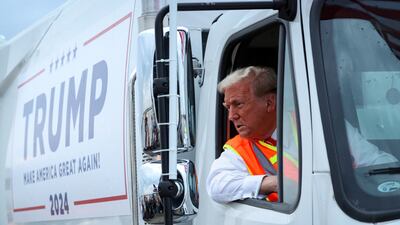
Republican presidential nominee Donald Trump sits in a truck while campaigning at Green Bay Austin Straubel International Airport in Wisconsin. Reuters -
Mr Trump arrives to speak at a campaign rally at Rocky Mount Event Centre in North Carolina. AP -

Supporters of Mr Trump in Rocky Mount. Reuters -
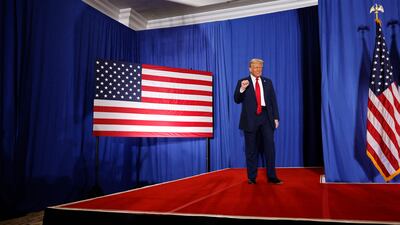
Mr Trump onstage during a campaign stop in Drexel Hill, Pennsylvania. AFP -
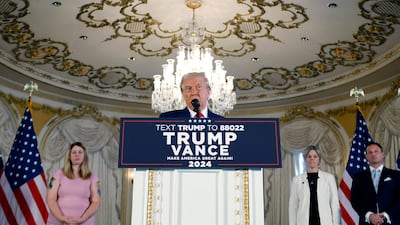
Mr Trump speaks during a press conference in the ballroom at his Mar-a-Lago Club in Palm Beach, Florida. AFP -

Mr Trump dances at a campaign rally in Atlanta. AP -
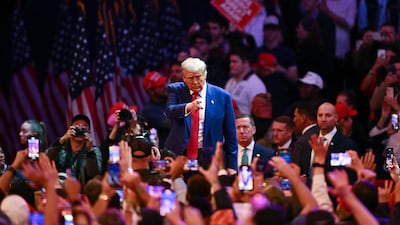
Mr Trump leaves a campaign rally at Madison Square Garden in New York. AFP -
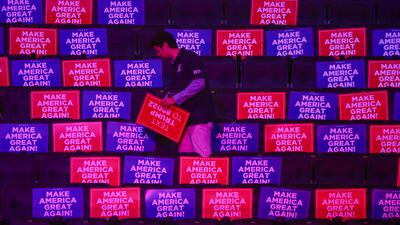
A campaign worker places a sign on a seat before a rally at Madison Square Garden in New York. EPA -
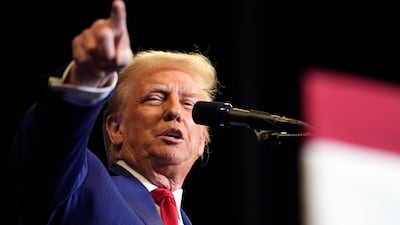
Mr Trump speaks at a campaign rally in State College, Pennsylvania. AP -
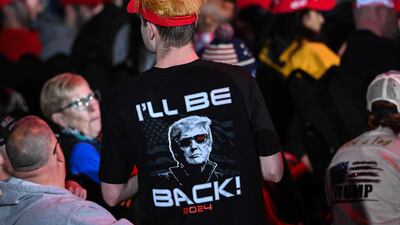
Supporters at a campaign rally in Novi, Michigan. AFP -
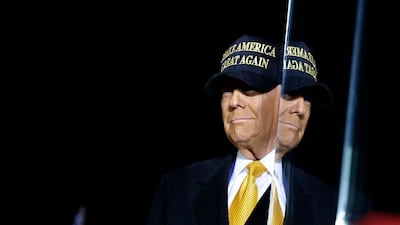
Mr Trump arrives for a campaign rally at Cherry Capital Airport in Traverse City, Michigan. AFP -
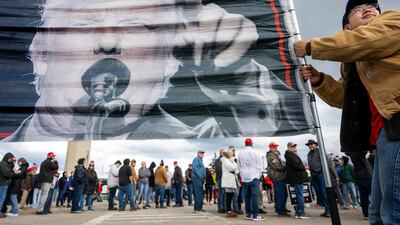
A supporter holds a flag in Traverse City, Michigan. AFP -
Mr Trump hands off an order of fries during a visit to a McDonald's in Feasterville-Trevose, Pennsylvania. AP -

Mr Trump at a campaign event in Las Vegas, Nevada. Reuters -

Elon Musk jumps around on the stage beside Mr Trump during a campaign rally in Butler, Pennsylvania. AFP -
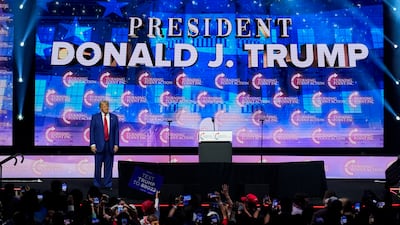
Mr Trump arrives to speak during a campaign rally in Las Vegas. AP -

Vice presidential nominee JD Vance onstage at a Trump campaign rally at Madison Square Garden in New York City. AFP -
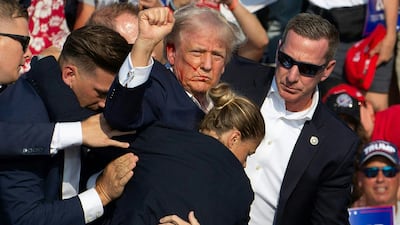
Mr Trump with blood on his face as secret service agents haul him off the stage after an assassination attempt in Butler, Pennsylvania. AFP


Geopolitical risks
Geopolitics and the continuing conflicts in Ukraine and the Middle East remain among the biggest threats to the global economy next year. Although Mr Trump has pledged to end both wars after taking office in January, how successful he will be in his efforts remains to be seen.
“There is clearly a risk that the situation in Ukraine does not get resolved and escalates, involving Nato troops on the ground,” Mr Murray says. “Similarly, the situation in the Middle East could deteriorate, for example, if one of the countries at the centre of the situation miscalculates in terms of the scale of retaliatory strikes.”
The potential of the Israel-Gaza war turning into a pan-regional conflict involving Israel, Iran and Tehran-backed militias is a lingering threat to global energy supplies from the Middle East, home to some of the world’s largest crude exporters. Iran this year has twice launched barrages of missiles on sites in Israel, for killing senior leaders of the Iran-back Hezbollah’s leaders in Tehran and Lebanon. Israel in retaliation has hit military targets in Iran. The more than a year-long war has spilt beyond the Gaza borders into Lebanon where the civil population paid a heavy price of constant Israeli attacks and air strikes until a ceasefire deal was reached between Israel and Lebanon at the end of last month.
The economic impact of the war is already evident. The IMF has lowered its outlook for the Middle East and North Africa region by 0.6 per cent for this year from its April forecast to 2.1 per cent, underpinned by Saudi Arabia’s oil production cuts and the conflicts in the region.
“Markets hate uncertainty, and while fundamentals are most important for investors, geopolitical tensions and military conflicts can’t be ignored and are undoubtedly some of the biggest challenges for the global economy and investors to navigate going into 2025,” Ms Malik says.
Equities landscape
After a stellar year in 2023, equity markets have been on the rise this year, driven higher by a multitude of factors, including bumper profits. Stocks hit multiple record highs before the November 5 presidential run for the White House and have not eased after the Republican control of Washington.
Benchmark S&P 500 index has gained more than 25 per cent this year, on track for a second year of returns above 20 per cent – a run that’s occurred just four times in the past 100 years. Nasdaq has risen by 28 per cent, while the Dow Jones Industrial Average Index has rallied more than 19 per cent since the beginning of this year.
However, analysts are sceptical if markets will be able to deliver a third year of stellar returns, despite Mr Trump’s pro-growth and expansionary policies.
“US equity markets have delivered nearly 25 per cent returns in not only 2024, but also in the year prior … [with] another year of 20 per cent returns unlikely in 2025," Mr Villamin says, adding that markets rarely outpace returns of two good years in a third consecutive year.
“Only in 2021 amid pandemic-era quantitative easing did the S&P 500’s nearly 27 per cent price returns outpace the already strong 22 per cent [compound annual growth rate] returns seen in the prior two years.”
Though company fundamentals will be the guiding yardstick for investors, policy action by the Trump administration could also determine investment trends in certain segments of the US market.
“While market valuations and company-specific fundamentals are more important than politics, we think the change to a Republican administration is likely to result in a shift in the regulatory environment for the financial, energy and healthcare sectors,” says Ms Malik. “We may also see increased investment in traditional oil and gas exploration, which would serve as a relative benefit to those areas of the market.”
EFG Asset Management expects Mr Trump’s pro-growth and low regulation policies to probably provide a tailwind to US markets next year.
“We expect returns to be more broadly based, in contrast with the concentrated returns of this year [and] small and mid-cap [stocks] could do better in such a situation,” says Mr Murray. "It may be the case that the headline indices do not move by that much because the larger weighted stocks are rangebound, while there is a high proportion of stocks in the index with lower market caps that do relatively well.”

