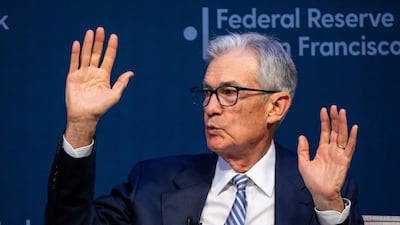
Federal Reserve Chairman Jerome Powell said on Wednesday that the US central bank has time to consider when to begin cutting interest rates, citing economic strength and recent inflation data.
“Given the strength of the economy and progress on inflation so far, we have time to let the incoming data guide our decisions on policy,” he said during an address at Stanford University's Graduate School of Business.
Recent data showed that consumer price index inflation, or CPI, increased 0.4 per cent on a monthly basis in February, while employers added 275,000 jobs. Both figures exceeded projections.
“Recent readings on both job gains and inflation have come in higher than expected,” he said.
Despite this, he still expects the Fed to cut interest rates at some point this year.
“The recent data do not, however, materially change the overall picture, which continues to be one of solid growth, a strong but rebalancing labour market, and inflation moving down towards 2 per cent on a sometimes bumpy path,” he said.
The Fed first began raising interest rates in 2022 after the US experienced a surge in inflation, which at one point peaked at 7.2 per cent.
The UAE, Saudi Arabia and other countries whose currencies are pegged to the dollar have followed the Fed's rate decisions. The US central bank has kept its target range steady between 5.25 per cent and 5.50 per cent since July.
Mr Powell's remarks follow the core Price Consumption Expenditures (PCE) Price Index – the Fed's preferred inflation metric – slowing on a month-to-month and annual basis in March. He had said that number was more in line with what the Fed wants to see.
“It is too soon to say whether the recent readings represent more than just a bump,” he said, again suggesting the Fed needs greater confidence before it is to begin cutting rates.
He did not specify how many rate cuts he expects this year.
But regional Fed presidents have publicly stated their projected number of rate cuts, showing there is some disagreement within the Federal Open Market Committee.
San Francisco Fed and Cleveland Fed presidents Mary Daly and Loretta Mester both said they believe three rate cuts are appropriate this year. Meanwhile, Atlanta Fed president Rafael Bostic foresees only one rate cut in 2024.
Dissenting votes during Fed policy decisions has become exceptionally rare under Mr Powell's leadership and economists have argued that unanimity in voting is critical to maintaining confidence in the central bank's decision-making.
Powell defends Fed's independence as 2024 election comes into focus
With the 2024 US election cycle now in full swing, Mr Powell also used his remarks to defend the Fed's independence.
The Fed was awarded significant independence by Congress when it was first created more than a century ago, and its policies and mandates can only be changed through legislation. Policymakers on the Fed's board also serve terms that do not coincide with presidential elections.
Recently, the Fed has come under pressure to cut interest rates by some congressional Democrats who argue higher rates are harming low-income households.
Meanwhile, former president Donald Trump has accused the Fed chairman of considering cutting rates to help Democrats and President Joe Biden's re-election bid.
As president, Mr Trump also accused Mr Powell of raising rates to harm the economy. Federal law is unclear whether or not a president can fire a Fed chairman, and this has never been tested in court.
Mr Powell has shrugged off political pressure he has faced during hearings or briefings.
“It doesn't matter what the election calendar is saying,” he said.
“I think we know that but it's a communication issue, but people need to understand that's what we do.”
“This independence both enables and requires us to make our monetary policy decisions without consideration of short-term political matters.”
To maintain public trust, he said the Fed should avoid "'mission creep'” by steering clear of issues like immigration, spending policies and climate change.
Mr Powell was first nominated to serve as Fed chairman by Mr Trump in 2018. Mr Biden nominated Mr Powell to a second term in 2021.
His current term expires in 2026.

Company%C2%A0profile
%3Cp%3E%3Cstrong%3EDate%20started%3A%20%3C%2Fstrong%3EMay%202022%3Cbr%3E%3Cstrong%3EFounder%3A%20%3C%2Fstrong%3EHusam%20Aboul%20Hosn%3Cbr%3E%3Cstrong%3EBased%3A%20%3C%2Fstrong%3EDIFC%3Cbr%3E%3Cstrong%3ESector%3A%20%3C%2Fstrong%3EFinTech%20%E2%80%94%20Innovation%20Hub%3Cbr%3E%3Cstrong%3EEmployees%3A%20%3C%2Fstrong%3Eeight%3Cbr%3E%3Cstrong%3EStage%3A%20%3C%2Fstrong%3Epre-seed%3Cbr%3E%3Cstrong%3EInvestors%3A%20%3C%2Fstrong%3Epre-seed%20funding%20raised%20from%20family%20and%20friends%20earlier%20this%20year%3C%2Fp%3E%0A
Other acts on the Jazz Garden bill
Sharrie Williams
The American singer is hugely respected in blues circles due to her passionate vocals and songwriting. Born and raised in Michigan, Williams began recording and touring as a teenage gospel singer. Her career took off with the blues band The Wiseguys. Such was the acclaim of their live shows that they toured throughout Europe and in Africa. As a solo artist, Williams has also collaborated with the likes of the late Dizzy Gillespie, Van Morrison and Mavis Staples.
Lin Rountree
An accomplished smooth jazz artist who blends his chilled approach with R‘n’B. Trained at the Duke Ellington School of the Arts in Washington, DC, Rountree formed his own band in 2004. He has also recorded with the likes of Kem, Dwele and Conya Doss. He comes to Dubai on the back of his new single Pass The Groove, from his forthcoming 2018 album Stronger Still, which may follow his five previous solo albums in cracking the top 10 of the US jazz charts.
Anita Williams
Dubai-based singer Anita Williams will open the night with a set of covers and swing, jazz and blues standards that made her an in-demand singer across the emirate. The Irish singer has been performing in Dubai since 2008 at venues such as MusicHall and Voda Bar. Her Jazz Garden appearance is career highlight as she will use the event to perform the original song Big Blue Eyes, the single from her debut solo album, due for release soon.
Some of Darwish's last words
"They see their tomorrows slipping out of their reach. And though it seems to them that everything outside this reality is heaven, yet they do not want to go to that heaven. They stay, because they are afflicted with hope." - Mahmoud Darwish, to attendees of the Palestine Festival of Literature, 2008
His life in brief: Born in a village near Galilee, he lived in exile for most of his life and started writing poetry after high school. He was arrested several times by Israel for what were deemed to be inciteful poems. Most of his work focused on the love and yearning for his homeland, and he was regarded the Palestinian poet of resistance. Over the course of his life, he published more than 30 poetry collections and books of prose, with his work translated into more than 20 languages. Many of his poems were set to music by Arab composers, most significantly Marcel Khalife. Darwish died on August 9, 2008 after undergoing heart surgery in the United States. He was later buried in Ramallah where a shrine was erected in his honour.
In numbers: China in Dubai
The number of Chinese people living in Dubai: An estimated 200,000
Number of Chinese people in International City: Almost 50,000
Daily visitors to Dragon Mart in 2018/19: 120,000
Daily visitors to Dragon Mart in 2010: 20,000
Percentage increase in visitors in eight years: 500 per cent
Ten tax points to be aware of in 2026
1. Domestic VAT refund amendments: request your refund within five years
If a business does not apply for the refund on time, they lose their credit.
2. E-invoicing in the UAE
Businesses should continue preparing for the implementation of e-invoicing in the UAE, with 2026 a preparation and transition period ahead of phased mandatory adoption.
3. More tax audits
Tax authorities are increasingly using data already available across multiple filings to identify audit risks.
4. More beneficial VAT and excise tax penalty regime
Tax disputes are expected to become more frequent and more structured, with clearer administrative objection and appeal processes. The UAE has adopted a new penalty regime for VAT and excise disputes, which now mirrors the penalty regime for corporate tax.
5. Greater emphasis on statutory audit
There is a greater need for the accuracy of financial statements. The International Financial Reporting Standards standards need to be strictly adhered to and, as a result, the quality of the audits will need to increase.
6. Further transfer pricing enforcement
Transfer pricing enforcement, which refers to the practice of establishing prices for internal transactions between related entities, is expected to broaden in scope. The UAE will shortly open the possibility to negotiate advance pricing agreements, or essentially rulings for transfer pricing purposes.
7. Limited time periods for audits
Recent amendments also introduce a default five-year limitation period for tax audits and assessments, subject to specific statutory exceptions. While the standard audit and assessment period is five years, this may be extended to up to 15 years in cases involving fraud or tax evasion.
8. Pillar 2 implementation
Many multinational groups will begin to feel the practical effect of the Domestic Minimum Top-Up Tax (DMTT), the UAE's implementation of the OECD’s global minimum tax under Pillar 2. While the rules apply for financial years starting on or after January 1, 2025, it is 2026 that marks the transition to an operational phase.
9. Reduced compliance obligations for imported goods and services
Businesses that apply the reverse-charge mechanism for VAT purposes in the UAE may benefit from reduced compliance obligations.
10. Substance and CbC reporting focus
Tax authorities are expected to continue strengthening the enforcement of economic substance and Country-by-Country (CbC) reporting frameworks. In the UAE, these regimes are increasingly being used as risk-assessment tools, providing tax authorities with a comprehensive view of multinational groups’ global footprints and enabling them to assess whether profits are aligned with real economic activity.
Contributed by Thomas Vanhee and Hend Rashwan, Aurifer
Company%20Profile
%3Cp%3E%3Cstrong%3ECompany%20name%3A%3C%2Fstrong%3E%20myZoi%3Cbr%3E%3Cstrong%3EStarted%3A%3C%2Fstrong%3E%202021%3Cbr%3E%3Cstrong%3EFounders%3A%3C%2Fstrong%3E%20Syed%20Ali%2C%20Christian%20Buchholz%2C%20Shanawaz%20Rouf%2C%20Arsalan%20Siddiqui%2C%20Nabid%20Hassan%3Cbr%3E%3Cstrong%3EBased%3A%3C%2Fstrong%3E%20UAE%3Cbr%3E%3Cstrong%3ENumber%20of%20staff%3A%3C%2Fstrong%3E%2037%3Cbr%3E%3Cstrong%3EInvestment%3A%3C%2Fstrong%3E%20Initial%20undisclosed%20funding%20from%20SC%20Ventures%3B%20second%20round%20of%20funding%20totalling%20%2414%20million%20from%20a%20consortium%20of%20SBI%2C%20a%20Japanese%20VC%20firm%2C%20and%20SC%20Venture%3C%2Fp%3E%0A
Islamophobia definition
A widely accepted definition was made by the All Party Parliamentary Group on British Muslims in 2019: “Islamophobia is rooted in racism and is a type of racism that targets expressions of Muslimness or perceived Muslimness.” It further defines it as “inciting hatred or violence against Muslims”.
PROFILE OF SWVL
Started: April 2017
Founders: Mostafa Kandil, Ahmed Sabbah and Mahmoud Nouh
Based: Cairo, Egypt
Sector: transport
Size: 450 employees
Investment: approximately $80 million
Investors include: Dubai’s Beco Capital, US’s Endeavor Catalyst, China’s MSA, Egypt’s Sawari Ventures, Sweden’s Vostok New Ventures, Property Finder CEO Michael Lahyani
Dhadak 2
Director: Shazia Iqbal
Starring: Siddhant Chaturvedi, Triptii Dimri
Rating: 1/5