


The future of trade is digital, green and inclusive, according to Ngozi Okonjo-Iweala, the World Trade Organisation’s director general.
Digital trade is one of the fastest-growing segments of trade today and it is expanding at 8 per cent per year, she said during a panel discussion in Abu Dhabi moderated by The National's Editor-in-Chief, Mina Al-Oraibi, ahead of the WTO’s 13th Ministerial Conference.
Digital trade refers to the production, distribution, marketing, sale or delivery of goods and services by electronic means, according to the WTO.
“Africa has only 1 per cent share of the digitally delivered services sector,” Ms Okonjo-Iweala said. “However, I see this as an opportunity. Countries like Morocco, Egypt, Ghana, Kenya and Nigeria are doing well in digital trade.
“We need to bridge the digital divide. Many countries don’t have the infrastructure, almost 55 per cent of sub-Saharan Africa does not have access to electricity.
“The regulatory framework for digital trade is non-existent in many countries. We can help with this in partnership with the World Bank.”
The value of digitally delivered services rose by an average of 8.1 per cent year on year between 2005 and 2022, outpacing the 5.6 per cent growth of physical goods trade and the 4.2 per cent advance in other services exports, according to the WTO.
Digital trade holds great promise to act as a catalyst for inclusive economic growth and sustainable development, according to a joint WTO-World Bank note last year.
Reaping the opportunities of digital trade requires an adequate ecosystem, starting with good connectivity and encompassing other elements, such as sufficient skills, logistics and payments systems, and an enabling policy framework, the note said.
The joint project aimed to identify obstacles to participation in digital trade, recommend policy actions and design interventions financed by the World Bank.
To support African countries’ efforts to harness these opportunities, the WTO and the World Bank joined forces in 2023 and launched the Digital Trade for Africa project. Nine countries are part of the project’s pilot phase.
The global economy will experience a third year of deceleration in growth, which has implications for trade, according to the World Bank.
13th WTO Ministerial Conference in Abu Dhabi – in pictures
-

The 13th WTO Ministerial Conference will be held in Abu Dhabi this month. All photos: Pawan Singh / The National -
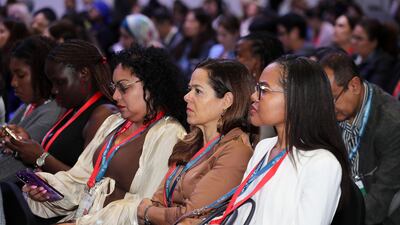
Delegates during the World Trade Organisation-International Trade Centre event on women and trade held in Abu Dhabi on Saturday. -

Delegates during the WTO-ITC event on women and trade in Abu Dhabi ahead of the 13th Ministerial Conference. -
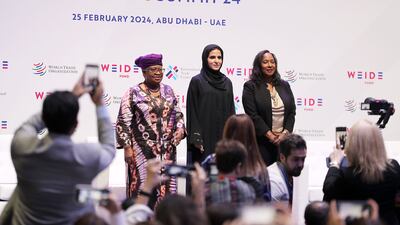
From left: Ngozi Okonjo-Iweala, WTO director general, Alia Al Mazrouei, chief executive of the Khalifa Fund for Enterprise Development, and Pamela Coke-Hamilton, executive director of the ITC, during an event on women and trade. -

Pamela Coke-Hamilton speaks about how trade can empower women. -
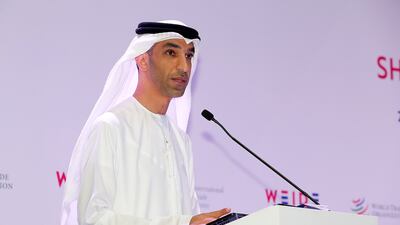
Dr Thani Al Zeyoudi, UAE Minister of State for Foreign Trade, speaks at the WTO-ITC event on women and trade.


“Against this backdrop, the growth of digitally delivered services is a glimmer of hope,” said Pablo Saavedra, vice president for equitable growth, finance and institutions global practice at the World Bank.
“Digital services have been growing in an accelerated manner. Digital services account for more than half of global service exports and 12 per cent of total exports.”
The growth of digital services in Africa is faster than any other export, he said.
Tackling digital trade in Africa requires a multi-phased approach, according to Mr Saavedra.
The first ingredient is connectivity infrastructure and there has been a lot of progress in 3G and 4G, but only 36 per cent of the population in sub-Saharan Africa have broadband access, he said.
“One needs to create an ecosystem, which includes electronic payments systems. Africa has made big progress in mobile money. We need to make more progress in integrating electronic payments systems with central bank infrastructure and fast cross-border payments,” he added.
The ecosystem also includes digital identification systems, which are critical to fostering the nascent FinTech industry in Africa, Mr Saavedra said.
By 2030, around 230 million jobs in sub-Saharan Africa will require digital skills, he estimated.

Rwanda has the political will and has put in place policies, strategies and tools over the past 30 years to connect to the world, said Jean Ngabitsinze, the country's Minister of Trade and Industry.
“Like other countries, we faced problems during Covid-19 surrounding our gross domestic product,” he said.
“The motivation was to make sure that we cannot continue to suffer from those shocks, and have solutions to innovate.”
The World Bank has 72 digital projects worth $9 billion under implementation in 37 countries.
The global lender has initiated digital trade assessment for five pilot countries, including Ghana, Benin, Rwanda and Kenya, over the past three months.
The teams identified opportunities for regulatory and policy reform to enable digital trade, said Ousmane Diagana, regional vice president for Western and Central Africa at World Bank.
“A lot of progress has been made on digital connectivity, in particular speed and connectivity in urban areas. However, digital infrastructure in rural areas remains a major challenge in almost all African countries,” he said.
“Further progress is also needed in the interoperability of digital payments.”
Some African countries have established a single window to process border information for imports and exports, including through electronic submission of trade documents. But many countries are yet to advance on this front, Mr Diagana said.

To fill this gap, the World Bank is implementing a regional project that seeks to improve and digitalise border processes, including by sharing data between customs agencies, he added.
Shadiya Assouman, Benin’s Minister of Industry and Trade, said the country now has paperless public services.
“We have connected practically all areas of the country now, right through to the border with Egypt,” she told the forum.
“We have a digital law, with a large part of it focusing on e-commerce. We are now adapting the consumer court to take into account digital trade.
“We have a large programme of reforms aimed at integrating youth and women into trade.”

