


When global thought leaders prepared their exhaustive lists of challenges they planned to address ahead of their arrival at the World Bank and International Monetary Fund’s annual meetings in Morocco, a new conflict with global reverberations was certainly not part of it.
But as they descended on Marrakesh on Monday for their week-long engagements in the historic Moroccan city, the Israel-Gaza war unfolded on television screens around the world.
Suddenly, the policymakers, government officials, corporate bosses, civil society representatives and finance leaders had another item on their agenda that has been widely discussed but little commented on in public.
Economists are also scrambling to reconfigure their risk assessment models as they try to re-evaluate their economic forecasts – diligently prepared ahead of the annual meetings – to reflect the impact of this unprecedented escalation between Israel and Hamas, which rules Gaza.
The knee-jerk reaction in oil prices in the first few days of the war, as well as a slump in Middle Eastern markets, underpinned the significance of the conflict.
However, the unfolding tragedy, civilian casualties and the siege of Gaza, which the UN says is turning into a humanitarian crisis, is at the forefront of everyone's mind and mentioned in almost every economic press briefing.
The death toll on both sides of the Israel-Gaza border has risen to 2,800.
Kristalina Georgieva, managing director of the IMF, described the loss of life in the Israel-Gaza war as “tragic”.
“It's heartbreaking to see innocent civilians dying,” she said at a press briefing in Marrakesh. “An attack from one place on another, causing reciprocity in response [and] who pays the price? It is the innocent who pay the price.”
The leadership of both IMF and World Bank, as well as economists and executives, said the conflict is being “closely monitored”.
“Very clearly this is a new cloud on not the sunniest horizon for the world economy … darkening the horizon, [which] of course was not needed. Let’s pray for peace,” Ms Georgieva said.
Ajay Banga, president of the World Bank, who also called for a rapid de-escalation of the conflict, telling Reuters that it is an “unnecessary human tragedy” and the “global economic shock” will make it harder for central banks to achieve soft landings.

Bloomberg economists see the global economy at risk of recession if the conflict drags out and other countries also getting involved in the war that could push oil prices to near $150 per barrel.
However, IMF chief economist Pierre-Olivier Gourinchas painted a milder picture, saying sustained increase in energy prices due to the Israel-Gaza war could affect global economic growth.
“The work we have done at the research department at the fund suggests that if there is something like a 10 per cent increase in oil prices, this would weigh down on global output by 0.15 per cent in the following year and will increase global inflation by 0.4 per cent,” he told a media briefing.
“We see often in situations where there is geopolitical instability in the region … we see spikes in energy prices, in oil prices. We have seen that in the previous crises and conflicts. This reflects the potential risk that there could be of disruption in transportation or production of oil in the region.”
He added, however, that it is too early to make assessments.
Oil prices shot up 5 per cent on Monday, the first day of trading after the war broke out. Brent, the benchmark for two thirds of the world’s oil, settled 5.69 per cent higher at $90.89 a barrel on Friday. West Texas Intermediate, the gauge that tracks US crude, closed up 5.77 per cent at $87.69 a barrel.
“You don't want oil prices to go up because of war. You want to go up because of demand,” Sunil Kaushal, chief executive of Standard Chartered Africa and Middle East region, told The National.
“So, we hope this [conflict] is short lived, and we get back to the fundamentals.”
The impact on Middle East and North African economies is expected to be larger than that on the global economy, with Israeli Prime Minister Benjamin Netanyahu already having warned of a “long war”.
With Israel's ground forces massing on the Gaza border and the country demanding the exodus of 1.1 million Palestinians from the Hamas-controlled territory, it does not look like the conflict will end soon.
Jihad Azour, Director of the IMF’s Middle East and Central Asia Department, said there would “no doubt” be an impact on Mena, but did not quantify the magnitude at the press briefing to launch the fund's Middle East and Central Asia economic outlook.
Growth in the region is set to decelerate sharply this year, with Mena's gross domestic product expanding at 2 per cent in 2023, after growing 5.6 per cent a year earlier.
-
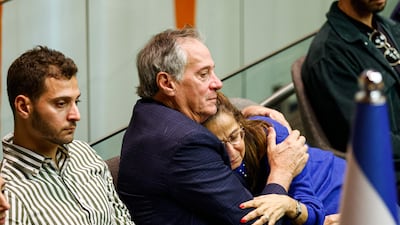
At UN headquarters in New York City, Rachel Zeitchik, right, and Jay Zeitchik attend an event for families of Israelis kidnapped by Hamas. AFP -
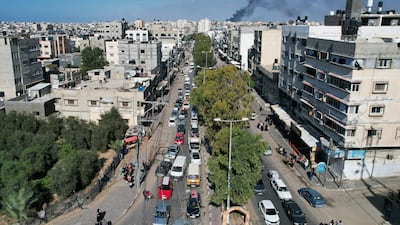
Palestinians flee from northern Gaza towards the south after the Israeli army demanded the population of more than a million people leave before a ground invasion. AP -

Demonstrators at a rally in support of Palestine face a counter-demonstration in support of Israel near Times Square in New York. EPA -
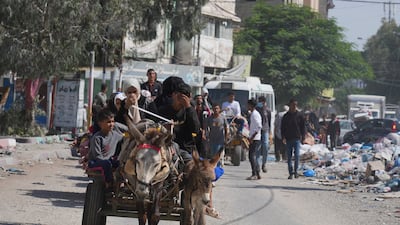
Palestinians flee from northern Gaza to the south after the Israeli army issued an evacuation warning. AP -
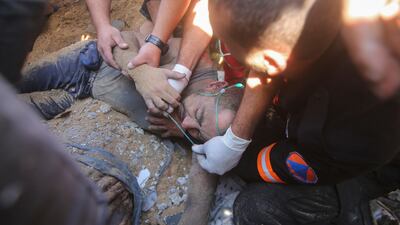
An injured man is rescued from the rubble of a building following an Israeli airstrike in Rafah, Gaza Strip. AP -
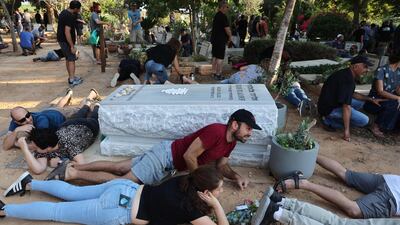
Mourners take cover as sirens sound during the funeral of Tom Godo, killed during the attack by Hamas militants on the Kibbutz Kisuffim last week, in Kibbutz Naan near Tel Aviv. AFP -
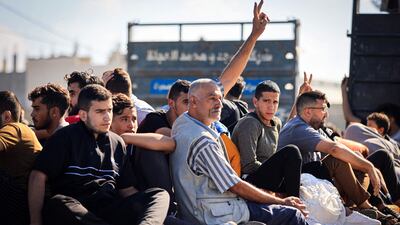
A Palestinian man flashes the victory sign as he and others leave northern Gaza before an expected Israeli ground offensive. AFP -
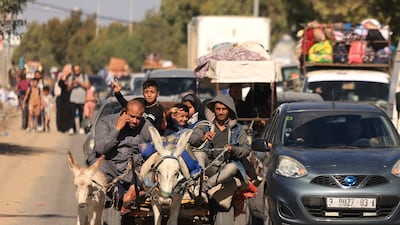
Palestinians head south with their belongings after being ordered by Israel to leave northern Gaza on Friday. AFP -

Israel ordered more than a million Palestinians to head south within 24 hours. Reuters -

The UN criticised the directive, saying forcing such a large number of people to flee en masse would be catastrophic. Reuters -

Gazans have to travel about 15km if they live in the northernmost part of the strip to reach the area south of the Wadi Gaza. Reuters -

The UN said that more than 423,000 people have already fled their homes in the territory, with a sizeable number making the more than 10km journey on foot. Reuters -
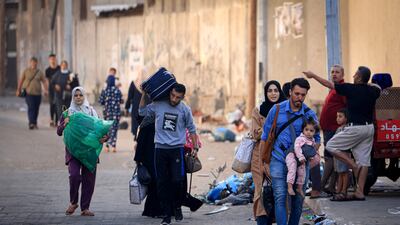
Palestinians with their belongings flee to safer areas in Gaza City. AFP -

An Armoured Personnel Carrier drives near Israel's border with the Gaza Strip. Reuters -
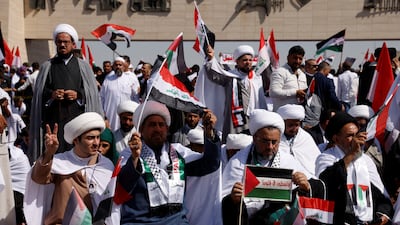
Supporters of Iraqi Shi'ite cleric Moqtada al-Sadr gather for mass Friday prayer during a protest in solidarity with Palestinians in Gaza, in Baghdad, Iraq. Reuters -
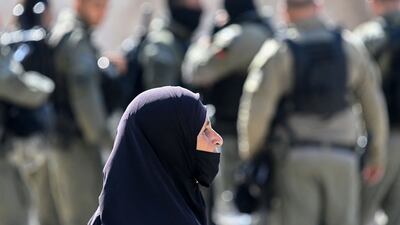
A Palestinian woman waits to cross into Jerusalem's Old City through Damascus Gate next to Israeli soldiers. AFP -
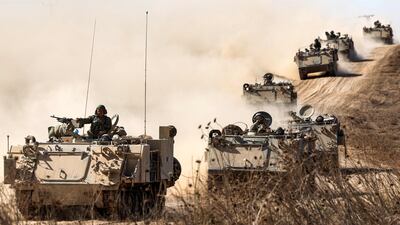
Israeli army infantry fighting vehicles deploy along the border with the Gaza Strip in southern Israel. AFP -
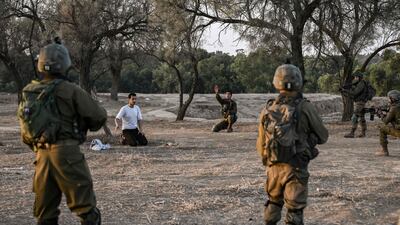
Israeli soldiers detain a man while on patrol near Kibbutz Beeri, near the Gaza Strip. AFP -
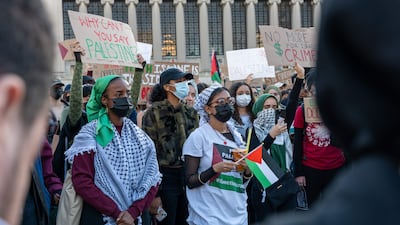
Students hold in a rally in support of Palestine at Columbia University in New York. Getty Images -

Family and friends mourn Valentin Ghnassia, 23, who was killed in a battle with Palestinian militants at Kibbutz Beeri near the Israeli border with the Gaza Strip. Getty Images -
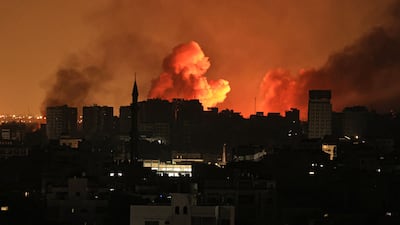
A ball of fire erupts in Gaza city after an Israeli air strike. AFP -
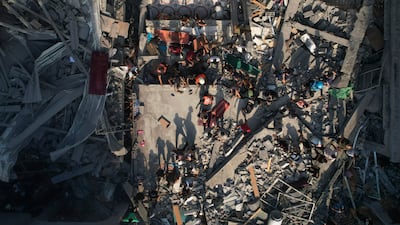
Palestinians inspect the rubble of buildings hit by an Israeli air strike at Al Shati refugee camp. AP -
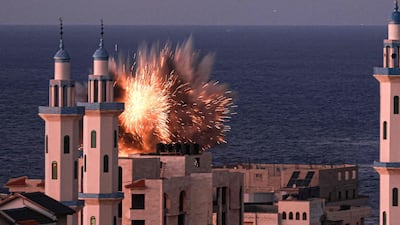
A fireball erupts from an Israeli air strike in Gaza city. AFP -

People waiting for news of victims outside the morgue at Al-Shifa hospital in Gaza City. AFP -
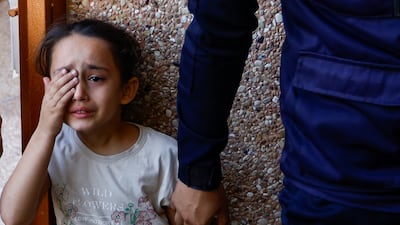
A girl mourns the death of members of the Samour family, who were killed in Israeli strikes on their house in Khan Younis in the southern Gaza Strip. Reuters -
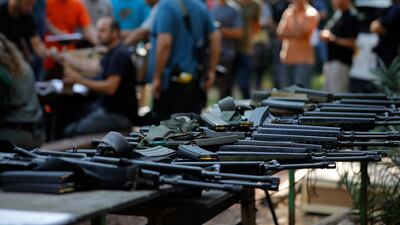
Israelis arrive to sign up at a weapons distribution point for people allowed to carry arms, at the Ayyelet HaShahar Kibbutz in northern Israel, near the Lebanese border. AFP -
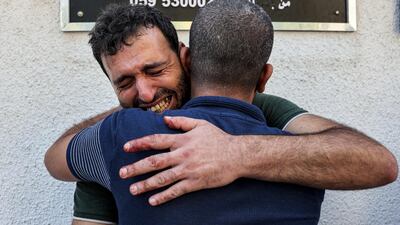
Mourners outside the morgue at Al-Shifa hospital in Gaza City as battles between Israel and the Hamas movement continue for a sixth consecutive day. AFP -
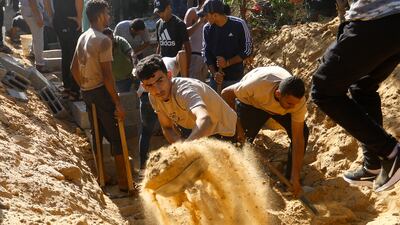
Men dig graves to bury members of the Samour family, who were killed in Israeli strikes on their house in Khan Younis. Reuters -

Palestinian children who fled their homes during Israeli strikes, play at a United Nations-run school in Gaza City. Reuters -
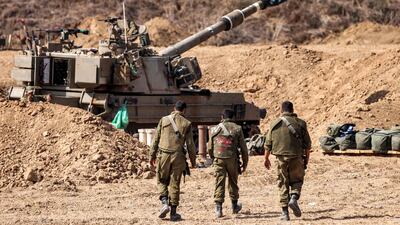
Israeli soldiers near a self-propelled howitzer near the border with Gaza in southern Israel. AFP -

Israel's Foreign Minister Eli Cohen, left, welcomes US Secretary of State Antony Blinken upon arrival at Israel's Ben Gurion Airport. AFP -

Palestinian children in a makeshift shelter at Al-Shifa hospital in Gaza City. Reuters -
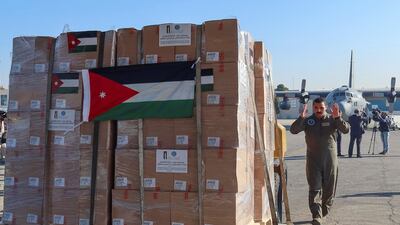
Boxes of humanitarian aid and supplies from Jordan Hashemite Charity Organisation destined for Gaza, in Amman, Jordan. Reuters -
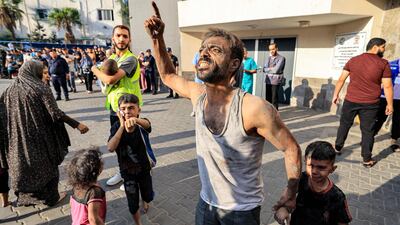
Palestinians outside Al-Shifa hospital in Gaza City on the sixth day of fighting between Israel and Hamas. AFP -
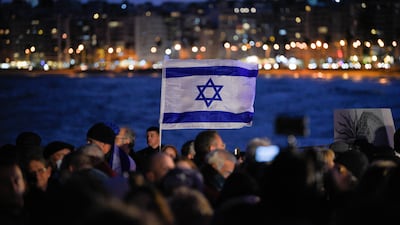
A pro-Israel vigil in Montevideo, Uruguay. EPA


Economists, most certainly, need more clarity on the intensity as well as the length of the war and whether this conflict will turn into a bigger refugee crisis for neighbouring countries before they make assessments on the economic fallout.
However, there could be a “significant balance of payments impact if the war continues”, said Monica Malik, chief economist at Abu Dhabi Commercial Bank.
“Also, if there's a marked increase in oil price this will impact the import bill of the oil importers of the region and also add to inflationary pressures.”
Another area that may bear the brunt of the situation is tourism.
“With fewer tourists visiting the region, especially if the conflict continues and escalates, a number of countries could be impacted, including Egypt,” she added.
The turn of events in the Middle East over the past few days has underpinned “just how fragile the situation remains in that part of the world”, said Daniel Murray, deputy chief investment officer and head of research at EFG Asset Management.
It is, however, very difficult to “draw strong consistent messages about the likely influence on financial markets”, he said.
“This is true for geopolitical events as a whole: because of the individuality of each event the consequences are very hard to predict.”
He added that the human cost of the conflict is “both sad and terrible” but the financial and economic spillover effects seem contained at the moment.

