


Israel is facing a significant risk of political and social tension because of the government’s push for judicial change, which will have damaging consequences for the economy and national security, Moody’s Investors Service says.
Governance in Israel is deteriorating as illustrated by the proposal to overhaul the judiciary, the rating agency, which changed its outlook on Israel's A1 rating to stable from positive in April, said in its latest research note.
“More specifically, we believe the wide-ranging nature of the government's proposals could materially weaken the judiciary's independence and disrupt effective checks and balances between the branches of government, which are important aspects of strong institutions,” Moody’s analysts said.
Israel has no written constitution and its institutional set-up relies to a great degree on judicial review.
However, “the executive and legislative institutions have become less predictable and more willing to create significant risks to economic and social stability”, Moody's said.
The government on Monday passed the first bill in a package that critics said could bring an end to democracy.
The far-right nationalist coalition led by Prime Minister Benjamin Netanyahu passed the legislation to limit some of the supreme court's powers, despite street protests and calls from allies such as the US to abstain.
The bill passed by the parliament stops the supreme court from using the standard of “reasonableness” in striking down government and ministerial decisions.
The government claimed that standard has allowed the Supreme Court to use powers it was never formally granted.
The bill’s passing has aggravated protests that have taken place across Israel for 29 weeks.
Dozens of demonstrators were arrested throughout Monday and early Tuesday as thousands attempted to block roads and access to the parliament in Jerusalem.
Workers across Israel are ready to strike on a what may be an unprecedented scale, Peter Lerner, a senior official in Israel's biggest labour union, Histadrut, told The National.
Mr Netanyahu has suffered a hit in the opinion polls over the judicial law as he navigates the most grave domestic crisis of his career.
Israeli currency, the shekel, slipped 0.1 per cent against the greenback, while the Tel Aviv share index recovered on Wednesday from some of the heavy losses it suffered during the rout earlier this week.
Morgan Stanley has downgraded Israel's credit score to “dislike” following the approval of the reasonability standard law in the Knesset.
-

Mass protests continue across Israel against the government's justice system reform plan. EPA -

Anti-government protesters march towards the Israeli Knesset in Jerusalem. EPA -

Protesters blocked roads across Israel, hours after parliament adopted a key clause of the government's judicial overhaul package, which opponents say threatens democracy. AFP -

A demonstrator in a dinosaur suit marches at Ben Gurion Airport near Lod. AFP -

Israelis wave flags during a protest against plans by Prime Minister Benjamin Netanyahu's government to overhaul the judicial system. AP -

Israelis have taken to the streets en masse to protest against the government’s plans to weaken the power of judges. Bloomberg -

Mass protests continue across the country against the government's justice system reform plan. EPA -
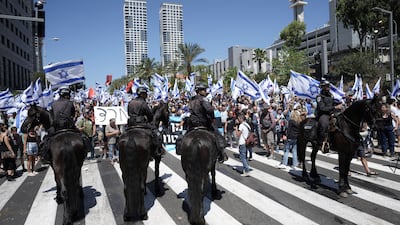
Mounted police in Tel Aviv, Israel, control protesters demonstrating against plans to overhaul the judicial system. AP -

Police and protesters clash on the 'Day of Disruption' opposing the judicial overhaul, in Tel Aviv. Reuters -

Israeli demonstrators wave flags as they block Highway 443 between Jerusalem and Tel Aviv, near Modiin. AFP -
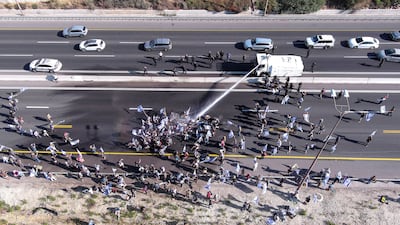
Israeli police use a water cannon against demonstrators at the Ein Hemed junction towards Jerusalem. Reuters -

Protesters set off a flare near Jerusalem as they oppose a bill to curb the Israeli Supreme Court's power to void government decisions. Reuters -

A confrontation in Tel Aviv, Israel, during protests against the move by Prime Minister Benjamin Netanyahu's coalition. Reuters -

Members of the Israeli security forces remove demonstrators blocking a highway to Jerusalem. Reuters -
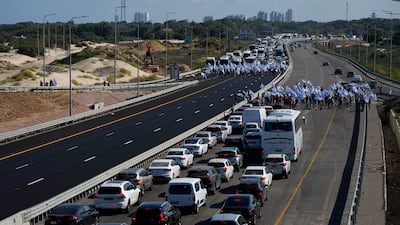
Israeli protesters block the Tel Aviv to Haifa highway near Beit Yanai, Israel. AP -
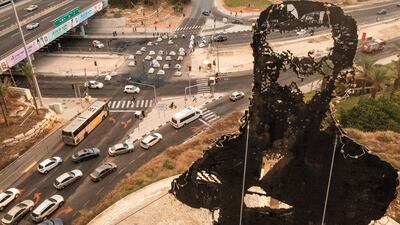
Demonstrators block a road with tents at the entrance to Herzliya, north of Tel Aviv, Israel. Reuters -

Israeli anti-government protesters block the entrance to Jerusalem, where some demonstrators entered the Knesset building. EPA


“We see increased uncertainty about the economic outlook in the coming months and risks becoming skewed to our adverse scenario,” media reports quoted Morgan Stanley's analysts as saying in a research note.
The latest bill may still be “struck down or frozen by the supreme court, as advocated by opponents of judicial changes”, according to a Bloomberg report, which cited Barclays analysts.
Moody’s expects the mass protests since January to continue as the government pushes for more packages of changes.
It said the petitions against the bill have already been moved to the supreme court, which raises the risk of a “constitutional crisis between the executive and judiciary”.
A large number of military reservists, including pilots, have threatened to stop reporting for training if the bill was passed, a move army leaders feared could put Israel’s security at risk, Moody’s said.

