


Ratings agencies S&P and Fitch have downgraded Ukraine's long-term foreign currency rating to default territory after a majority of the war-torn country’s bondholders agreed to a debt restructuring plan.
S&P cut Ukraine's rating to SD, or selective default, from CC on Friday. Fitch followed suit, slashing the nation's rating to RD, or restricted default, from C.
The agencies' actions came a day after bondholders approved a plan to defer payments for two years, which could save Kyiv about $5.8 billion.
“We view the transaction as distressed and tantamount to default. Ukraine’s debt restructuring comes amid significant macroeconomic, external, and fiscal pressures emanating from the war,” S&P said.
Fitch, meanwhile, noted that its next expected review date would have been six months from its review on July 22, but it “believes that developments in the country warrant such a deviation from the calendar”.
“Consent solicitation to defer Ukraine's external debt repayments for 2 years was agreed by the requisite share of bondholders. Fitch deems this completion of a distressed debt exchange and has therefore downgraded [its rating],” it said.
Ukraine's economy has been ravaged since it was invaded by Russia in February. In June, institutions including Ukraine's economy ministry and the Kyiv School of Economics pegged economic losses at between $564bn and $600bn — almost four times the nation's annual gross domestic product.
The Eastern European country's economy is projected to shrink by about 45 per cent this year, but the magnitude of the contraction will depend on the duration and intensity of the war, the World Bank said.
The International Institute of Finance had a more conservative estimate, saying that Ukraine's economy would shrink by about 35 per cent this year, with the monthly fiscal gap seen between $3bn to $10bn.
Fitch sees Ukraine's 2022 economic decline at 33 per cent, with the damage to infrastructure alone at $100bn, or about three quarters of GDP. Kyiv has projected that reconstruction needs over the next decade will be $750bn.
Investors representing around 75 per cent of $19.6bn worth of Ukraine's foreign bonds agreed to defer coupon and principal payments until 2024, officials announced on Wednesday.
A majority also approved a request to amend the terms of payments on gross domestic product warrants, which are linked to economic growth.
-
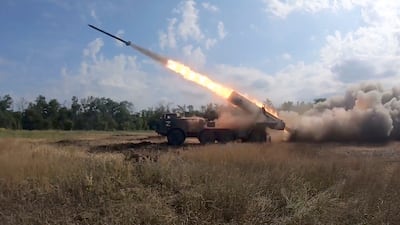
A Russian multiple-launch 'Hurricane' rocket system in action during battles in an undisclosed area in Ukraine. EPA -
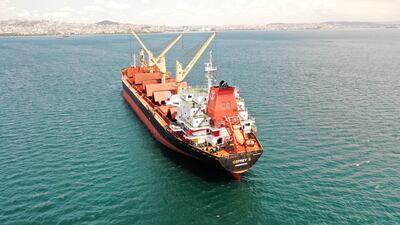
The Turkish bulk carrier 'Osprey S' is anchored off the shore near Istanbul. The vessel was expected to arrive in Ukraine's Chornomorsk port carrying grain, becoming the first ship to arrive at a Ukrainian port during the war. Reuters -
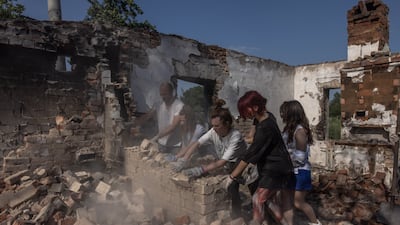
Young volunteers from the 'Repair Together' initiative, together with the local residents, clear rubble from a house that was destroyed during fighting, in Ivanivka, Chernihiv region. EPA -

A member of the Ukrainian National Guard jumps into a trench at a position near a front line, in the Kharkiv region. Reuters -

A Ukrainian soldier after a rocket fragment hit his car, in Bakhmut. AFP -

Combine harvesters of the Continental Farmers Group agricultural company harvest wheat in the Ternopil region of Ukraine. Getty Images -

A cemetery worker places a cross on the grave of Ukrainian soldier Serhiy Marchenko, who died aged 26, after his burial in Pokrovsk, Donetsk region. AP -

Women attend a rally of relatives and friends of defenders of the Azovstal Iron and Steel Works in Mariupol. Reuters -
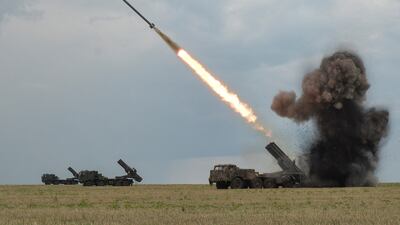
Ukrainian troops fire with a BM27 Uragan multiple-launch rocket system, in the Kharkiv region. Reuters -

A couple carry water bottles after filling them up at a store in Pokrovsk, Donetsk region. AP -

A girl holds a doll as people wait in Pokrovsk, to board a train to Dnipro and Lviv, during an evacuation effort from war-affected areas of eastern Ukraine. Reuters -
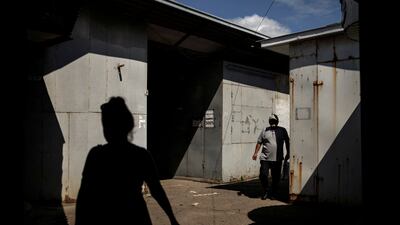
People make their way through the partially-closed Market of Kramatorsk. Reuters


The International Monetary Fund and many of Ukraine’s key supporters, including the US, have supported the restructuring process.
S&P expects to raise its long-term foreign-currency rating on Ukraine after the restructuring plan is implemented, while flagging a negative outlook due to “war-induced macroeconomic and fiscal stress”.
Fitch voiced a similar tone, saying it will upgrade Ukraine's foreign currency issuer default rating “to a level appropriate for its debt service payment prospects on a forward-looking basis”.
On the other hand, the economy of Russia, which began its military offensive in Ukraine in February, has already plunged into a deep recession, having been hit by unprecedented international sanctions, with output projected to diminish more than 11.2 per cent this year.
The effects of the conflict go beyond the two countries as economies elsewhere, including emerging and developing countries in Europe and Central Asia, are feeling its negative effects.
Fitch anticipates the war will continue well into 2023, and any negotiated political settlement will remain weak, because Kyiv is unlikely to cede any substantial territory lost to Russia.

