

India's U-turn on increasing wheat exports to fill the shortage caused by the Russia-Ukraine crisis makes economic sense as the country struggles with high inflation, according to agriculture and business experts.
This is despite the move being a setback for India's ambitions to boost international trade, with few expectations that it would be in a position to resume wheat shipments in the near future.
A scorching heatwave in India that has badly affected crops prompted the government on May 13 to enforce a ban on wheat exports as local prices of the commodity rose to record levels.
In recent weeks, however, India has given assurances that it has enough wheat stocks and can help other countries to meet their needs despite the shortages.
“It is a calibrated step taken by the government to address the challenges due to geopolitical developments,” says Pradeep Multani, president of New Delhi industry group PHD Chamber of Commerce and Industry.
“This step of the government will ensure food security in the country despite humanitarian and natural challenges.”
There is a very real risk that global wheat prices could rise even further as a result, “considering the prevailing supply shortage due to geopolitical developments and climate conditions”, Mr Multani says.
The situation has created a dilemma for India as it tries to balance the demands of its domestic population with its aim of meeting global needs and generating revenue from exports. Agriculture ministers from the Group of Seven have raised concerns about the protectionist move.
But soaring inflation, partly the result of rising food prices, is also a major concern for India and it is a major risk for the popularity of Prime Minister Narendra Modi’s government, prompting it to prioritise its citizens.
“We may expect wheat supplies to resume once the situation in the world market normalises,” Mr Multani says.
However, there is little clarity on when that might occur.
“Looking at the prolonged war scenario leading to shortfalls in supply of fertilisers and food grains from both Russia and Ukraine, India might not resume immediately exports of wheat,” says Suseelendra Desai, dean of the School of Agriculture Sciences and Technology at NMIMS University in Shirpur.
There are some exemptions to the ban, including permitting export orders where a letter of credit has been issued to be fulfilled and allowing a “government-to-government window” for exports.
The government also gave assurances it would meet the needs of its “neighbours and vulnerable countries”. Bangladesh is a long-term major buyer of wheat from India.
“The order served three main purposes: ensure India’s food security and check inflation [and] it helps other countries facing food deficit,” according to a statement issued by the Mr Modi's government.
After striking a deal with Egypt recently, India also permitted a consignment of 61,500 tonnes of wheat to be transported to the country.
Despite such allowances, India's ban has had enormous ripple effects, leading to record-high prices of the commodity globally.
The impact on rates was somewhat surprising given that India is not traditionally a major exporter of wheat, experts say.
However, several countries and traders had been relying on India to meet their wheat needs over the coming months to offset the supply crunch.
India, the world’s second-largest grower of wheat, had earlier indicated that it planned to help meet a shortfall due to the impact of Russia’s invasion of Ukraine on those countries' exports of the grain.
Russia and Ukraine are among the world’s biggest exporters of wheat. Before the conflict, Russia was the world's largest wheat exporter and Ukraine the fifth largest, according to data from the World Bank.
In 2020, Russia accounted for 17.6 per cent of wheat export revenue globally, or $7.9 billion, while Ukraine had an 8 per cent share of the market, according to research portal World's Top Exports.
In contrast, India accounted for only 0.5 per cent of wheat exports in 2020, despite producing more than 100 million tonnes a year, placing it second only to China.
Last month, New Delhi said that the country could import a record high of at least 10 million tonnes of wheat in the current financial year — which started in April — compared with 7.2 million in the previous year.
The government had also been preparing to dispatch trade delegations to countries including Morocco, Tunisia and the Philippines in an effort to boost wheat exports.
“The pressure of being the exporter of wheat came to India,” says Shammi Agarwal, director of Pansari Group, an Indian manufacturer and exporter of food products.
“It was a good move by the Indian government to ban raw wheat export. The wheat industry is facing some downsides as many of the export orders had been cancelled at the last moment, resulting in substantial financial losses. However, it is believed to help strengthen the Indian economy in the long run.”
-

A baker holds up a seeded white loaf of bread at a bakery in Beirut, Lebanon, which faces a food crisis because of war in Europe. All photos: Bloomberg -
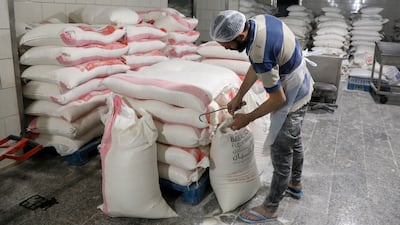
A worker opens a sack of flour to prepare bread dough in Beirut. Lebanon's wheat importers are already rationing flour sales to counter panic buying. -
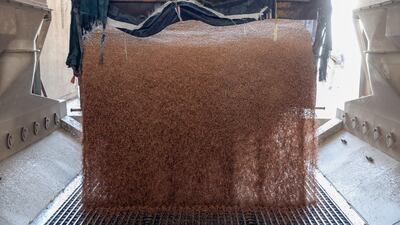
Lebanon, already suffering from years of financial crisis, has faced new problems since Russia invaded Ukraine in February. -
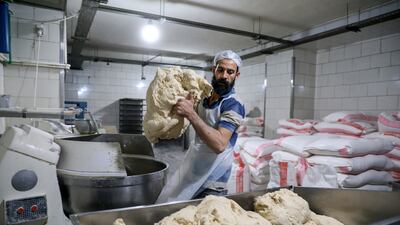
Lebanon normally buys 96 per cent of its wheat from Russia and Ukraine. -

The war between two of the world's biggest wheat exporters has sparked fears of a food crisis in many Middle Eastern countries. -
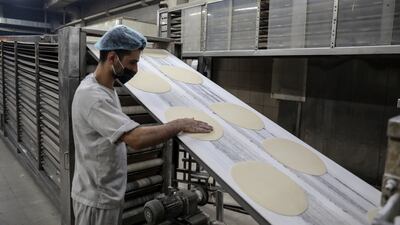
Lebanese importers are struggling to get dollars from a subsidy programme to buy wheat from new suppliers. -
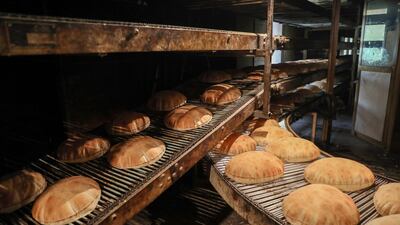
As countries try to secure new sources of wheat, cash-strapped Lebanon's small market of 6 million people could go without. -
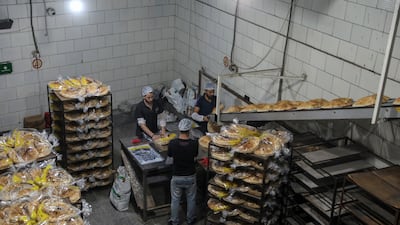
Lebanon lacks grain storage after silos were destroyed in the 2020 Beirut Port blast. -

The country needs 50,000 tonnes of wheat to feed its people for a month. -
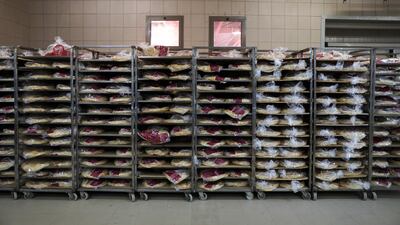
Subsidies keep the price of bread in Lebanon artificially low. -
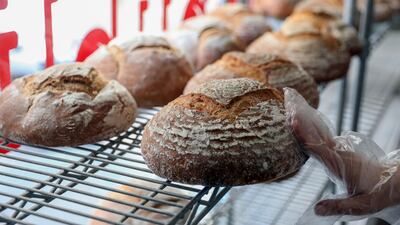
But a loaf now costs on average 10,000 Lebanese pounds, or $0.45, more than six times the price in 2019. -

Millers estimate that without subsidies, prices could more than double. -

Analysts fear that could cause social unrest in a country where three quarters of the population now live in poverty.


On Thursday, India’s Agriculture Ministry cut its wheat production forecast to 106.41 million tonnes for this year, down from a projection of 111.32 million tonnes, which would have been a record high, as the heatwave affected crops.
However, industry insiders are concerned that India’s U-turn on wheat shipments could bring into question its dependability as an exporter.
“I do agree that an overall consistent policy on exports gives a more longer-term kind of approach for people, for everybody in the ecosystem,” says Tauseef Khan, chief executive and co-founder of Gramophone, an Indian agricultural technology company that is working on maximising farmers' incomes.
“In general, if we, as a country, have a buffer of stocks, then India should have a better policy in terms of a long-term approach towards exports so that farmers benefit from that.”
About half of India's population depend on agriculture for their livelihood and the sector makes up about 20 per cent of the country's gross domestic product, according to government figures.
However, “these are times, which basically, are a little unprecedented for everybody”, Mr Khan says.
a Supreme Court advocate
India distributes grains including wheat to the public as part of its welfare scheme, which adds to the pressure to ensure that its internal demand can be met first, he adds.
“This is the right step by the government of India to ensure food security for 1.4 billion people,” says Vijay Sardana, a Supreme Court advocate who has worked on a range of issues affecting the agriculture sector.
Other experts agree that India was left with little choice.
“It will be definitely beneficial for domestic markets,” Mr Desai says. “Looking at the surge in global wheat prices and the constant rise in retail price inflation, the government decided that it is better to safeguard the national interest.”
However, there is a much bigger issue behind the current problems that India and the rest of the world face when it comes to wheat supplies: the challenge of climate change, which is leading to extreme weather conditions that are damaging crops in India and other countries.
“Climate change is a large problem for the entire globe right now,” Mr Khan says.
“For farmers, it reduces the certainty in income. I think it's definitely one of the big challenges that we are facing in these times.”

